


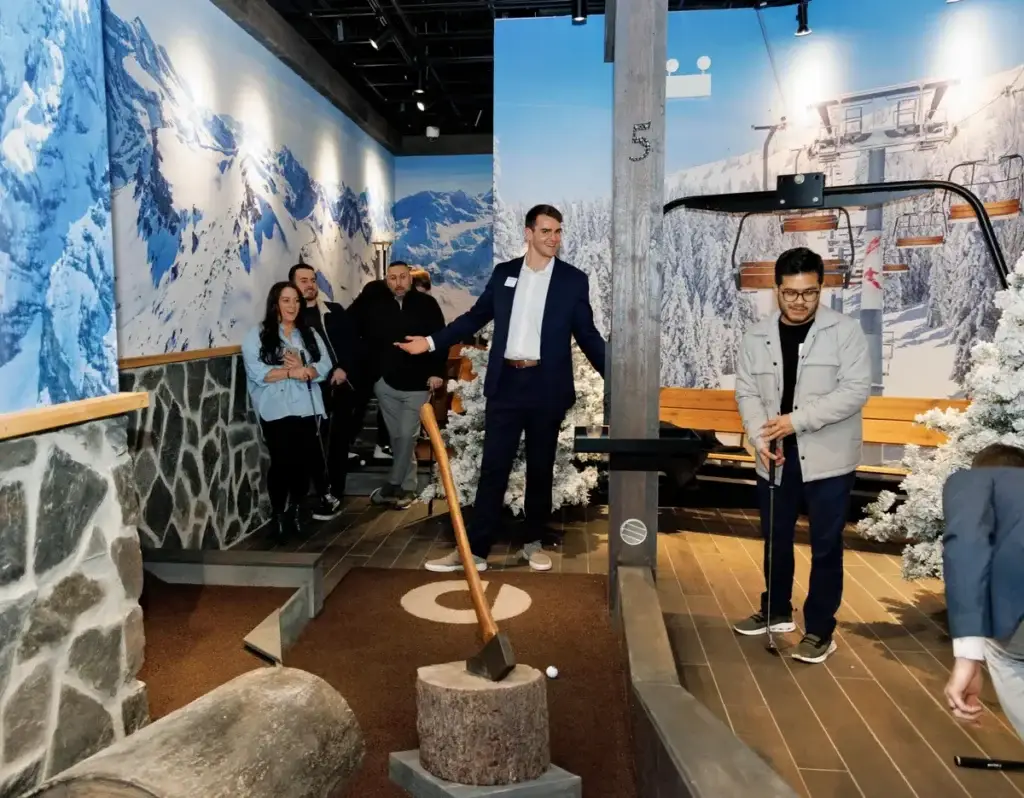
Nobody wants to go to team building. Plenty of people want to beat the VP of Sales at mini golf. Same event. The second one is team building nobody calls team building, and the only real difference is what you make people do once they’re in the room.
We run ten venues that host this every week, so read the rest knowing where we stand. What follows is what works when a group of coworkers walks through our door, what goes wrong, and three formats you can run yourselves without a facilitator, a lanyard, or a single trust fall.
Why the label backfires
The numbers are not subtle. Gallup’s 2024 read on roughly 79,000 U.S. employees put engagement at a ten-year low: 31% engaged, and only 39% strongly agreeing that someone at work cares about them as a person. So companies reach for the standard fix, and the standard fix is the problem. In a 2025 study of 6,821 leaders and employees by the U.S. research firm Leadership IQ, nearly half said traditional “forced-fun” team-building activities make them uncomfortable or feel inauthentic.
Read those together and the problem is obvious. People don’t hate their coworkers. They hate being watched. Put the words “team building” on a calendar invite and an afternoon becomes a performance: share a fun fact, hold the rope, reflect on what we learned. The extroverts shine, everyone else counts the minutes, and the group goes back to Slack with a story about the time HR made them build a tower out of dry spaghetti.
Meanwhile the thing that actually moves a team is almost embarrassingly simple. Gallup has tracked it for decades: people with a best friend at work are more engaged, more likely to stay, and more likely to recommend where they work, and that link got stronger after the pandemic. Just two in 10 U.S. employees have one. Gallup’s own advice to leaders includes preplanned social events, off-site ones specifically, because friendship doesn’t come out of an exercise. It comes from time together where the stakes are low and the point is something other than the relationship.
So the fix is not a better icebreaker. It’s an outing with its own point, where the bonding happens on the side. A good one has four things going for it.
What the outing has to do instead
Nobody has to be good at it
The second an activity rewards skill, half the room checks out. Axe throwing, karaoke, trivia: someone is about to be humiliated and they know it. Mini golf has a skill floor of roughly zero. A hole in one is luck in a nice jacket. One guest at a Women in Medicine event in Houston said it better than we can: “some of the holes were impossible for our group of four. Still fun… Team building for sure.” (Helene S., Yelp, November 2025)
The group mixes without being told to
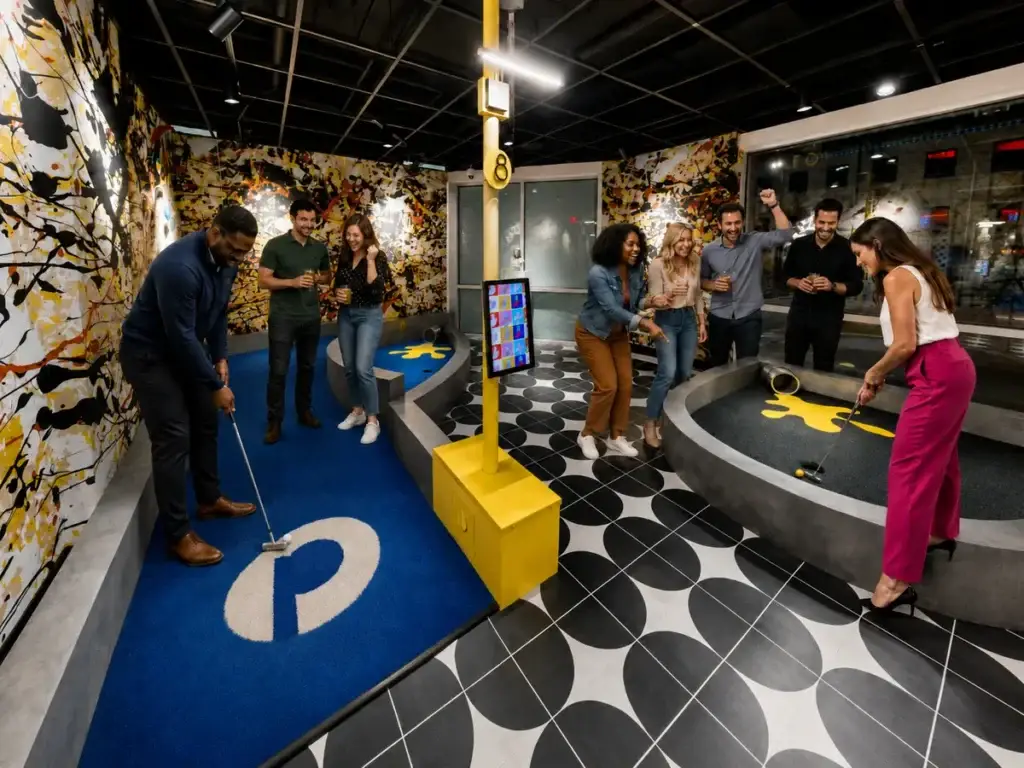
Our scorecards hold four names. That’s the whole trick. A team of twelve becomes three foursomes, and if you build those foursomes across departments instead of within them, the hard part is done before anyone picks up a putter. Each course is nine holes and takes about 30 minutes, so the foursomes reshuffle between rounds and the bar is where everyone lands. One organizer who brought 50 to 70 people to our New York rooftop watched it happen: “Although you need to be in groups of 3/4, most of our teams were going back-to-back and the size/layout of the space allowed us to still mingle with everyone so we didn’t feel isolated.” (Chloe Lee, Google, May 2024)
There’s something to talk about that isn’t work
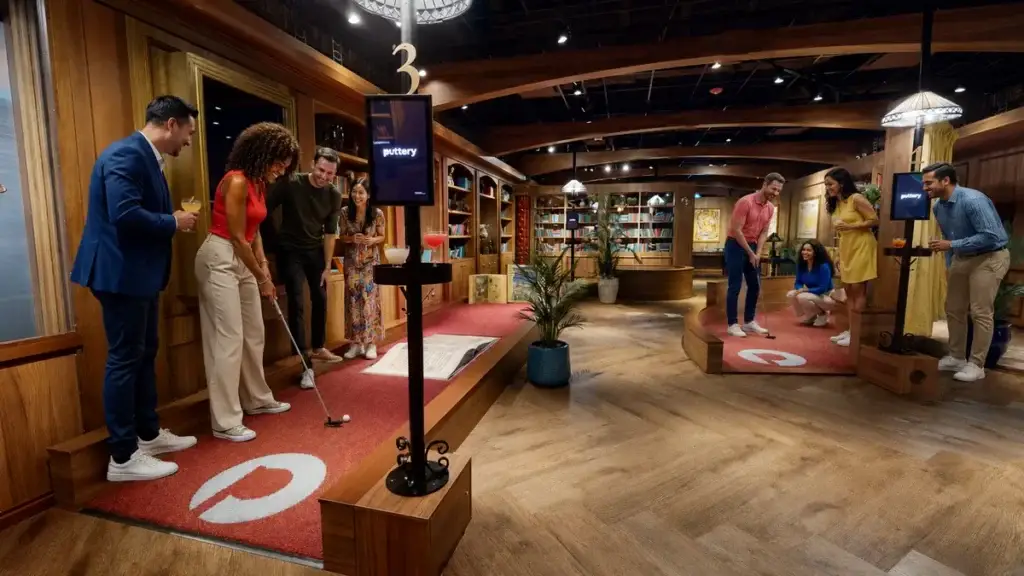
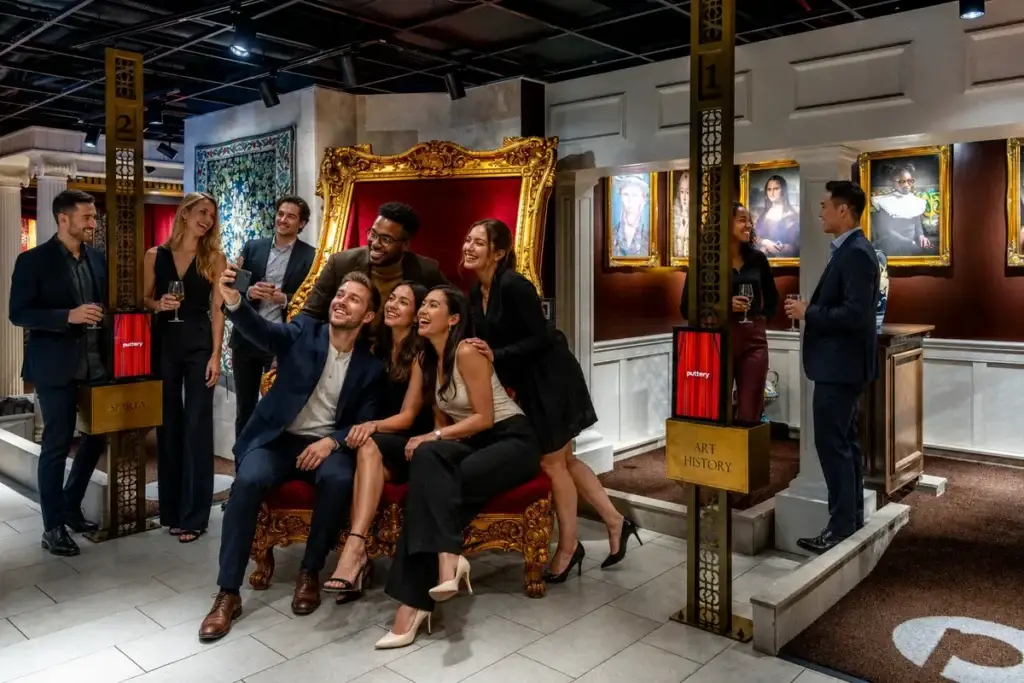
Every hole is a world you step into, not just play through. There’s a dinosaur in the Library. There’s a ski lift and a fireplace in the Lodge. The Illusion course is black and white and will mess with your read. Small talk needs material, and a room that is actively strange gives people something to point at. Two coworkers with nothing in common will find it in a putt that broke left for no reason.
It ends on one check
Food and a drink at the end are not the reward for the team building. They are the team building. The course gets people talking; the table keeps them there. Our kitchen is scratch, the bar is full, and every city pours its own Hometown Heroes, three or four rotating cocktails created by the bartenders in that market, with zero-proof options always on the list. One check, one planner, nobody Venmo-ing the boss.

Three formats you can run on any course
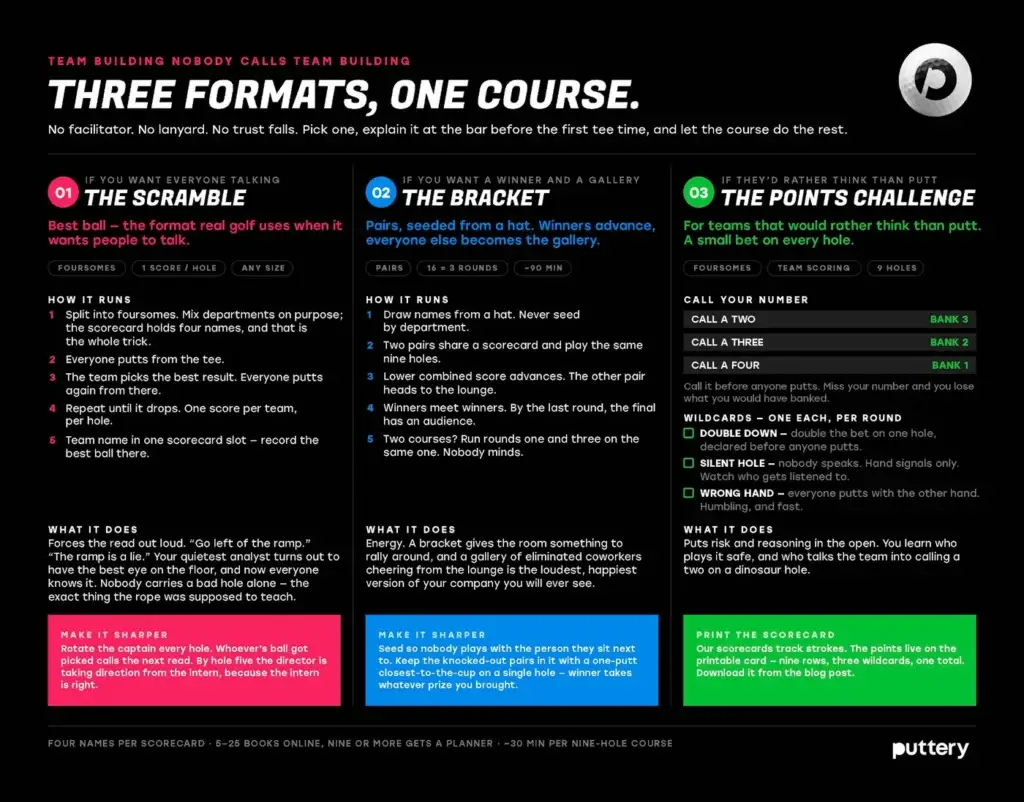
We don’t sell these as packages. We don’t need to. Each one runs on the courses, scorecards, and tables we already have. A team outing with a format beats a team outing without one, every time. Pick one. Explain the rules at the bar before the first tee time. That is the entire setup.
#1: The Scramble
Best ball, the format real golf uses when it wants people to talk. Foursomes. Everyone putts from the tee. The team picks the best result, everyone putts from that spot, and so on until the ball drops. One score per team per hole. Put the team name in one scorecard slot and record the best ball there.
What it does: forces the read out loud. “Go left of the ramp.” “The ramp is a lie.” Your quietest analyst turns out to have the best eye on the floor, and now everyone knows it. Nobody carries a bad hole alone, which is the exact thing the rope was supposed to teach.
Make it sharper: rotate the captain every hole. Whoever’s ball got picked calls the next read. By hole five the director is taking direction from the intern, because the intern is right.
#2: The Bracket
Pairs, seeded by drawing names from a hat, never by department. Two pairs share a scorecard and play the same nine holes; the lower combined score advances. Winners meet winners in the next round, losers head to the lounge as the gallery. With unlimited gameplay, a 16-person bracket is three rounds, roughly 90 minutes, and the final has an audience.
What it does: energy. A bracket gives the room something to rally around, and a gallery of eliminated coworkers cheering from the lounge is the loudest, happiest version of your company you will ever see. Keep the knocked-out pairs in it with a one-putt closest-to-the-cup on a single hole, winner takes whatever prize you brought.
Make it sharper: seed so nobody plays with the person they sit next to. If your venue has two courses, rounds one and three run on the same course and nobody minds.
#3: The Points Challenge
For teams that would rather think than putt. Foursomes, team scoring, and a small bet on every hole. Before each hole the team calls a number: two, three, or four. Make the hole in that many strokes or fewer and bank points. Call a two and make it, bank three. Call a three, bank two. Call a four, bank one. Miss your number and you lose what you would have banked. Then the wildcards, each usable once per round:
- Double Down. Double the bet on one hole of your choosing. Declare it before anyone putts.
- Silent Hole. Nobody speaks. Hand signals only. Watch who gets listened to when nobody can talk.
- Wrong Hand. Everyone putts with the other hand. Humbling, and fast.
Our scorecards track strokes. The points live on a phone or a printed card, and the arguing lives at the table afterward.
What it does: puts risk and reasoning out in the open. You’ll learn who plays it safe, who doubles down with a lead, and who talks the whole team into calling a two on a hole with a dinosaur in the way. That tells you more than a personality assessment, and it costs nothing.
Here’s an easy way to compare the three formats, then download the PDFs so HR can call it team building while everyone else just calls it a good time.
Two offices, one leaderboard
Teams split across two of our cities run the same format in the same week and settle it on one leaderboard. Dallas against Houston. Chicago against Minneapolis. Agree on the format, the week, and the prize, and let the group chat handle the rest.
Under nine people
You don’t need the events team. Groups of five to eight book two tee times in one transaction, we do our best to run them back to back, one person pays, and you run the Scramble as two foursomes. Or book a package online for five to 25 and have the food waiting. Want a custom event for nine or more? A planner takes over. More on that below.
Call it what it is
A happy hour comes out of someone’s discretionary budget and it’s the first line cut. Team building sits in HR, learning and development, and culture budgets that exist to be spent on exactly this, and it clears with a lot less friction. Same group. Same afternoon. Same invoice. If your company has a culture budget, a Scramble across three departments qualifies, and nobody had to trust-fall to earn it. The events team writes one agreement and one invoice, which is usually everything the people who ask about receipts need to see.
Read this before you book
The questions organizers ask most, and the ones the reviews keep bringing up. Answered plainly.
You’ll play in fours. Four names per scorecard, no exceptions. A group of 40 is ten foursomes, not one mob walking the course together. Decide the foursomes in advance, on purpose, across teams. Your planner staggers the tee times so groups go back to back, and the lounge or private room is where the whole group reconnects between rounds.
It gets loud at night. Music is part of the room, and Friday at 9 PM is built for adults who came to be loud. If your outing involves a speech, an award, or a client, book a weekday afternoon or ask your planner about a private room. Chicago, for example, has a glass-walled private room and a curtained semi-private space; every city has its own version. One Charlotte organizer last November: “The music was at a good volume where you could hear it, but you didn’t have to shout to hear each other.” (Christina Janek, Google, November 2025)
One invoice or split the check. Nine or more people go through the events team: one agreement, one invoice, gameplay and food priced per guest. Under nine, you’re booking tee times like any other guest, which means paying at the desk. Don’t make your team stand in a line deciding who covers the boss. Have one person book and pay online ahead of time, or book a five-to-25 package and let the link do it.
Who’s allowed in after dark. Every venue is family-friendly during the day and built for adults at night. The courses don’t change. The vibe does. What changes by city is the hour and the age. If your team includes interns under 21, book a weekday or a daytime slot, and check your city’s location page before you send the invite or read this blog post about our age policy.
How long it takes. About 30 minutes per nine-hole course. One course plus food is a tight two hours. Two courses and the Bracket is closer to three. Unlimited gameplay means you can go longer; one Pittsburgh group “Just spent 4 hours and played 63 holes.” (Ryan Merriman, Google, August 2024) Book the block you want, not the block you think you can justify.
Drinks go on the course. Plates stay at the table. Carry your cocktail hole to hole. Food stays in the dining and lounge areas, which is where the night should start and end anyway: shareables first, then tee times, then back to the table to settle the bracket.
Reserve, and reserve early. “Just make sure to reserve first, sometimes this place can get busy with corporate team building people.” (Ethan Jin, Google, July 2026) He’s right, and it’s us he’s describing. Private events block courses, and December goes first. Your planner confirms everything in writing in your event agreement. That’s your contact, not the online booking system.
What it looks like, city by city
Ten venues, and the same two words keep showing up in the reviews, usually followed by a recommendation.
| CITY | WHAT ORGANIZERS SAID |
|---|---|
| Charlotte | “Service was excellent and he made my team feel super welcome… highly recommend this venue for team building events” Armie D, Google, August 2026 |
| Chicago | “Amazing team building event that delivered beyond expectation” Alison Walsh, Google, October 2025 |
| Dallas (The Colony) | “We did 3 of the mini golf courses and were surprised at the creativity within such a compact area.” Michael Cheney, Google, May 2025 |
| Houston | “One of my co-workers has a gluten allergy. The chef went out of his way to make a delicious gluten-free dish for him and came out to talk to us.” Alexis Sassard, Google, February 2026 |
| Kansas City | “So accommodating and patient with our group. We recommend Puttery for any teambuilding opportunities.” Andrew Diegel, Google, February 2025 |
| Miami | “Took my employees for team building and what a great experience… The menu is very much geared towards shareables which is great to me.” Jessica A., Yelp, July 2024 |
| Minneapolis | “East Coast girly here visiting Minnesota for a work trip and came to Puttery for a team building event. We had the most fun.” Melissa G., Yelp, January 2024 |
| New York City | “We were looking for a venue to host a corporate event for about 50-70 people and everyone had a blast. I was worried about day-of logistics since we had such a big group but check-in was seamless.” Chloe Lee, Google, May 2024 |
| Pittsburgh | “My company rented out the top floor of Puttery for a team building event… We had the absolute best time. Everyone is still talking about that day.” Caitlin Allen, Google, June 2024 |
| Washington DC | “This was great for team building and corporate events and is conveniently located near the Gallery Place and Metro Center metro stops.” Evan P., Yelp, December 2025 |
The planners agree. When Connect NYC, an industry event where meeting planners spend two days with suppliers, gave its attendees an optional team-building session, it was at Puttery NYC. People who book rooms for a living picked ours.
Bring the team
One Houston organizer left a line we think about more than we should: “Thank you for being more fun than I was expecting.” (Eric Rodgers, Google, November 2023) We’d take that on a plaque. We’d rather you find out for yourself.
That’s team building nobody calls team building. You bring the list. We handle the wow. Contact a planner, or start with group events to see packages and capacities for your city. Every location page has a 360 tour if you want to see the room before you commit.
