


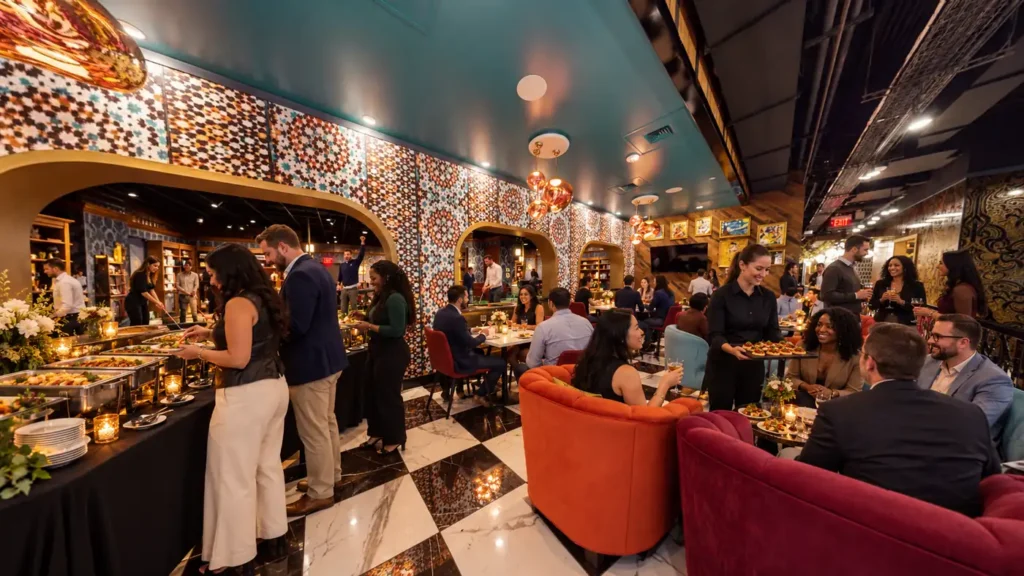
If your group is nine or more, book with a planner. Every time. There is no planning fee, and it is the only way to choose your space, set your own timeline, build the menu around your group, hold tee times in the middle of your event and use any offer we’re running. Booking online gets you a preset package, 90 minutes of reserved seating and whatever space is open that day.
We understand why the online button is tempting. Five minutes, a card number, done. But online is only easier until the night doesn’t match what you pictured: the corner you didn’t choose, the menu that skipped your three vegetarians, the 90-minute clock nobody mentioned to your boss. A planner’s whole job is making sure that gap never opens.
This guide comes from the people who plan our events every day: Ken Kitchen (New York City), our National Director of Event Sales, Sierra Youngblood, CPCE (Charlotte) and Keith Nadal (Houston), two of our Regional Directors of Event Sales, and Amanda Woods (Chicago) one of our Directors of Event Sales. We asked each of them the same forty-some questions and built this from their answers.
The short version
The benefits of booking with an event planner at Puttery vs. booking online:
- You choose your space. Online, the venue assigns it.
- You get the time the event needs. Two or three hours, against 90 minutes of reserved seating online.
- Golf happens in the middle of your event, at tee times held for your group, and your table is still yours when you come back.
- The full event menu opens up, and it gets built around your people: the vegetarians, the big eaters, the guest with the allergy.
- The bar and the bill work the way your company needs. A hosted tab, drink tickets, a package or separate checks. One agreement, one invoice.
- Every offer we run is applied by a planner. Monthly offers and early-booking holiday offers can’t be added to an online booking. There’s no place to enter one.
- Somebody asks what the event is for, then builds it to do that.
- Plans can change. Headcount, menu and timing move until your final details are due.
There is no fee for a planner, and the minimum is nine guests. If you’re five to eight, our online packages and back-to-back tee times are built for you.
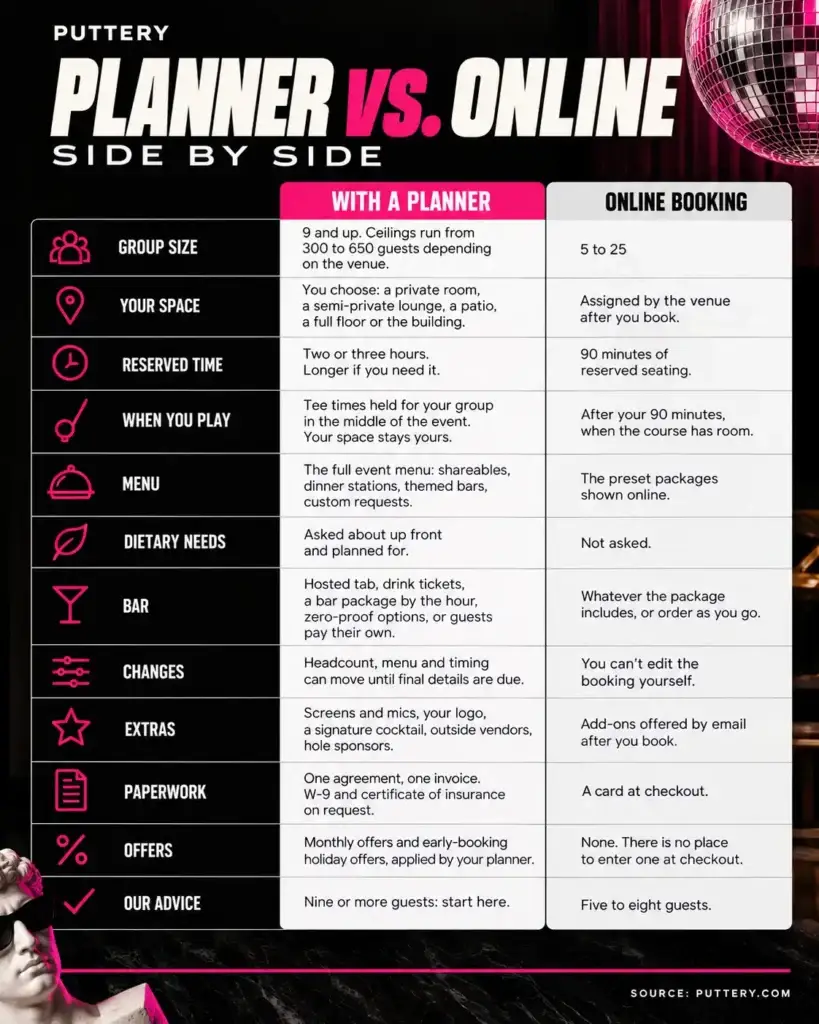
Planner vs. online, side by side
| WITH A PLANNER | ONLINE BOOKING | |
|---|---|---|
| Group size | 9 and up. Ceilings run from 300 to 650 guests depending on the venue. | 5 to 25 |
| Your space | You choose: a private room, a semi-private lounge, a patio, a full floor or the building | Assigned by the venue after you book |
| Reserved time | Two or three hours. Longer if you need it. | 90 minutes of reserved seating |
| When you play | Tee times held for your group in the middle of the event. Your space stays yours. | After your 90 minutes, when the course has room |
| Menu | The full event menu: shareables, dinner stations, themed bars, custom requests | The preset packages shown online |
| Dietary needs | Asked about up front and planned for | Not asked |
| Bar | Hosted tab, drink tickets, a bar package by the hour, zero-proof options, or guests pay their own | Whatever the package includes, or order as you go |
| Changes | Headcount, menu and timing can move until final details are due | You can’t edit the booking yourself |
| Extras | Screens and mics, your logo, a signature cocktail, outside vendors, hole sponsors | Add-ons offered by email after you book |
| Paperwork | One agreement, one invoice. W-9 and certificate of insurance on request. | A card at checkout |
| Offers | Monthly offers and early-booking holiday offers, applied by your planner | None. There is no place to enter one at checkout. |
| Our advice | Nine or more guests: start here | Five to eight guests |
One more difference the checkout page doesn’t show. An online booking isn’t final until someone at the venue confirms it and assigns your space. It feels instant. It isn’t a conversation.
Already booked online? Reply to your confirmation email or contact a planner. We can pick it up from there: add time, hold a tee time, move your space, rework the menu, and see which offers you qualify for.
Why “easier” usually isn’t
Online checkout is fast because it doesn’t ask you anything. Here is what it skips:
- What is this event for?
- Who’s coming, and what can’t they eat?
- Where in the building do you want to be?
- Is anyone giving a toast or showing slides?
- Who’s paying for drinks, and is there a limit?
- Which of this month’s offers applies to your date?
- What happens when your 90 minutes are up?
Those questions don’t go away. They come up during the event, when nobody can do anything about them. Our planners see the same stories over and over: the host who paid in full and then asked about a drop-down screen (we don’t have one), the boss who walked in expecting a private room nobody booked, the three guests who couldn’t eat anything on the package, the group still eating when their seating time ran out.
None of that is the host’s fault. Most people who book a group event aren’t event planners. They’re an office manager, a sales lead or somebody’s very organized friend, and someone handed them a date and a budget. The Bureau of Labor Statistics counts event planning as a full-time profession. You got it on a Tuesday, on top of your real job. Borrow ours.
A planner starts somewhere checkout can’t. Keith Nadal opens his calls in Houston with the same question. “What’ll make you look like a hero? And I go, you can’t say free.” The answer decides the space, the hour, the food and what’s on the screens when people walk in.
The hesitation we hear most is about being upsold. “They think that we’re gonna nickel and dime them,” Keith says. Here’s how it works instead. There’s no planning fee. You get a quote with the all-in total before you sign anything. And if the quote isn’t right, say so. Ken Kitchen, who oversees event sales for all ten venues: “It’s okay to tell me this isn’t what I want.” You can still end up with a simple package. You’ll just end up there on purpose.
One New York host described the difference after a corporate event: “They were super helpful in the planning and walkthrough process as well as accommodating the needs of my team” (Jordan Smith, Google, June 2026).
Tell us your headcount, the occasion, and how you want the tab to work. That’s the whole first conversation. Contact a planner.
What changes when a planner builds it
You choose where your group sits
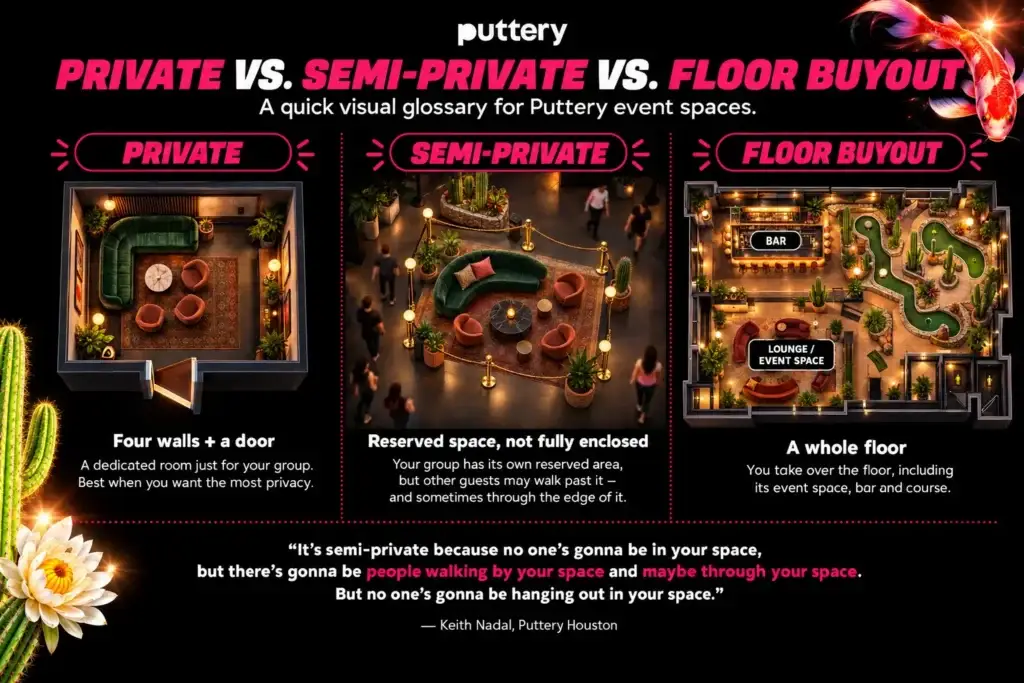
Online, the venue places you wherever there’s room. With a planner, you pick, and the choice is written into your agreement. That matters more than people expect, because most of our event spaces are semi-private, and that is the most misread word in events. Keith’s definition is the best one we’ve heard: “It’s semi-private because no one’s gonna be in your space, but there’s gonna be people walking by your space and maybe through your space. But no one’s gonna be hanging out in your space.”
Your area is marked off with stanchions or curtains and signed for your group. Guests notice. “Signage in the lobby and the hostess directed our group to where light bites were set up,” one Houston guest wrote about a Women in Medicine event (Helene S., Yelp, November 2025).
Private means four walls and a door, and every venue has fewer of those than you’d guess. Chicago’s holds about 15 people. Charlotte’s holds 25 standing or 18 seated. They go first, which is one more reason to call early.
Bigger groups can take a whole floor, with its own bar and its own course, or the entire building. Houston is laid out for it: three bar areas, each with a bar, outdoor space and a course of its own. Full buyouts run from 300 guests in Charlotte to 650 in New York. “My company rented out the top floor of Puttery for a team building event,” one Pittsburgh organizer wrote. “Everyone is still talking about that day” (Caitlin Allen, Google, June 2024). Every venue’s fact sheet and 360 tour are linked from the group events page, so you can see a space before you ask for it.
One thing to know about sharing a building. Every venue is family-friendly during the day and built for adults at night. The courses don’t change. The vibe does. Age cutoffs vary by city and hour, so check the policy for your venue, and tell your planner if kids are coming or if you’d prefer a room without them.
You get the time the event needs
Online packages come with 90 minutes of reserved seating. Ken has a question for anyone who thinks that’s plenty. “When you’ve gone to a restaurant with fifteen or twenty of your colleagues or your friends, were you only there for ninety minutes? You weren’t. You were there for multiple hours.”
At 90 minutes the seating is released and the group heads to the course, carrying bags and drinks, some of them mid-burger. Planner-built events run two or three hours, with golf in the middle and your space held the whole time. If you can do three hours, do three. With a big group, foursomes leave for the course in waves, and the extra hour is what gives the last group time back at the table.
Golf in the middle, with your table waiting
The question organizers ask us most is how the golf works with a group. The basics:
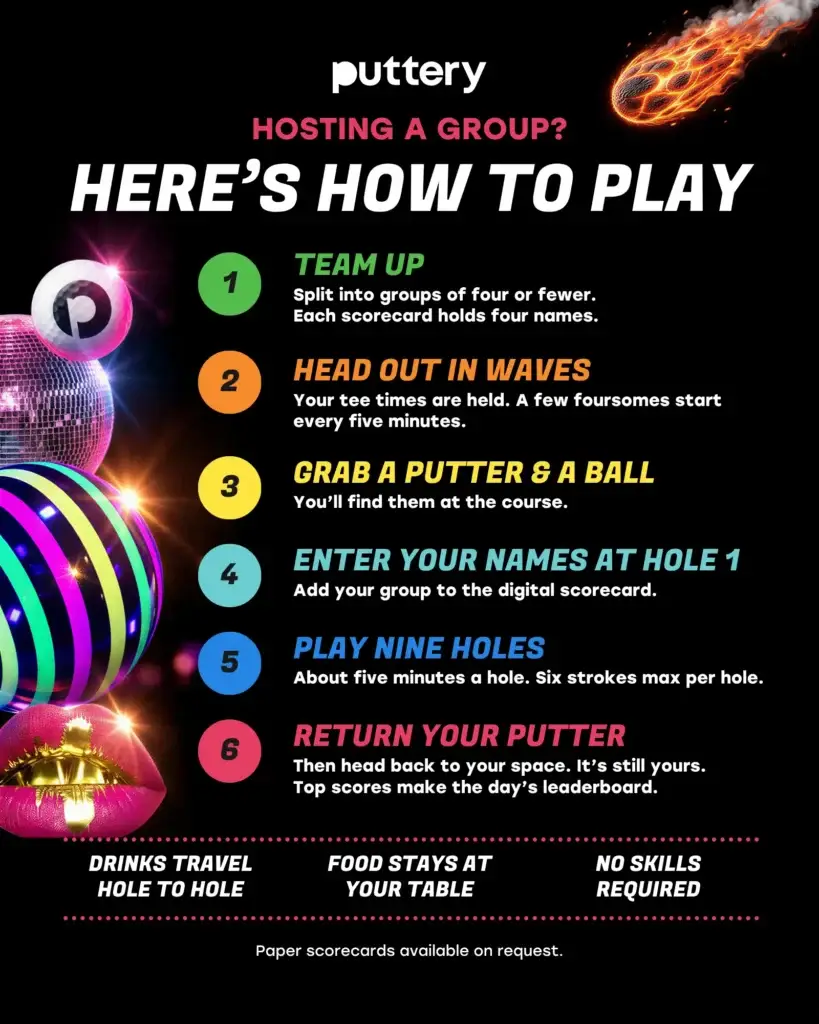
- Every course is nine holes. Guests play in groups of up to four, because the digital scorecard holds four names.
- Six strokes is the max on any hole. The scorecard stops counting at six, and so does the wait for the group behind you.
- Top scores post to the venue leaderboard for the day, which is where the office rivalry gets settled.
- Foursomes tee off about five minutes apart. Budget about five minutes a hole: 30 minutes for a course at event pace, closer to 45 when the course is full.
- A group of 12 is through a course in 30 to 45 minutes. Fifty takes about an hour, because your planner spreads the foursomes across more than one course.
- Play is self-guided. Staff work the courses taking drink orders. Drinks travel hole to hole. Food stays at your table.
- Nobody has to play. Plenty of guests would rather hold down the lounge.
- One round per guest is included. Unlimited play is an upgrade where the venue and the date allow it. Ask which courses it covers on your date, since a course can be closed for someone else’s event.
Amanda Woods, who plans events in Chicago, calls the rest “the cadence of the event,” and it’s the part a planner designs for you:
| TWO-HOUR EVENT | THREE-HOUR EVENT | |
|---|---|---|
| Arrival | Chips and dips are out when guests walk in | Same |
| Food | Shareables land about 15 minutes in | Shareables about 30 minutes in. On dinner packages, entrées and sides follow. |
| Golf | First foursomes head out about an hour in | About 90 minutes in |
| After golf | Back to your space until the two-hour mark | Back to your space with time to spare |
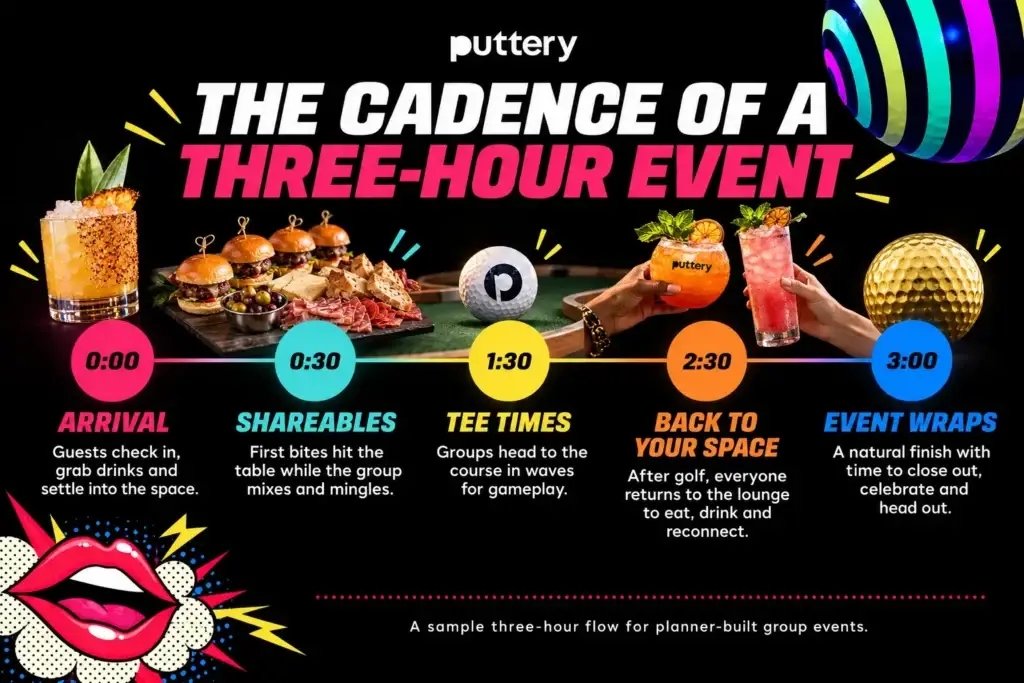
The chips and dips are there on purpose. Guests trickle in, and nobody should walk into cold food. The timeline arrives with your quote, and all of it can move. Golf first and dinner after, tee times an hour in, a toast at 7:15. Tell us.
The one mistake we see is sending everyone to the first tee at once. Split into foursomes before you arrive and send a few at a time. Your planner maps the waves with you.
It’s the part hosts worry about most and mention first afterward. “I was worried about day-of logistics since we had such a big group,” wrote the organizer of a 50-to-70-person corporate event in New York, who went on to credit the staff for “informing people about the drink packages and tee times” (Chloe Lee, Google, 2024). Another host this September: “Great balance of flex social networking time and organized game play” (Avery Chung, Google, September 2026).
The menu gets built around your group
The most common wrong guess about us is the food. Amanda hears the same sentence after events, always with an apology attached: “I hope you’re not offended by this, but we were really surprised at how good the food was.”
Nobody’s offended. Every venue runs a scratch kitchen, and Keith has the line we wish we’d written: “There are mini golf places that have food. And we’re a venue with food and beverage that has mini golf.”
Online, you choose from a few preset packages. With a planner, the whole event menu is on the table, and two words on it need translating:
- Shareables are heavy appetizers such as sliders, wings, spring rolls and boards. They’re set on a food station by your space, not passed on trays and not crowded onto your cocktail tables.
- Stationary means dinner: entrées such as filet, chicken, salmon and pasta, plus sides, served from a station.
- Themed stations include a taco bar, barbecue, Italian and Mediterranean. In December, venues add carving stations and pasta cooked to order in front of guests.
All of it is cocktail-reception style: some seats, some standing, people moving between the food, the bar and the course.
Event food is portioned per guest, so the most useful thing you can tell your planner is who’s coming. A team arriving straight from work at 6:00 eats differently than a client reception at 3:00. If your crowd has big appetites, we’ll point you toward barbecue, the taco bar or Italian, which hold up better for a hungry line than filet does. The add-on hosts most often wish they’d said yes to is more food.
Planners ask about dietary needs up front, and the kitchen keeps an allergen guide by menu item. For a guest with a serious restriction, we order that guest’s meal ahead from the regular menu and a server walks it to them. One Houston guest at a team building event wrote that “one of my co-workers has a gluten allergy. Chef went out of his way to make a delicious gluten-free dish for him and came out to talk to us” (Alexis Sassard, Google, February 2026).
What we can’t do: our kitchens are not kosher certified, and we won’t pretend otherwise. One shared kitchen means cross-contact. Last-minute religious dietary requests can’t be met on the night. With notice, we’ll tell you exactly what we can do.
The bar and the bill fit your company
There are four ways to run the bar, and a planner can set up any of them where state law allows:
- Hosted on consumption. A tab opens when your event starts, and you pay for what guests actually order. You can cap the total, or cap the price per drink.
- Drink tickets. Built for companies with a policy. Two per guest is a common ask, then guests buy their own. Tickets come in tiers: beer and wine, house, call and premium. There’s a non-alcoholic beverage package too.
- A bar package by the hour. Priced per guest for two or three hours, in the same tiers, paid in advance. No tab at the end.
- Guests pay their own. Common for social events, usually against a food and beverage minimum.
Which one is right depends on the day and the crowd. A Tuesday lunch usually does better on consumption. A Friday night holiday party usually does better on a package. Your planner will ask what your bar tabs have looked like before and do the math with you.
Ask for two things: the brand list for each tier, and the all-in total. We quote upgrades as a total, not per person, because the total is the number finance sees.
Zero-proof cocktails are on every menu, every day. If your group includes guests under 21 or people who don’t drink, tell your planner, and their drinks get built into the plan.
The paperwork is simple: one agreement and one invoice, with a W-9 and certificate of insurance if your company needs them.
Plans change. That’s fine.
People drop. Plus-ones appear. The VP decides she’s coming after all. With a planner, headcount, menu and timing can move until your final details are due. Final guest count, menu and payment are due seven to ten business days before the event; book inside that window and it’s paid in full up front, with no changes after.
“They were so accommodating with our dietary needs and stayed flexible even when we had last-minute adjustments,” a New York organizer wrote after a corporate outing (Julie Kosmynka, Google, March 2026).
Every offer runs through a planner
We run an offer most months, and a separate early-booking offer for holiday parties. Both live on our site, on the seasonal offers page and the holiday events page. What neither page can do is apply the offer to an online booking, because the online checkout has no place to enter one. Every offer we run is applied by a planner, on your quote, before you sign.
So if you’re comparing the two buttons on price, the answer is simpler than it looks. The best deal we have at any given time is only available through a planner. Tell them your date and headcount, ask what’s running, and they’ll tell you what you qualify for. The offers change, and each has its own terms, so ask rather than assume.
The extras that make it yours
Sierra Youngblood, our regional director in Charlotte, has a line she uses on every call: “It’s never a no. It’s a how.” The hows we get asked for most:
- Your logo, a slideshow or a presentation on the screens, and a microphone for the toast.
- A signature cocktail, renamed for your team or built from scratch by the bar.
- Scorecards with your logo at some venues, for teams that want the rivalry to follow them back to the office.
- Outside vendors: DJs, photo booths, caricature artists, calligraphers.
- Sponsor banners at each hole for fundraisers.
What we aren’t is a ballroom. No stage, no drop-down screen, no theater seating. If the centerpiece of your event is a 45-minute presentation, tell your planner first. A private room, a floor buyout or an off-peak afternoon solves most of it.
When to have it, and how far ahead to call
For work events, the best nights are Tuesday through Thursday, starting around 6:00. People need time to leave the office, cross town, park and find the floor, and an 8:00 start is too late for anyone with a family waiting.
The package is the same on a Saturday. The room isn’t. Weekends run younger and louder. Early in the week, you’re mostly among other work groups, and you can hear each other. One Charlotte organizer noticed: “The music was at a good volume where you could hear it, but you didn’t have to shout to hear each other” (Christina Janek, Google, November 2025).
We can take an event with a day’s notice when space allows. Seventy-two hours is better for the kitchen and the staff, and anything custom wants more than a week. December is its own season. Peak dates in Charlotte are usually gone by late October. Thursdays go first in Chicago. East Coast holiday parties land Monday through Thursday, and Texas fills Fridays and Saturdays first. DJs and photo booths book months out. Holiday events have their own page, and usually an early-booking offer, which your planner applies.
If it’s a work event
Budgets are tight and getting tighter. In Amex GBT’s 2026 Global Meetings and Events Forecast, a survey of 601 meeting professionals, cost was the top planning challenge (38%), and 71% expected cost per attendee to rise. That’s why we lead with the all-in total, not the per-person price.
Three things that make a work event go better:
- Name your on-site host. The person who books is often not the person who shows up. Tell us who’s running the night and forward them the timeline, so nobody walks in expecting a different event.
- Say what the event is for. We build a team outing around structure and play. We build client entertaining around food and drink. “Group outing” on the form tells us neither.
- Bring your other quotes. If another venue offered you something, tell us. We’d rather build to it than guess.
People who plan events for a living tend to agree with the approach. When Connect NYC offered a room full of professional meeting planners a team outing, it was at Puttery New York City. And from a Kansas City team: “So accommodating and patient with our group” (Andrew Diegel, Google, February 2025).
Planning for a team: contact a planner with your date range, headcount and budget. City guides: Chicago, Dallas, Houston, New York City. For formats your team will actually show up for, read Team Building Nobody Calls Team Building.
If it’s a birthday, a shower or a reunion
Nine friends is enough for a planner, and social hosts get the most out of one, because it’s your own money on the line. Friends flake. With a planner, your headcount can move until final details are due. And if you’d rather not pay for everyone, we can hold your space against a food and beverage minimum and let guests pay their own tabs toward it.
- Cake: bring one. It has to come from a bakery or a grocery store. “It can’t be grandma’s cake,” Keith says. Health code, not snobbery. Cutting fees vary by venue, so ask.
- Decor: tabletop is fine. Nothing goes on the walls, so no tape and no adhesive strips. Bring a pop-up banner. Balloon setups can be added.
- Swag and vendors: welcome, with notice.
More ideas in our adult birthday guide.
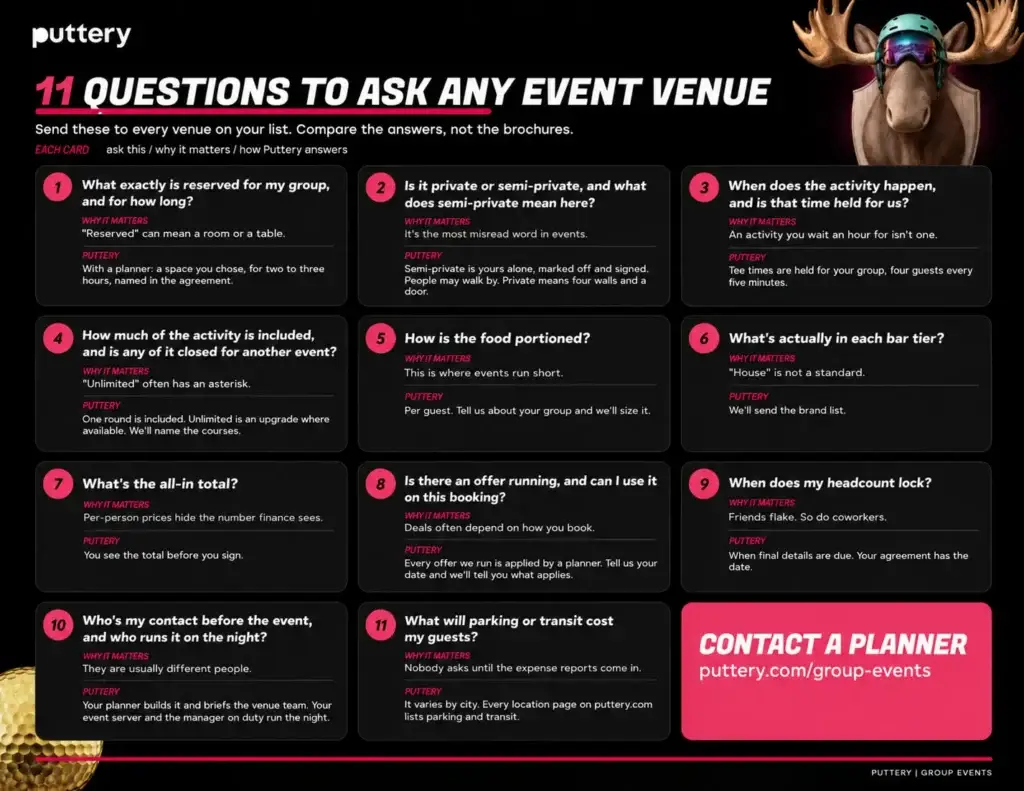
Puttery vs. the competition: what to ask any venue
Most activity venues have the same two buttons we do. Send these questions to every venue on your list and compare the answers, not the brochures. Ours are in the right-hand column.
| ASK THIS | WHY IT MATTERS | OUR ANSWER |
|---|---|---|
| What exactly is reserved for my group, and for how long? | “Reserved” can mean a room or a table. | With a planner: a space you chose, for two to three hours, named in the agreement. |
| Is it private or semi-private, and what does semi-private mean here? | It’s the most misread word in events. | Semi-private is yours alone, marked off and signed. People may walk by. Private means four walls and a door. |
| When do we play, and is that time held for us? | An activity you wait an hour for isn’t one. | Tee times are held for your group, four guests every five minutes. |
| One round or unlimited, and on which courses? | A course can be closed for another event. | One round is included. Unlimited is an upgrade where available. We’ll name the courses. |
| How is the food portioned? | This is where events run short. | Per guest. Tell us about your group and we’ll size it. |
| What’s actually in each bar tier? | “House” is not a standard. | We’ll send the brand list. |
| What’s the all-in total? | Per-person prices hide the number finance sees. | You see the total before you sign. |
| Is there an offer running, and can I use it on this booking? | Deals often depend on how you book. | Every offer we run is applied by a planner. Tell us your date and we’ll tell you what applies. |
| When does my headcount lock? | Friends flake. So do coworkers. | When final details are due. Your agreement has the date. |
| Who’s my contact before the event, and who runs it on the night? | They are usually different people. | Your planner builds it and briefs the venue team. Your event server and the manager on duty run the night. |
| What will parking or transit cost my guests? | Nobody asks until the expense reports come in. | It varies by city. Every location page lists parking and transit. |
And sometimes we’re not the right venue. If you need a ballroom with a stage and theater seating, a seated and plated dinner for every guest, or a certified kosher kitchen, a hotel or a caterer will serve you better. If your team voted for a different game, go play it: darts at Flight Club, full swings at Topgolf, a ball that keeps score for you at Puttshack. An independent directory, Mini Golf Spots, framed that last comparison as “whether your group cares more about the game or the atmosphere around the game.” Fair enough. We’re the atmosphere, the kitchen and the bar, with a very good game attached.
What hosts say afterward
We searched every public review we’ve received since our first venue opened in 2021: 29,094 written reviews across Google, Yelp, TripAdvisor and Facebook, through September 15, 2026. We pulled every one that mentions a work event (corporate, team building, holiday party, coworkers, clients). That’s 901 reviews, averaging 4.49 out of 5, with 87% at four or five stars. The average has climbed every year: 4.24 in 2022, 4.27 in 2023, 4.54 in 2024, 4.60 in 2025, and 4.65 so far in 2026.
About one in eleven gave one or two stars, and we read those twice. They cluster around four things: waits, communication, billing and mix-ups about space. Every one of those is a problem a conversation solves before the event. That is the whole case for a planner.
Talk to a planner
Bring three things: your headcount, the occasion, and how you want the tab to work. We’ll bring the space, the timeline and the questions you haven’t thought of yet.
Whatever offer is running this month is on the seasonal offers page, holiday offers are on the holiday events page, and both are applied by your planner. The basics are in our FAQs.

About this guide: built from interviews conducted in September 2026 with Ken Kitchen, National Director of Event Sales, New York City; Sierra Youngblood, CPCE, Regional Director of Event Sales, Charlotte; Amanda Woods, Director of Event Sales, Chicago; and Keith Nadal, Regional Director of Event Sales, Houston. The CPCE is the National Association for Catering and Events’ professional certification, held by just over 330 people in the industry.
