


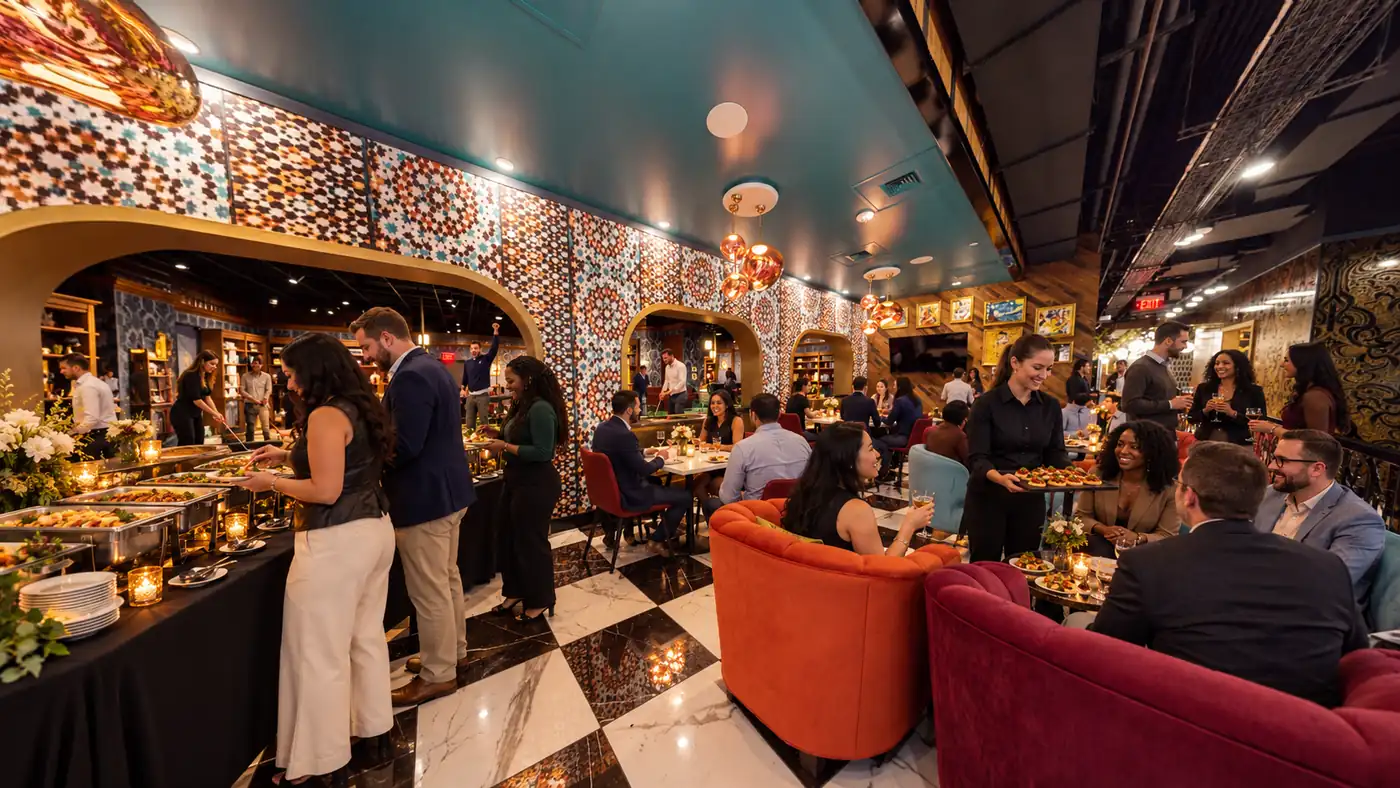
Benefits of Booking with a Puttery Event Planner vs. Booking Online
If your group is nine or more, book with a planner. Every time. There is no planning fee, and it is the only way to choose your space, set your own timeline, build the menu around your group, hold tee times in the middle of your event and use any offer we’re running. Booking online gets you a preset package, 90 minutes of reserved seating and whatever space is open that day.
We understand why the online button is tempting. Five minutes, a card number, done. But online is only easier until the night doesn’t match what you pictured: the corner you didn’t choose, the menu that skipped your three vegetarians, the 90-minute clock nobody mentioned to your boss. A planner’s whole job is making sure that gap never opens.
This guide comes from the people who plan our events every day: Ken Kitchen (New York City), our National Director of Event Sales, Sierra Youngblood, CPCE (Charlotte) and Keith Nadal (Houston), two of our Regional Directors of Event Sales, and Amanda Woods (Chicago) one of our Directors of Event Sales. We asked each of them the same forty-some questions and built this from their answers.
The short version
The benefits of booking with an event planner at Puttery vs. booking online:
- You choose your space. Online, the venue assigns it.
- You get the time the event needs. Two or three hours, against 90 minutes of reserved seating online.
- Golf happens in the middle of your event, at tee times held for your group, and your table is still yours when you come back.
- The full event menu opens up, and it gets built around your people: the vegetarians, the big eaters, the guest with the allergy.
- The bar and the bill work the way your company needs. A hosted tab, drink tickets, a package or separate checks. One agreement, one invoice.
- Every offer we run is applied by a planner. Monthly offers and early-booking holiday offers can’t be added to an online booking. There’s no place to enter one.
- Somebody asks what the event is for, then builds it to do that.
- Plans can change. Headcount, menu and timing move until your final details are due.
There is no fee for a planner, and the minimum is nine guests. If you’re five to eight, our online packages and back-to-back tee times are built for you.
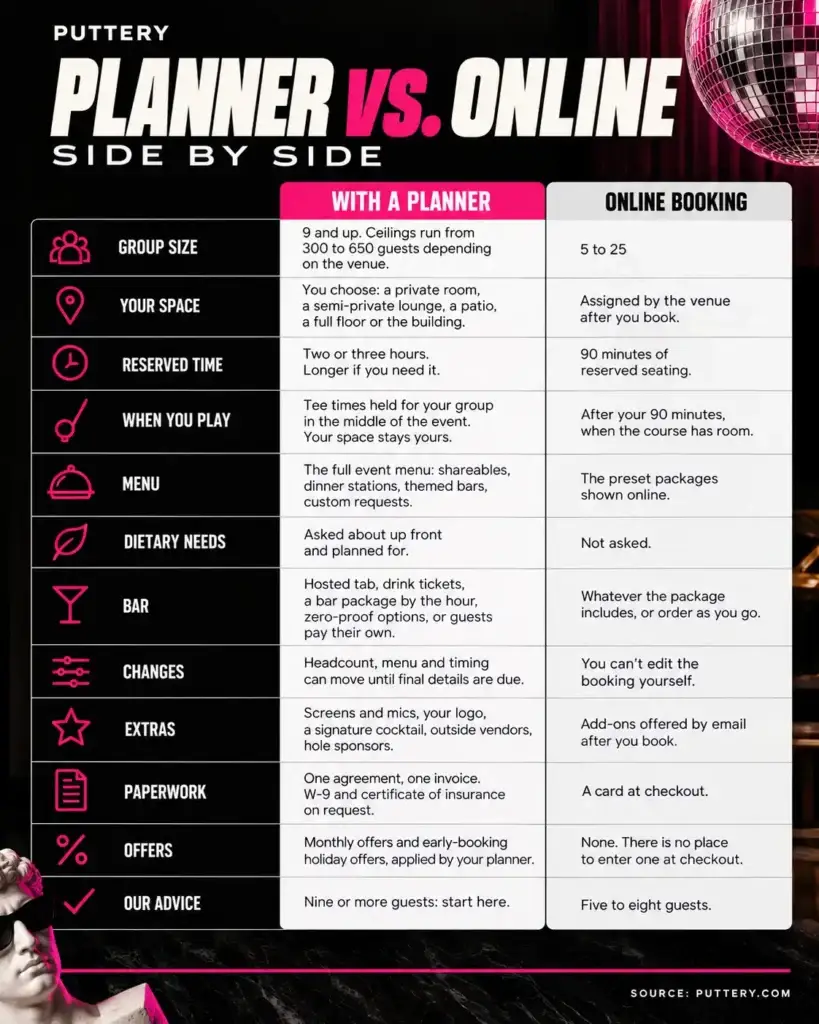
Planner vs. online, side by side
| WITH A PLANNER | ONLINE BOOKING | |
|---|---|---|
| Group size | 9 and up. Ceilings run from 300 to 650 guests depending on the venue. | 5 to 25 |
| Your space | You choose: a private room, a semi-private lounge, a patio, a full floor or the building | Assigned by the venue after you book |
| Reserved time | Two or three hours. Longer if you need it. | 90 minutes of reserved seating |
| When you play | Tee times held for your group in the middle of the event. Your space stays yours. | After your 90 minutes, when the course has room |
| Menu | The full event menu: shareables, dinner stations, themed bars, custom requests | The preset packages shown online |
| Dietary needs | Asked about up front and planned for | Not asked |
| Bar | Hosted tab, drink tickets, a bar package by the hour, zero-proof options, or guests pay their own | Whatever the package includes, or order as you go |
| Changes | Headcount, menu and timing can move until final details are due | You can’t edit the booking yourself |
| Extras | Screens and mics, your logo, a signature cocktail, outside vendors, hole sponsors | Add-ons offered by email after you book |
| Paperwork | One agreement, one invoice. W-9 and certificate of insurance on request. | A card at checkout |
| Offers | Monthly offers and early-booking holiday offers, applied by your planner | None. There is no place to enter one at checkout. |
| Our advice | Nine or more guests: start here | Five to eight guests |
One more difference the checkout page doesn’t show. An online booking isn’t final until someone at the venue confirms it and assigns your space. It feels instant. It isn’t a conversation.
Already booked online? Reply to your confirmation email or contact a planner. We can pick it up from there: add time, hold a tee time, move your space, rework the menu, and see which offers you qualify for.
Why “easier” usually isn’t
Online checkout is fast because it doesn’t ask you anything. Here is what it skips:
- What is this event for?
- Who’s coming, and what can’t they eat?
- Where in the building do you want to be?
- Is anyone giving a toast or showing slides?
- Who’s paying for drinks, and is there a limit?
- Which of this month’s offers applies to your date?
- What happens when your 90 minutes are up?
Those questions don’t go away. They come up during the event, when nobody can do anything about them. Our planners see the same stories over and over: the host who paid in full and then asked about a drop-down screen (we don’t have one), the boss who walked in expecting a private room nobody booked, the three guests who couldn’t eat anything on the package, the group still eating when their seating time ran out.
None of that is the host’s fault. Most people who book a group event aren’t event planners. They’re an office manager, a sales lead or somebody’s very organized friend, and someone handed them a date and a budget. The Bureau of Labor Statistics counts event planning as a full-time profession. You got it on a Tuesday, on top of your real job. Borrow ours.
A planner starts somewhere checkout can’t. Keith Nadal opens his calls in Houston with the same question. “What’ll make you look like a hero? And I go, you can’t say free.” The answer decides the space, the hour, the food and what’s on the screens when people walk in.
The hesitation we hear most is about being upsold. “They think that we’re gonna nickel and dime them,” Keith says. Here’s how it works instead. There’s no planning fee. You get a quote with the all-in total before you sign anything. And if the quote isn’t right, say so. Ken Kitchen, who oversees event sales for all ten venues: “It’s okay to tell me this isn’t what I want.” You can still end up with a simple package. You’ll just end up there on purpose.
One New York host described the difference after a corporate event: “They were super helpful in the planning and walkthrough process as well as accommodating the needs of my team” (Jordan Smith, Google, June 2026).
Tell us your headcount, the occasion, and how you want the tab to work. That’s the whole first conversation. Contact a planner.
What changes when a planner builds it
You choose where your group sits
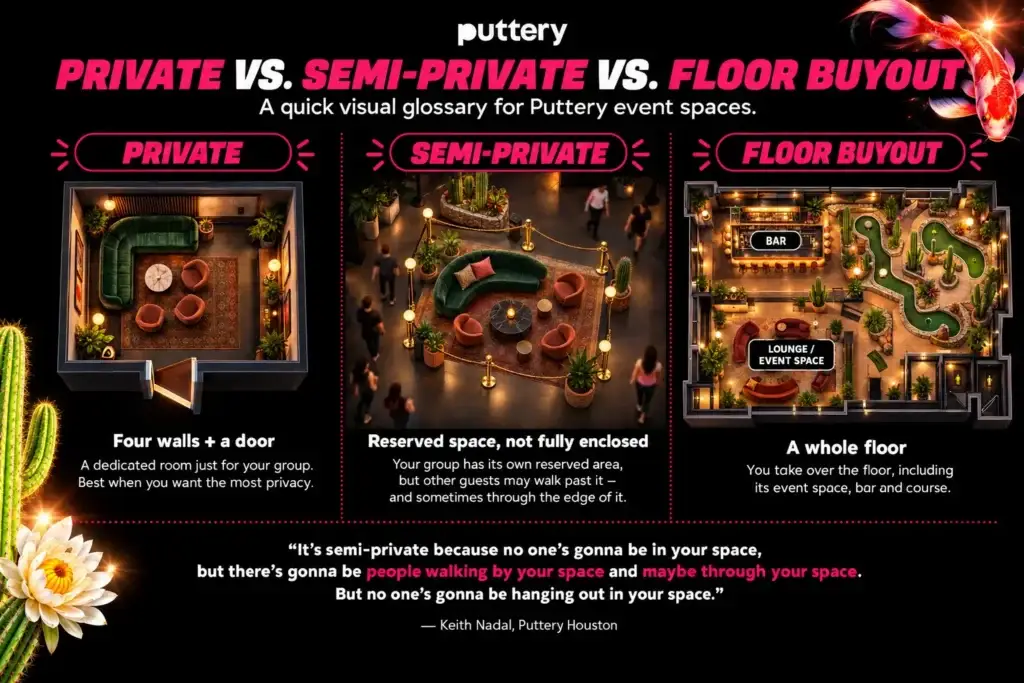
Online, the venue places you wherever there’s room. With a planner, you pick, and the choice is written into your agreement. That matters more than people expect, because most of our event spaces are semi-private, and that is the most misread word in events. Keith’s definition is the best one we’ve heard: “It’s semi-private because no one’s gonna be in your space, but there’s gonna be people walking by your space and maybe through your space. But no one’s gonna be hanging out in your space.”
Your area is marked off with stanchions or curtains and signed for your group. Guests notice. “Signage in the lobby and the hostess directed our group to where light bites were set up,” one Houston guest wrote about a Women in Medicine event (Helene S., Yelp, November 2025).
Private means four walls and a door, and every venue has fewer of those than you’d guess. Chicago’s holds about 15 people. Charlotte’s holds 25 standing or 18 seated. They go first, which is one more reason to call early.
Bigger groups can take a whole floor, with its own bar and its own course, or the entire building. Houston is laid out for it: three bar areas, each with a bar, outdoor space and a course of its own. Full buyouts run from 300 guests in Charlotte to 650 in New York. “My company rented out the top floor of Puttery for a team building event,” one Pittsburgh organizer wrote. “Everyone is still talking about that day” (Caitlin Allen, Google, June 2024). Every venue’s fact sheet and 360 tour are linked from the group events page, so you can see a space before you ask for it.
One thing to know about sharing a building. Every venue is family-friendly during the day and built for adults at night. The courses don’t change. The vibe does. Age cutoffs vary by city and hour, so check the policy for your venue, and tell your planner if kids are coming or if you’d prefer a room without them.
You get the time the event needs
Online packages come with 90 minutes of reserved seating. Ken has a question for anyone who thinks that’s plenty. “When you’ve gone to a restaurant with fifteen or twenty of your colleagues or your friends, were you only there for ninety minutes? You weren’t. You were there for multiple hours.”
At 90 minutes the seating is released and the group heads to the course, carrying bags and drinks, some of them mid-burger. Planner-built events run two or three hours, with golf in the middle and your space held the whole time. If you can do three hours, do three. With a big group, foursomes leave for the course in waves, and the extra hour is what gives the last group time back at the table.
Golf in the middle, with your table waiting
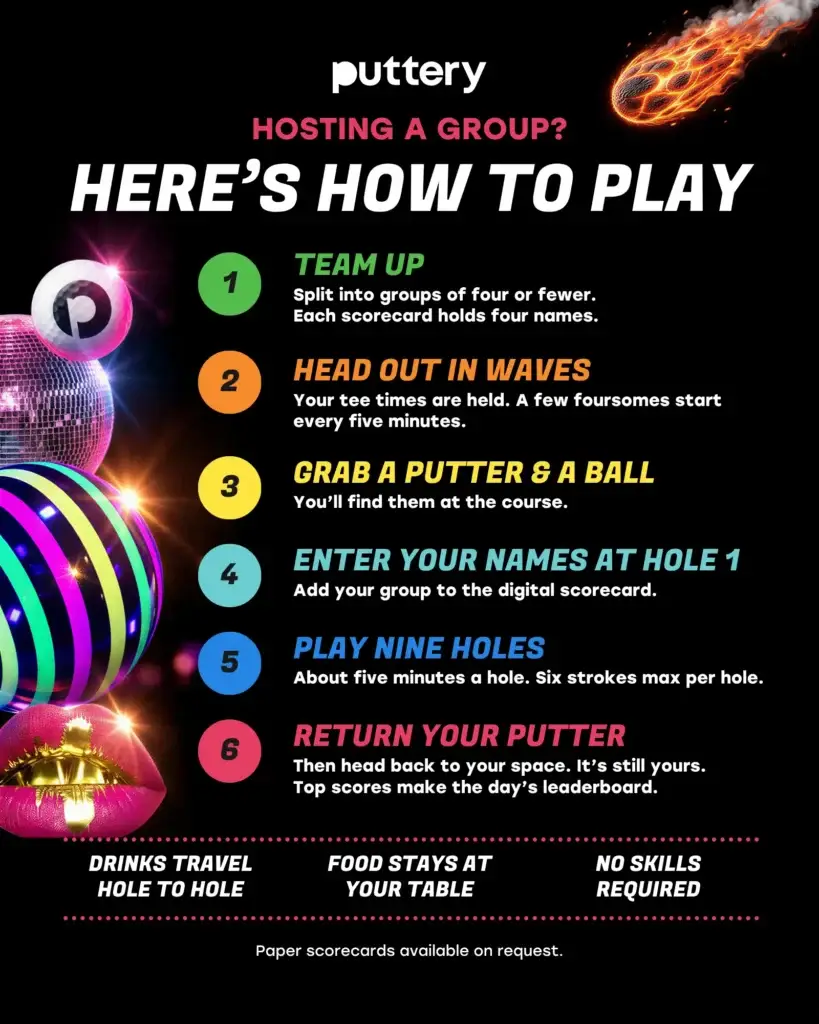
The question organizers ask us most is how the golf works with a group. The basics:
- Every course is nine holes. Guests play in groups of up to four, because the digital scorecard holds four names.
- Six strokes is the max on any hole. The scorecard stops counting at six, and so does the wait for the group behind you.
- Top scores post to the venue leaderboard for the day, which is where the office rivalry gets settled.
- Foursomes tee off about five minutes apart. Budget about five minutes a hole: 30 minutes for a course at event pace, closer to 45 when the course is full.
- A group of 12 is through a course in 30 to 45 minutes. Fifty takes about an hour, because your planner spreads the foursomes across more than one course.
- Play is self-guided. Staff work the courses taking drink orders. Drinks travel hole to hole. Food stays at your table.
- Nobody has to play. Plenty of guests would rather hold down the lounge.
- One round per guest is included. Unlimited play is an upgrade where the venue and the date allow it. Ask which courses it covers on your date, since a course can be closed for someone else’s event.
Amanda Woods, who plans events in Chicago, calls the rest “the cadence of the event,” and it’s the part a planner designs for you:
| TWO-HOUR EVENT | THREE-HOUR EVENT | |
|---|---|---|
| Arrival | Chips and dips are out when guests walk in | Same |
| Food | Shareables land about 15 minutes in | Shareables about 30 minutes in. On dinner packages, entrées and sides follow. |
| Golf | First foursomes head out about an hour in | About 90 minutes in |
| After golf | Back to your space until the two-hour mark | Back to your space with time to spare |
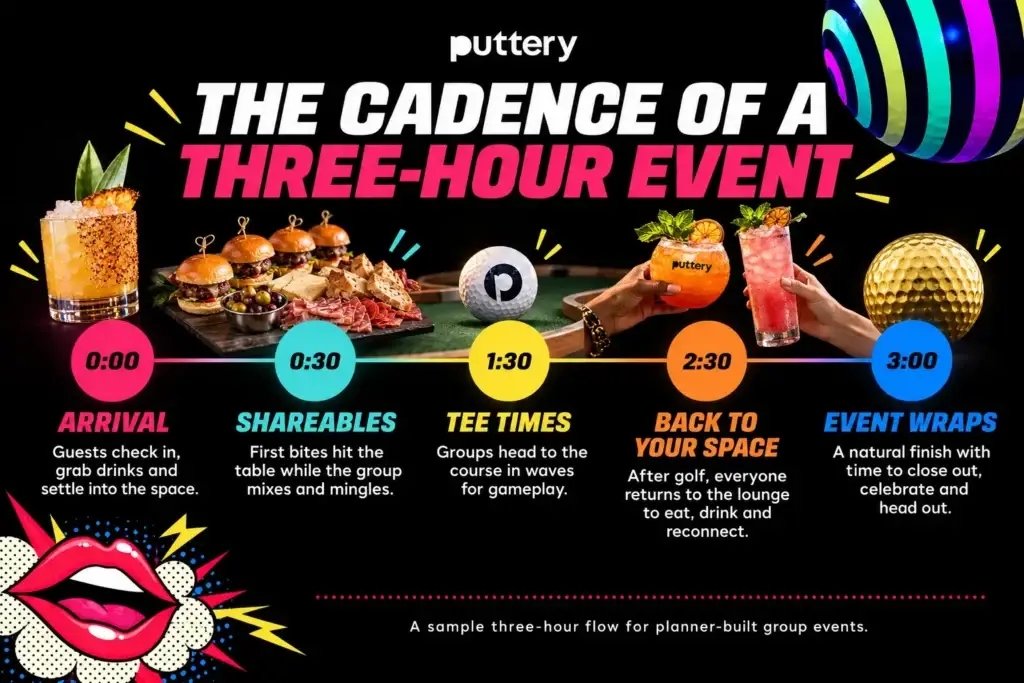
The chips and dips are there on purpose. Guests trickle in, and nobody should walk into cold food. The timeline arrives with your quote, and all of it can move. Golf first and dinner after, tee times an hour in, a toast at 7:15. Tell us.
The one mistake we see is sending everyone to the first tee at once. Split into foursomes before you arrive and send a few at a time. Your planner maps the waves with you.
It’s the part hosts worry about most and mention first afterward. “I was worried about day-of logistics since we had such a big group,” wrote the organizer of a 50-to-70-person corporate event in New York, who went on to credit the staff for “informing people about the drink packages and tee times” (Chloe Lee, Google, 2024). Another host this September: “Great balance of flex social networking time and organized game play” (Avery Chung, Google, September 2026).
The menu gets built around your group
The most common wrong guess about us is the food. Amanda hears the same sentence after events, always with an apology attached: “I hope you’re not offended by this, but we were really surprised at how good the food was.”
Nobody’s offended. Every venue runs a scratch kitchen, and Keith has the line we wish we’d written: “There are mini golf places that have food. And we’re a venue with food and beverage that has mini golf.”
Online, you choose from a few preset packages. With a planner, the whole event menu is on the table, and two words on it need translating:
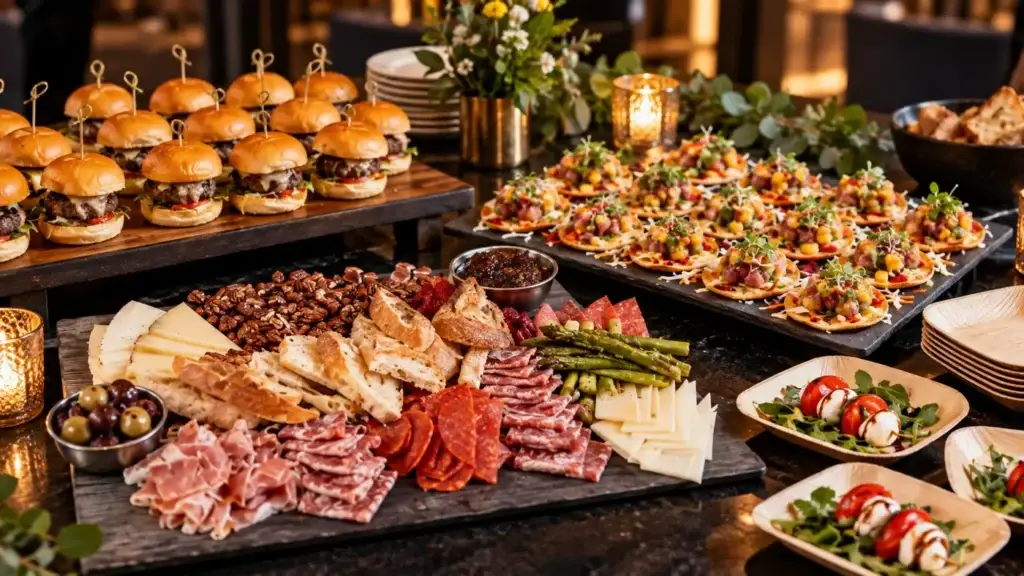
- Shareables are heavy appetizers such as sliders, wings, spring rolls and boards. They’re set on a food station by your space, not passed on trays and not crowded onto your cocktail tables.
- Stationary means dinner: entrées such as filet, chicken, salmon and pasta, plus sides, served from a station.
- Themed stations include a taco bar, barbecue, Italian and Mediterranean. In December, venues add carving stations and pasta cooked to order in front of guests.
All of it is cocktail-reception style: some seats, some standing, people moving between the food, the bar and the course.
Event food is portioned per guest, so the most useful thing you can tell your planner is who’s coming. A team arriving straight from work at 6:00 eats differently than a client reception at 3:00. If your crowd has big appetites, we’ll point you toward barbecue, the taco bar or Italian, which hold up better for a hungry line than filet does. The add-on hosts most often wish they’d said yes to is more food.
Planners ask about dietary needs up front, and the kitchen keeps an allergen guide by menu item. For a guest with a serious restriction, we order that guest’s meal ahead from the regular menu and a server walks it to them. One Houston guest at a team building event wrote that “one of my co-workers has a gluten allergy. Chef went out of his way to make a delicious gluten-free dish for him and came out to talk to us” (Alexis Sassard, Google, February 2026).
What we can’t do: our kitchens are not kosher certified, and we won’t pretend otherwise. One shared kitchen means cross-contact. Last-minute religious dietary requests can’t be met on the night. With notice, we’ll tell you exactly what we can do.
The bar and the bill fit your company
There are four ways to run the bar, and a planner can set up any of them where state law allows:
- Hosted on consumption. A tab opens when your event starts, and you pay for what guests actually order. You can cap the total, or cap the price per drink.
- Drink tickets. Built for companies with a policy. Two per guest is a common ask, then guests buy their own. Tickets come in tiers: beer and wine, house, call and premium. There’s a non-alcoholic beverage package too.
- A bar package by the hour. Priced per guest for two or three hours, in the same tiers, paid in advance. No tab at the end.
- Guests pay their own. Common for social events, usually against a food and beverage minimum.
Which one is right depends on the day and the crowd. A Tuesday lunch usually does better on consumption. A Friday night holiday party usually does better on a package. Your planner will ask what your bar tabs have looked like before and do the math with you.
Ask for two things: the brand list for each tier, and the all-in total. We quote upgrades as a total, not per person, because the total is the number finance sees.
Zero-proof cocktails are on every menu, every day. If your group includes guests under 21 or people who don’t drink, tell your planner, and their drinks get built into the plan.
The paperwork is simple: one agreement and one invoice, with a W-9 and certificate of insurance if your company needs them.
Plans change. That’s fine.
People drop. Plus-ones appear. The VP decides she’s coming after all. With a planner, headcount, menu and timing can move until your final details are due. Final guest count, menu and payment are due seven to ten business days before the event; book inside that window and it’s paid in full up front, with no changes after.
“They were so accommodating with our dietary needs and stayed flexible even when we had last-minute adjustments,” a New York organizer wrote after a corporate outing (Julie Kosmynka, Google, March 2026).
Every offer runs through a planner
We run an offer most months, and a separate early-booking offer for holiday parties. Both live on our site, on the seasonal offers page and the holiday events page. What neither page can do is apply the offer to an online booking, because the online checkout has no place to enter one. Every offer we run is applied by a planner, on your quote, before you sign.
So if you’re comparing the two buttons on price, the answer is simpler than it looks. The best deal we have at any given time is only available through a planner. Tell them your date and headcount, ask what’s running, and they’ll tell you what you qualify for. The offers change, and each has its own terms, so ask rather than assume.
The extras that make it yours
Sierra Youngblood, our regional director in Charlotte, has a line she uses on every call: “It’s never a no. It’s a how.” The hows we get asked for most:
- Your logo, a slideshow or a presentation on the screens, and a microphone for the toast.
- A signature cocktail, renamed for your team or built from scratch by the bar.
- Scorecards with your logo at some venues, for teams that want the rivalry to follow them back to the office.
- Outside vendors: DJs, photo booths, caricature artists, calligraphers.
- Sponsor banners at each hole for fundraisers.
What we aren’t is a ballroom. No stage, no drop-down screen, no theater seating. If the centerpiece of your event is a 45-minute presentation, tell your planner first. A private room, a floor buyout or an off-peak afternoon solves most of it.
When to have it, and how far ahead to call
For work events, the best nights are Tuesday through Thursday, starting around 6:00. People need time to leave the office, cross town, park and find the floor, and an 8:00 start is too late for anyone with a family waiting.
The package is the same on a Saturday. The room isn’t. Weekends run younger and louder. Early in the week, you’re mostly among other work groups, and you can hear each other. One Charlotte organizer noticed: “The music was at a good volume where you could hear it, but you didn’t have to shout to hear each other” (Christina Janek, Google, November 2025).
We can take an event with a day’s notice when space allows. Seventy-two hours is better for the kitchen and the staff, and anything custom wants more than a week. December is its own season. Peak dates in Charlotte are usually gone by late October. Thursdays go first in Chicago. East Coast holiday parties land Monday through Thursday, and Texas fills Fridays and Saturdays first. DJs and photo booths book months out. Holiday events have their own page, and usually an early-booking offer, which your planner applies.
If it’s a work event
Budgets are tight and getting tighter. In Amex GBT’s 2026 Global Meetings and Events Forecast, a survey of 601 meeting professionals, cost was the top planning challenge (38%), and 71% expected cost per attendee to rise. That’s why we lead with the all-in total, not the per-person price.
Three things that make a work event go better:
- Name your on-site host. The person who books is often not the person who shows up. Tell us who’s running the night and forward them the timeline, so nobody walks in expecting a different event.
- Say what the event is for. We build a team outing around structure and play. We build client entertaining around food and drink. “Group outing” on the form tells us neither.
- Bring your other quotes. If another venue offered you something, tell us. We’d rather build to it than guess.
People who plan events for a living tend to agree with the approach. When Connect NYC offered a room full of professional meeting planners a team outing, it was at Puttery New York City. And from a Kansas City team: “So accommodating and patient with our group” (Andrew Diegel, Google, February 2025).
Planning for a team: contact a planner with your date range, headcount and budget. City guides: Chicago, Dallas, Houston, New York City. For formats your team will actually show up for, read Team Building Nobody Calls Team Building.
If it’s a birthday, a shower or a reunion
Nine friends is enough for a planner, and social hosts get the most out of one, because it’s your own money on the line. Friends flake. With a planner, your headcount can move until final details are due. And if you’d rather not pay for everyone, we can hold your space against a food and beverage minimum and let guests pay their own tabs toward it.
- Cake: bring one. It has to come from a bakery or a grocery store. “It can’t be grandma’s cake,” Keith says. Health code, not snobbery. Cutting fees vary by venue, so ask.
- Decor: tabletop is fine. Nothing goes on the walls, so no tape and no adhesive strips. Bring a pop-up banner. Balloon setups can be added.
- Swag and vendors: welcome, with notice.
More ideas in our adult birthday guide.
Puttery vs. the competition: what to ask any venue
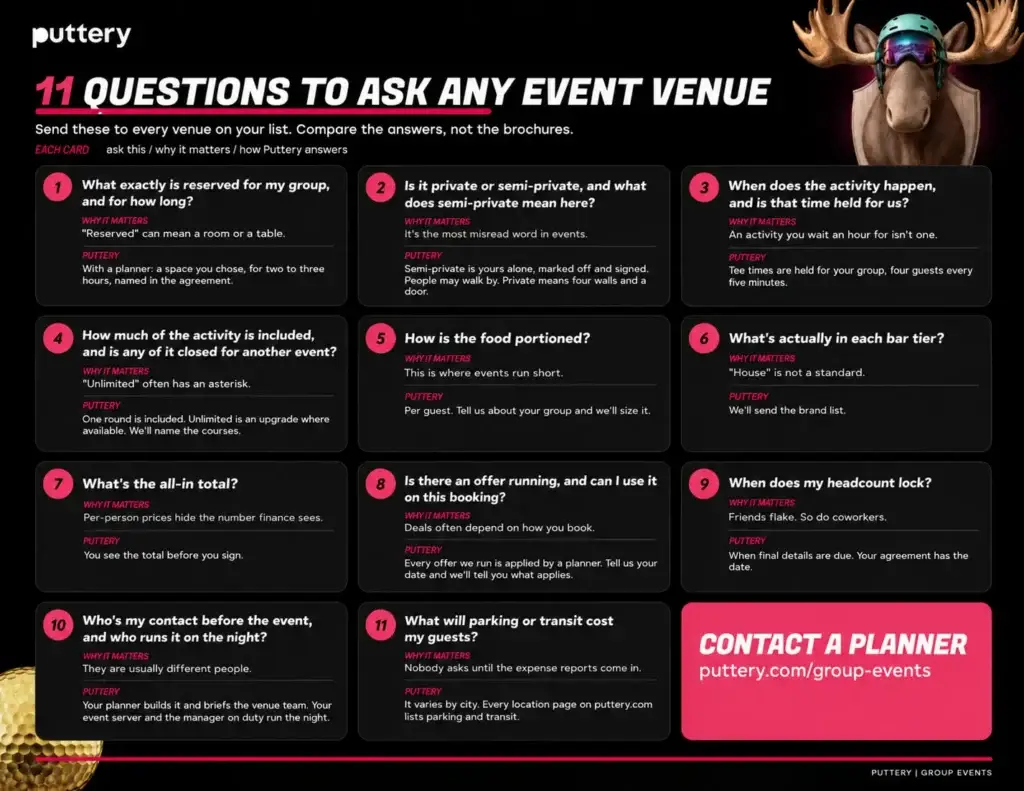
Most activity venues have the same two buttons we do. Send these questions to every venue on your list and compare the answers, not the brochures. Ours are in the right-hand column.
| ASK THIS | WHY IT MATTERS | OUR ANSWER |
|---|---|---|
| What exactly is reserved for my group, and for how long? | “Reserved” can mean a room or a table. | With a planner: a space you chose, for two to three hours, named in the agreement. |
| Is it private or semi-private, and what does semi-private mean here? | It’s the most misread word in events. | Semi-private is yours alone, marked off and signed. People may walk by. Private means four walls and a door. |
| When do we play, and is that time held for us? | An activity you wait an hour for isn’t one. | Tee times are held for your group, four guests every five minutes. |
| One round or unlimited, and on which courses? | A course can be closed for another event. | One round is included. Unlimited is an upgrade where available. We’ll name the courses. |
| How is the food portioned? | This is where events run short. | Per guest. Tell us about your group and we’ll size it. |
| What’s actually in each bar tier? | “House” is not a standard. | We’ll send the brand list. |
| What’s the all-in total? | Per-person prices hide the number finance sees. | You see the total before you sign. |
| Is there an offer running, and can I use it on this booking? | Deals often depend on how you book. | Every offer we run is applied by a planner. Tell us your date and we’ll tell you what applies. |
| When does my headcount lock? | Friends flake. So do coworkers. | When final details are due. Your agreement has the date. |
| Who’s my contact before the event, and who runs it on the night? | They are usually different people. | Your planner builds it and briefs the venue team. Your event server and the manager on duty run the night. |
| What will parking or transit cost my guests? | Nobody asks until the expense reports come in. | It varies by city. Every location page lists parking and transit. |
And sometimes we’re not the right venue. If you need a ballroom with a stage and theater seating, a seated and plated dinner for every guest, or a certified kosher kitchen, a hotel or a caterer will serve you better. If your team voted for a different game, go play it: darts at Flight Club, full swings at Topgolf, a ball that keeps score for you at Puttshack. An independent directory, Mini Golf Spots, framed that last comparison as “whether your group cares more about the game or the atmosphere around the game.” Fair enough. We’re the atmosphere, the kitchen and the bar, with a very good game attached.
What hosts say afterward
We searched every public review we’ve received since our first venue opened in 2021: 29,094 written reviews across Google, Yelp, TripAdvisor and Facebook, through September 15, 2026. We pulled every one that mentions a work event (corporate, team building, holiday party, coworkers, clients). That’s 901 reviews, averaging 4.49 out of 5, with 87% at four or five stars. The average has climbed every year: 4.24 in 2022, 4.27 in 2023, 4.54 in 2024, 4.60 in 2025, and 4.65 so far in 2026.
About one in eleven gave one or two stars, and we read those twice. They cluster around four things: waits, communication, billing and mix-ups about space. Every one of those is a problem a conversation solves before the event. That is the whole case for a planner.
Talk to a planner
Bring three things: your headcount, the occasion, and how you want the tab to work. We’ll bring the space, the timeline and the questions you haven’t thought of yet.
Whatever offer is running this month is on the seasonal offers page, holiday offers are on the holiday events page, and both are applied by your planner. The basics are in our FAQs.

About this guide: built from interviews conducted in September 2026 with Ken Kitchen, National Director of Event Sales, New York City; Sierra Youngblood, CPCE, Regional Director of Event Sales, Charlotte; Amanda Woods, Director of Event Sales, Chicago; and Keith Nadal, Regional Director of Event Sales, Houston. The CPCE is the National Association for Catering and Events’ professional certification, held by just over 330 people in the industry.
Is Puttery’s Eat & Play Combo Worth It? What One Price Actually Buys
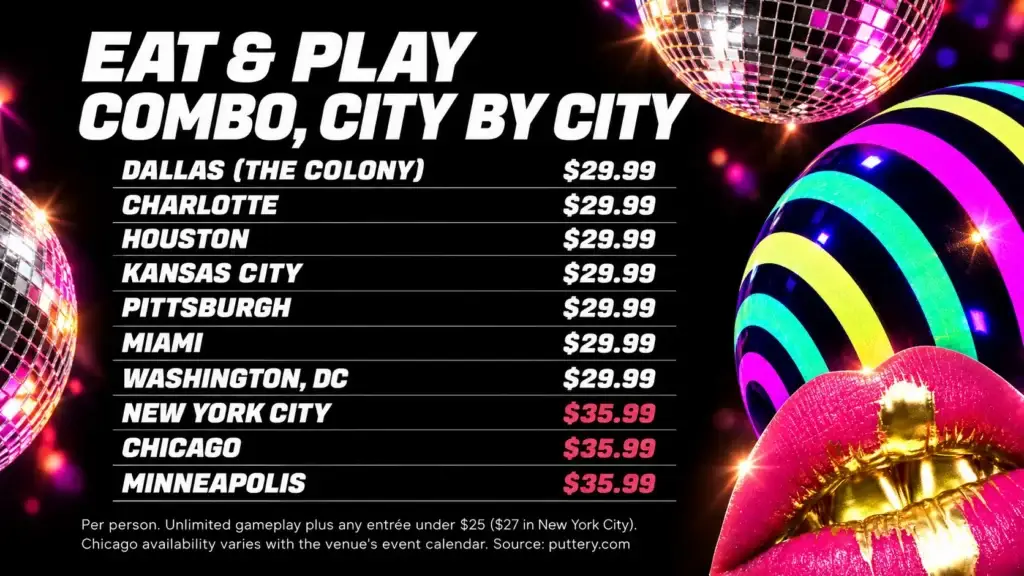
The short answer: yes, and not because it is cheap. For one price you get every course in the building, every round you want, no clock, and a real dinner from the scratch kitchen, in one place, on one check. Most nights out charge you twice, once for dinner and once for whatever comes after. This one doesn’t. The numbers: in seven of our 10 cities, unlimited mini golf is $25 and for $4.99 more dinner is included. That is the Eat & Play Combo, $29.99 per person. It is $35.99 in New York City, Chicago and Minneapolis, where the play alone is $32 in New York and the entrée cap is $27. Every day the venue is open, from open to close, at nine of our 10 locations. Chicago runs it around its event calendar; see the note under the city table.
If you want to putt one course and leave, buy the single-course ticket instead. Everyone else, keep reading.

What one price buys
Value is what you get in exchange for what you give up, and on a night out the thing you give up is rarely only money. It is the drive between the restaurant and whatever comes after. The second wait for a table. The 90-minute session that turns dinner into a race. Here is the trade, in full.
| WHAT YOU GIVE UP | WHAT YOU GET |
|---|---|
| $29.99 per person ($35.99 in New York City, Chicago and Minneapolis) | Every course at your location, in any order, as many times as you want |
| One reservation, or a walk-in | No clock and no per-round charge |
| The second stop | Any entrée under $25 from the scratch kitchen ($27 in New York) |
| The second wait, the second parking spot, the second check | The bar a few steps from the last hole, and a night that runs at the table’s pace instead of a timer’s |
“Most nights out charge you twice: once for dinner and once for whatever you do after. The Eat & Play Combo is one price for both. Unlimited play on every course, no clock, plus a real entrée from our scratch kitchen, starting at $29.99 a person. In most of our markets that’s less than five dollars more than the play alone, so at that point dinner is practically on us. This isn’t a limited-time promotion. It’s how we think a night out should be priced,” says Kyle Rickman, President and Chief Operating Officer.
There is no end date on it. It is the price.
What is the Eat & Play Combo?
The Eat & Play Combo is Puttery’s standing offer that bundles unlimited mini golf with one entrée for a single per-person price. Unlimited means every course in the building, in any order, as many times as you want, at whatever pace your table sets. The entrée is anything on your venue’s menu under $25 ($27 in New York City). Drinks, shareables and dessert are separate.
It launched in March 2026 at all 10 locations. It replaced a $40 package that bundled a shareable, an entrée and gameplay, which guests liked less than we hoped, mostly because nobody enjoys being told what to order. So we cut the price, dropped the forced shareable and let you pick the plate. A Dallas guest reviewed it on launch day: “it came with any entree under $25 and you can use that deal anyday of the week” (Google, Puttery Dallas, March 2026)
Puttery is a social destination that reimagines indoor mini golf around larger-than-life themed courses, a scratch kitchen and a full craft bar. Every hole is a world you step into, not just play through. The combo is the simplest way to buy the whole idea at once.
Find your city and book the Eat & Play Combo >
How much is the Eat & Play Combo in each city?
The Eat & Play Combo is $29.99 per person at seven Puttery locations and $35.99 at three. Prices are per person, before drinks, tax and tip; each venue sets its own, and these were current as of September 2026. Kids’ unlimited gameplay is $15 at every location, and kids meals are $10 at most ($12 in New York City), so a kid eats and plays for about $25.
| CITY | EAT & PLAY COMBO | BOOK IT |
|---|---|---|
| Dallas (The Colony) Grandscape 4 courses: Rooftop, Lodge, Library, Illusion |
$29.99 Just unlimited play: $25 Entrée cap: under $25 |
Book the combo |
| Charlotte South End 2 courses: Conservatory, Library |
$29.99 Just unlimited play: $25 Entrée cap: under $25 |
Book the combo |
| Houston Sawyer Yards 3 courses: Conservatory, Lodge, Library |
$29.99 Just unlimited play: $25 Entrée cap: under $25 |
Book the combo |
| Kansas City Country Club Plaza 3 courses: Art Museum, Conservatory, Rooftop |
$29.99 Just unlimited play: $25 Entrée cap: under $25 |
Book the combo |
| Pittsburgh Strip District 3 courses: Garage, Library, Lodge |
$29.99 Just unlimited play: $25 Entrée cap: under $25 |
Book the combo |
| Miami Wynwood 3 courses: Rooftop, Lodge, Library |
$29.99 Just unlimited play: $25 Entrée cap: under $25 |
Book the combo |
| Washington, DC Penn Quarter 3 courses: Art Museum, Conservatory, Illusion |
$29.99 Just unlimited play: $25 Entrée cap: under $25 |
Book the combo |
| New York City Meatpacking District 2 courses: History Museum, Lodge |
$35.99 Just unlimited play: $32 Entrée cap: under $27 |
Book the combo |
| Chicago* Fulton Market 2 courses: Library, Lodge |
$35.99 Just unlimited play: $25 Entrée cap: under $25 |
Check availability |
| Minneapolis North Loop 3 courses: Library, Conservatory, Art Museum |
$35.99 Just unlimited play: $25 Entrée cap: under $25 |
Book the combo |
*Chicago is the asterisk. Fulton Market’s event calendar decides whether the combo is on, and lately the calendar usually wins. Check the Chicago booking page or talk to the front desk upon arrival. Unlimited play at $25 and the full menu are there regardless.
Is the Eat & Play Combo actually a good deal?
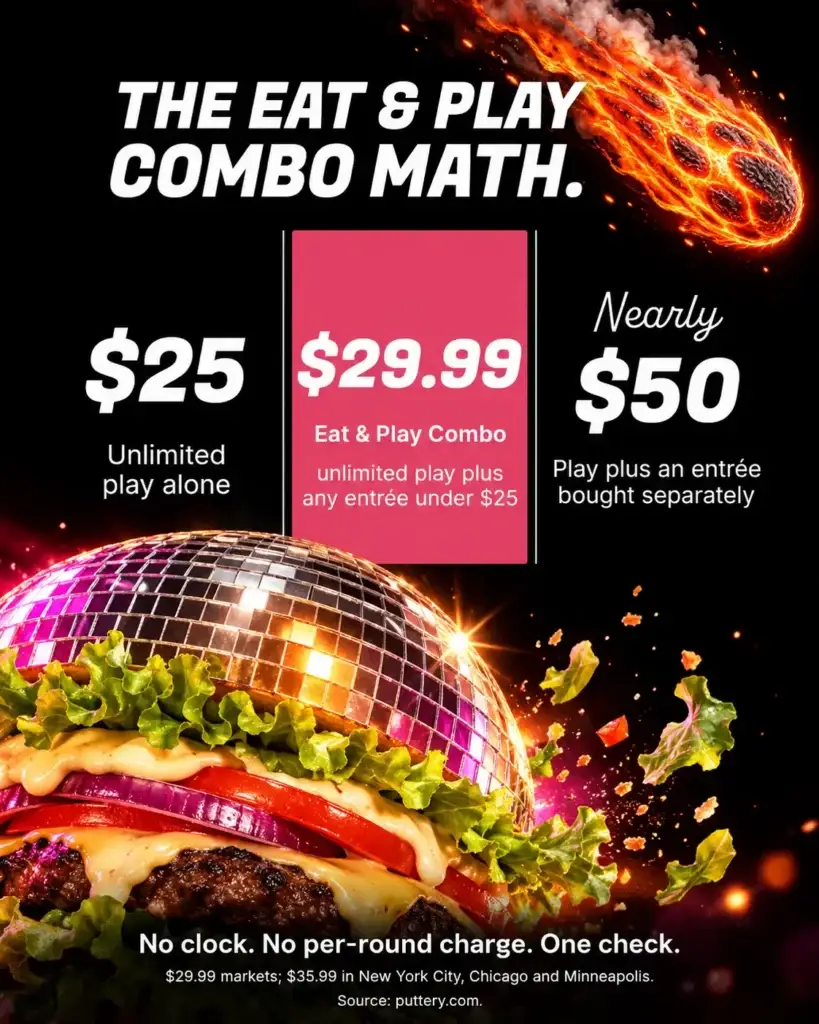
Dinner is the upgrade. In eight of our 10 cities the entrée costs you less than $5 on top of the play. In the other two it costs $10.99, which is still less than the plate alone. Run the numbers, then we can argue about what value means.
| PER PERSON | BOUGHT SEPARATELY | EAT & PLAY COMBO |
|---|---|---|
| Dallas, Charlotte, Houston, Kansas City, Pittsburgh, Miami, Washington, DC | Nearly $50 Unlimited play alone: $25 Plus an entrée at the top of the range |
$29.99 The entrée costs you: $4.99 Two people: $59.98 |
| New York City | Nearly $59 Unlimited play alone: $32 Plus an entrée at the top of the range |
$35.99 The entrée costs you: $3.99 Two people: $71.98 |
| Chicago, Minneapolis | Nearly $50 Unlimited play alone: $25 Plus an entrée at the top of the range |
$35.99 The entrée costs you: $10.99 Two people: $71.98 |
In seven cities the combo costs $4.99 more than the play alone, and a full entrée is what you get for it. In New York the gap is $3.99. Chicago and Minneapolis pay $10.99 over the play, which is still less than any of the qualifying plates costs on its own. Two people get dinner and an entire evening for under $60 in the $29.99 markets, before drinks, tax and tip, and they can keep playing after the plates are cleared. No time limit.
That is the arithmetic, and it is only two thirds of the story. Deloitte’s 2026 restaurant research found that price explains about two thirds of what diners perceive as value; the rest is quality, service and how well the night is run. A combo that keeps dinner and the evening under one roof, with no clock, does its work in that other third.
It also arrives at a moment when people are counting. The National Restaurant Association’s Q3 2026 consumer survey found restaurants are still the top discretionary purchase, and that 40% of consumers used more value promotions than usual last quarter, up from 35% the quarter before. EY-Parthenon’s June 2026 survey found only one in four Americans feel very confident about their finances, and more than 30% are rethinking what they spend on leisure and entertainment. Nobody is cancelling nights out. They are asking each one to earn its place.
Book the Eat & Play Combo in your city >
What does “unlimited, no time limit” mean in practice?
It means the clock is not part of the deal. A nine-hole course takes most groups about 30 minutes. Every Puttery runs a lineup of two to four courses drawn from eight worlds (Library, Lodge, Conservatory, Art Museum, Rooftop, Illusion, History Museum and Garage), and no two locations run the same set. That is 28 courses and 252 holes across the system, and not one of them is on a timer. Dallas has four. Play all of them, then go back and play the one that beat you. Stop for the entrée whenever the table is hungry: before, between or after. Servers bring drinks to you on the course. Food stays in the dining and lounge areas so the greens stay clean.
Digital scorecards keep score for up to four names at a time, so bigger groups split into foursomes and race. Tables are first come, first served. Reservations open 21 days out, and walk-ins are welcome; we hold tee times for them.
A Dallas guest on a girls’ night summed it up: “there is no time frame of completing it, just check in at your time” (Google, Puttery Dallas, June 2026). That is the whole difference between this and a timed lane, bay or session. The meal is not eating into your slot, because there is no slot.
Which entrées qualify for the Eat & Play Combo?
Any entrée under $25 on your venue’s menu, or under $27 in New York City. Not a snack. Not a sample. A plate off the regular menu. Menus vary by city, so the exact list depends on where you are. A few plates sit on the menu at nearly every Puttery and qualify everywhere they are served:
- Double Smashburger (every location; the build varies in Chicago and New York)
- Fried Chicken Sandwich
- Classic Margherita Pizza
- Green Goddess Cobb
- Chicken Caesar
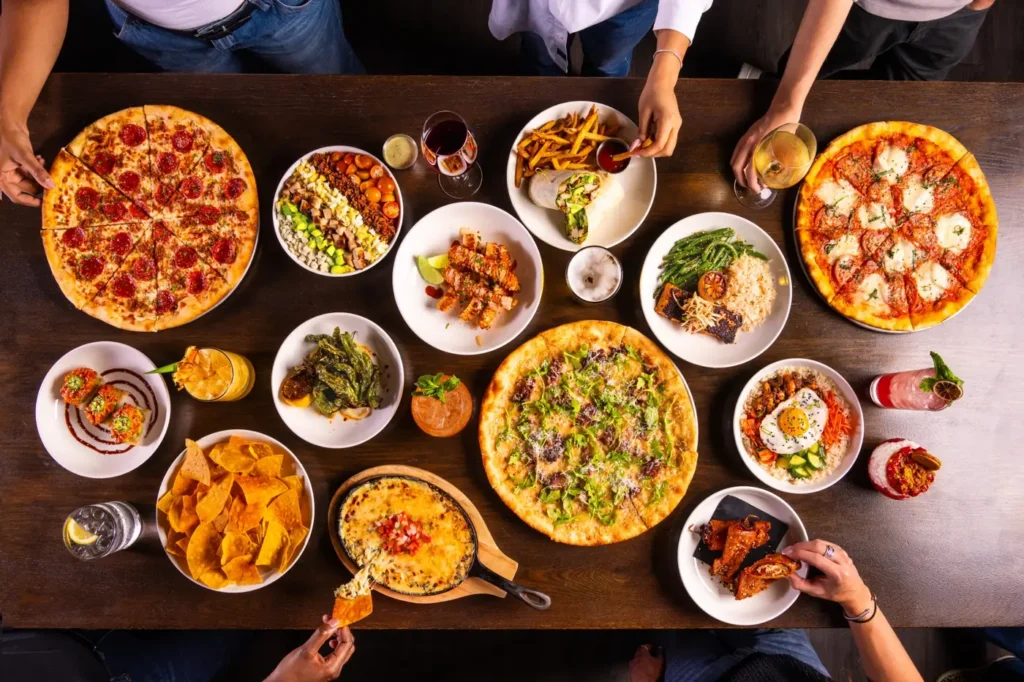
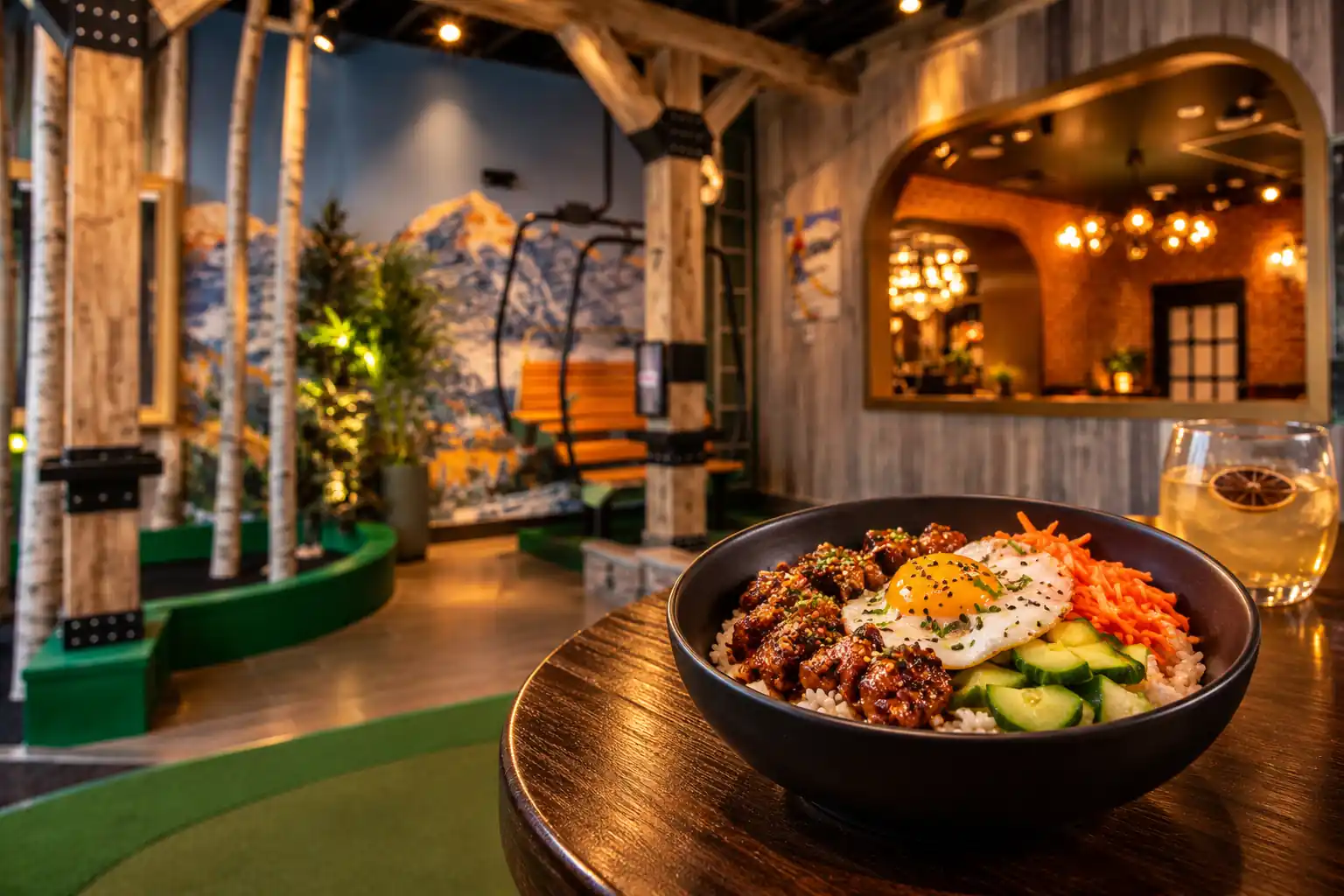
At most locations the list runs deeper. The Miso Salmon and the Sausage & Hot Honey Pizza are on eight of 10 menus, the Creamy Cajun Alfredo is on seven, and the Korean Power Bowl is on six (Charlotte, Dallas, Houston, Kansas City, Pittsburgh and Washington, DC). Miami and New York run market-specific menus with their own qualifying plates.
“The rule for the combo was simple: nothing on it can feel like the cheap option. The Double Smashburger, the Margherita, the Cajun Alfredo. Those are plates we’d put up against any restaurant in the neighborhood, and they’re all included,” says Koby Grace, Culinary Director.
Our pick is the Korean Power Bowl, where it is served. The reviews vote burger, loudly, in Miami and Houston. Both are right. Vegetarian, vegan and gluten-free options are on every menu and the kitchen can swap many ingredients, so tell your server what you need. One thing worth knowing: extras are extra. Added protein on a salad or a side swap can push a plate past the line, and the difference goes on the check.
The bar is open
Drinks are not in the combo, and we would rather say that plainly than bury it in the fine print. What is a few steps from the last hole: a full craft bar, a rotating Hometown Hero cocktail created by a bartender in your city and poured nowhere else, local drafts, and a zero-proof list worth ordering twice. Order from the course and a server will find you.
Who is the Eat & Play Combo for?
Anyone who wants dinner and something to do without planning two stops.
Date night, first or fiftieth. More than 75 guest reviews since the combo launched mention date night, and they average 4.9 stars (source: our reviews across Google, Yelp and other platforms through September 15, 2026). “We went for date day and did the all you can play and eat combo for 30$ per person. Worth it” (Google, Puttery Houston, July 2026). There is science behind the instinct. Researchers at UT Austin, Penn and Cornell tracked 2,635 adults and found people were happier spending on experiences than on things, regardless of what they cost. A dinner you play through counts.
Girls’ night, guys’ night, the group chat that finally picked a date. “We had so much fun on girls night, the Eat and play combo for $29.99 is a great deal per person” (Google, Puttery Dallas, June 2026). Up to eight guests can book online. Nine or more, talk to a planner, who can hold space and build a menu around the group.
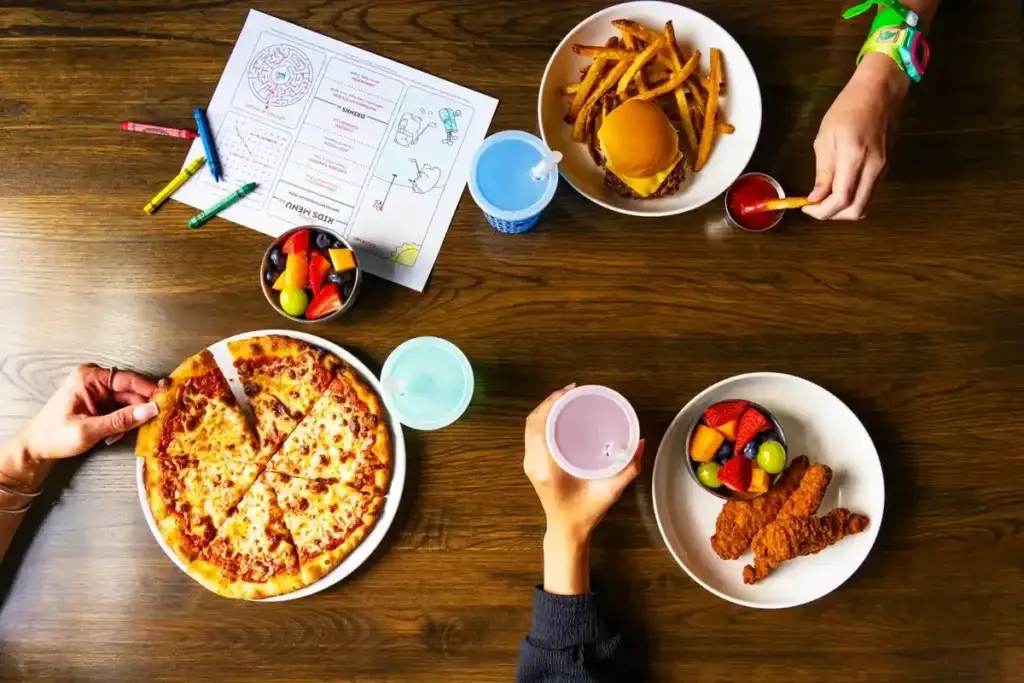
Family day. Kids eat and play for $25. Unlimited gameplay is $15 for guests 17 and under every day of the week, and kids meals are $10 at most locations ($12 in New York City), so a kid’s whole afternoon, every course plus a meal, comes to $25 at most Puttery locations. Two adults on the Eat & Play Combo and two kids come to about $110 for the family, before drinks, tax and tip. “The eat and play combo was a great value for our family of 4” (Google, Puttery Dallas, April 2026). Family-friendly during the day and built for adults at night. The courses don’t change. The vibe does. Evening age minimums vary by city, so check the age policy by location before you book with kids.
A Tuesday, for no reason. The best nights out rarely have an occasion attached, and grown-ups still get to play. The combo is priced like a weeknight, not a milestone.
What to know before you go
Of the 61 reviews that mention the combo since it launched on March 30, 38 are five stars. The ones that are not rarely complain about the deal. They complain about two things, and both are avoidable.
Packed Saturday nights. Unlimited play with no clock is the same deal at 8 pm on a Saturday as at 2 pm on a Wednesday, but the wait between holes is not. A Houston guest was blunt about it: “I recommend coming in the early afternoon, it was basically abandoned. We had the whole place to ourselves” (Yelp, Puttery Houston, April 2026). An independent Charlotte travel blogger reached the same conclusion after a Sunday visit: “I recommend going anytime other than Friday and Saturday night.” We will not argue. Weeknights and early afternoons are when the combo is at its most generous.
Booking and check-in. The Eat & Play Combo reservation is free to make. Tock keeps a card on file to hold it, nothing is charged online, and the combo itself goes on your check at the venue. You can move or cancel it up to an hour before your time from the confirmation email; a no-show or late cancellation is a $10 fee. At the desk, give your name. Your reservation already says Eat & Play Combo, and the team takes it from there; you don’t have to repeat it to anyone. The one thing to get right is on the booking page: the combo is its own listing, separate from Unlimited Gameplay, so pick that one. Guests who booked the play and expected the meal to be inside it ended up with a bigger check than they planned on.
How to get the Eat & Play Combo
- Pick your city at puttery.com/locations. Reservations open 21 days ahead (30 days ahead in Dallas). Walk-ins are welcome, and tee times are held for them, but weekends fill.
- Book the Eat & Play Combo as its own listing. It is a separate reservation type from Unlimited Gameplay, so pick the right one. Or walk in and ask for it at the desk.
- Your reservation time is your check-in time. Give your name at the desk; the reservation already carries the combo, and you will go out on a course as soon as one opens.
- Eat before, between or after. Order the entrée with your server. Shareables, dessert and anything from the bar are extra.
- Keep playing. When the plates are cleared, go find the hole that robbed you.
Three questions to ask of any dinner-and-activity deal
Ours or anyone else’s. If a night-out package cannot answer these three, it is a coupon wearing a bundle.
- Is there a clock? A lane hour, a bay hour or a 90-minute session makes the meal a race and the second round a surcharge. Ask what happens at minute 91.
- Is the food the afterthought? If the “meal” in the package is a basket, it is a snack with a discount stapled to it. Ask to see the list of what qualifies.
- What is the out-the-door number? Per-person price times the group, plus drinks, tax and tip. Ask before you add anything that is not on the list.
The Eat & Play Combo answers no clock, any entrée under the cap, and the price on the table above plus whatever you drink.
What guests say about the Eat & Play Combo
Puttery has collected more than 5,000 guest reviews so far in 2026, averaging 4.8 stars with nearly nine in ten at five stars. The ones that name the combo say it plainly.
- “Had an amazing time here and the eat and play deal is unbeatable.” (Google, Puttery Pittsburgh, June 2026)
- “Amazing prices especially the Unlimited play/Entree combo. Worth every penny” (Google, Puttery Dallas, August 2026)
- “We bought the combination food/ golf package which is a great value. The mini golf was fun, three short courses. But the real takeaway was that the food was OUTSTANDING.” (Google, Puttery Kansas City, June 2026)
- “Food was surprisingly good. Burgers, pizza and shrimp all great. The house catsup was really nice. We didn’t go in expecting much since it was a mini-golf place but boy were we surprised. It’s worth going there just for the food and drinks.” (Google, Puttery Dallas, September 2026)
- “Unlimited play. And the food and drinks were phenomenal for not being the main attraction” (Google, Puttery Kansas City, August 2026)
- “A really great deal of $60 for 2 entrees and unlimited golf play, we had fun in both the Library and the Conservatory courses.” (Google, Puttery Charlotte, August 2026, four stars)
- “this is the best smashed burger i have had in wynwood, and the mini golf was soo fun. I will be coming back, especially for the $30 eat and play deal” (Google, Puttery Miami, August 2026)
Come check their math.
Pick your city. Bring the whole appetite.
Every course, every round, one real meal, one price, no clock. Book the Eat & Play Combo at your Puttery, or walk in and ask for it at the desk.
Eat & Play Combo: only entrées under $25 qualify ($27 in New York City). Cannot be combined with other offers, including coupons. Offer subject to change. Restrictions may apply. Pricing and offers vary by location. See venue for details.
Frankenstein’s Mad Scientist Cocktail Lab Is Back at Puttery
Short answer: Frankenstein’s Mad Scientist Cocktail Lab is a 21+ Halloween pop-up bar from Bucketlisters, and for the second year it lives inside Puttery in Chicago, Houston, New York City and Washington, D.C. It runs September 24 through October 31, 2026, Wednesday through Sunday, in 90-minute seatings that start at 6 pm. A ticket covers your seat and one interactive welcome drink. It does not cover mini golf. Tickets are sold only through Bucketlisters and start at $20.35 per person, including fees. Unlimited mini golf, additional themed cocktails, and themed food can be bought onsite.
Buy tickets on Bucketlisters:
What is Frankenstein’s Mad Scientist Cocktail Lab?
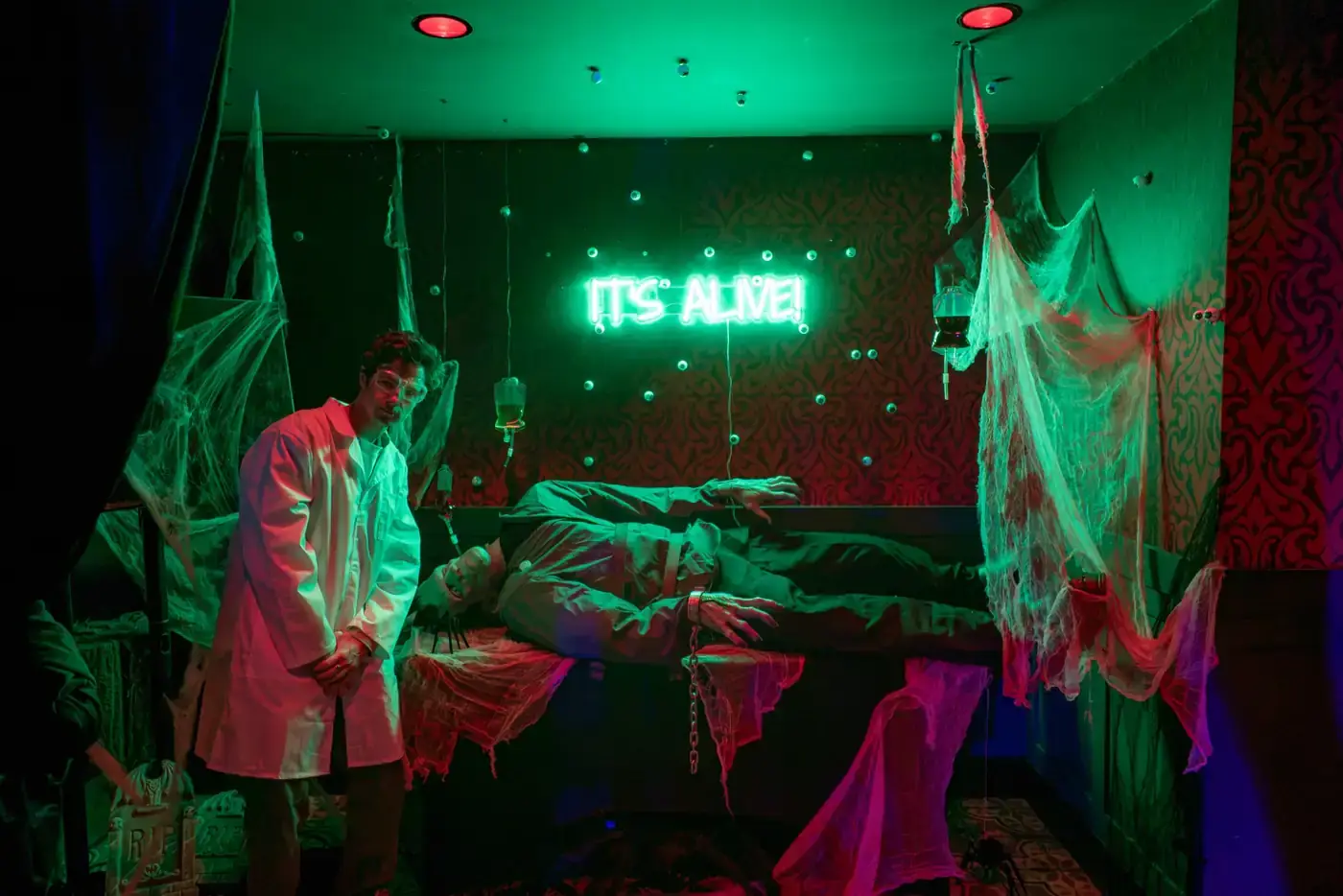
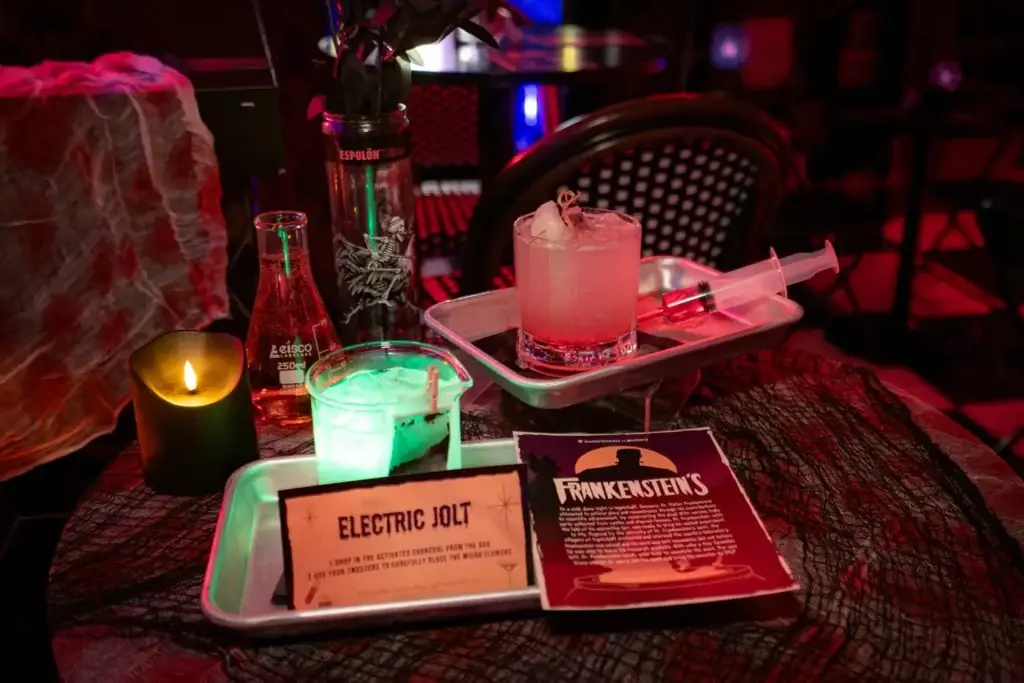
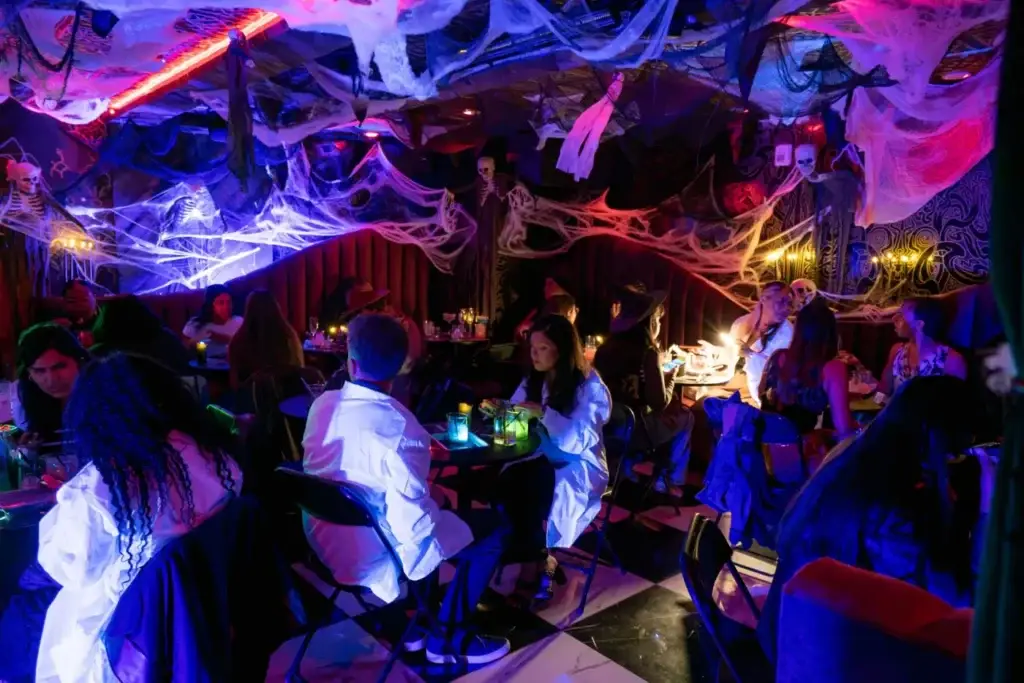
Frankenstein’s is a ticketed cocktail experience: a bar dressed as Dr. Frankenstein’s laboratory, where the drinks arrive on surgical trays with the last step left for you. You pour the charcoal. You stir with the dry ice. You add the lemon that changes the color of the gin. Bartenders in lab coats run the room, the monster is laid out on a table under an “It’s Alive” sign for your photos, and the food menu has names like Blackout Nachos and the Grey Matter Sundae.
Bucketlisters created the concept and runs it in cities around the country every fall. In four of them, the lab is built inside a Puttery venue, and our bartenders and our scratch kitchen do the pouring and the cooking. Last fall was our first year hosting it. This fall it is back in the same four cities, with a food menu that changes by city and the same rule as before: your drink is the experiment.
Where is Frankenstein’s, and which room is it in?
Each venue gives the lab its own space, so you are not squeezed next to a tee time. Tickets are city-specific, so buy the right one.
| CITY | PUTTERY VENUE | THE LAB IS IN |
|---|---|---|
| Chicago | 932 W Randolph St, Fulton Market | The Parlor and the Study |
| Houston | 1818 Washington Ave, Sawyer Yards | The entire first floor |
| New York City | 446 W 14th St, Meatpacking District | Rojo Room, our underground supper club |
| Washington, D.C. | 800 F St NW, Penn Quarter | The Upper and Lower F Street bars |
When is Frankenstein’s open?
September 24 through October 31, 2026, Wednesday through Sunday, from 6 to 11 pm. There are five seatings a night: 6:00, 6:45, 7:45, 8:30 and 9:30 pm. Each seating is 90 minutes and each one is capped, so expect Fridays, Saturdays and the last week of October to sell out first. If your group only works on a Saturday, buy now and argue about the time later.
What does a Frankenstein’s ticket include?
General admission covers:
- 90 minutes of open seating in the lab
- One interactive welcome drink, cocktail or zero-proof
- The photo ops, including the monster on the table
- Access to the full lab drink menu and the themed food menu, all available to order
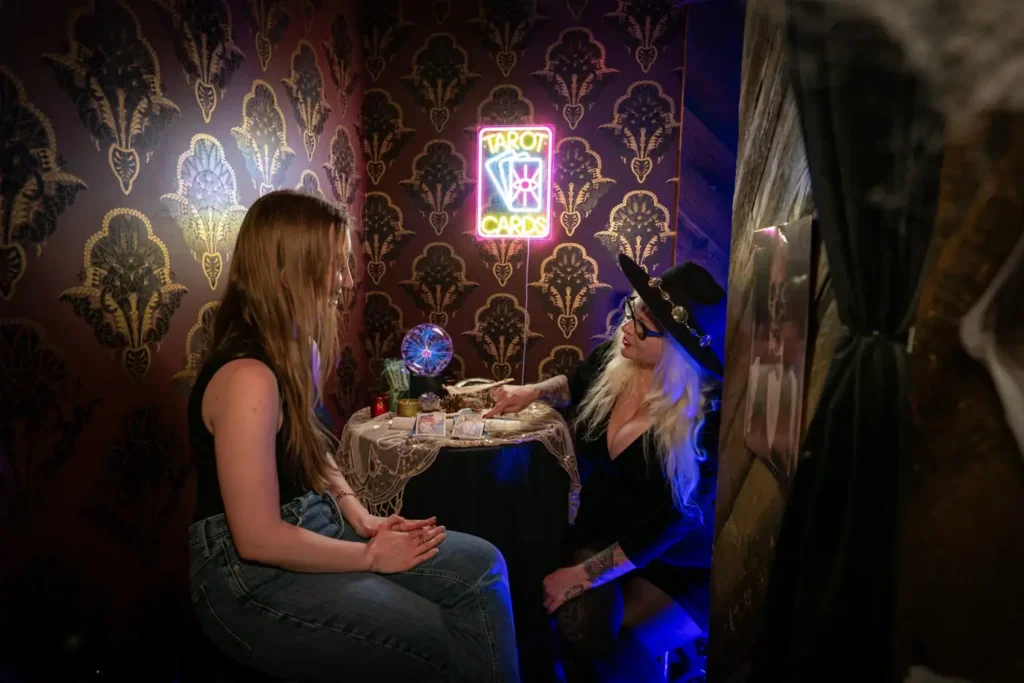
It does not cover mini golf gameplay, extra drinks, or food. Tarot readings are offered on-site for an additional cost. Everyone needs to be 21 or older with a valid ID, including the person ordering the zero-proof version. Tickets are sold only through Bucketlisters, and any refund request goes to Bucketlisters, not to the venue.
How do the welcome drinks work?
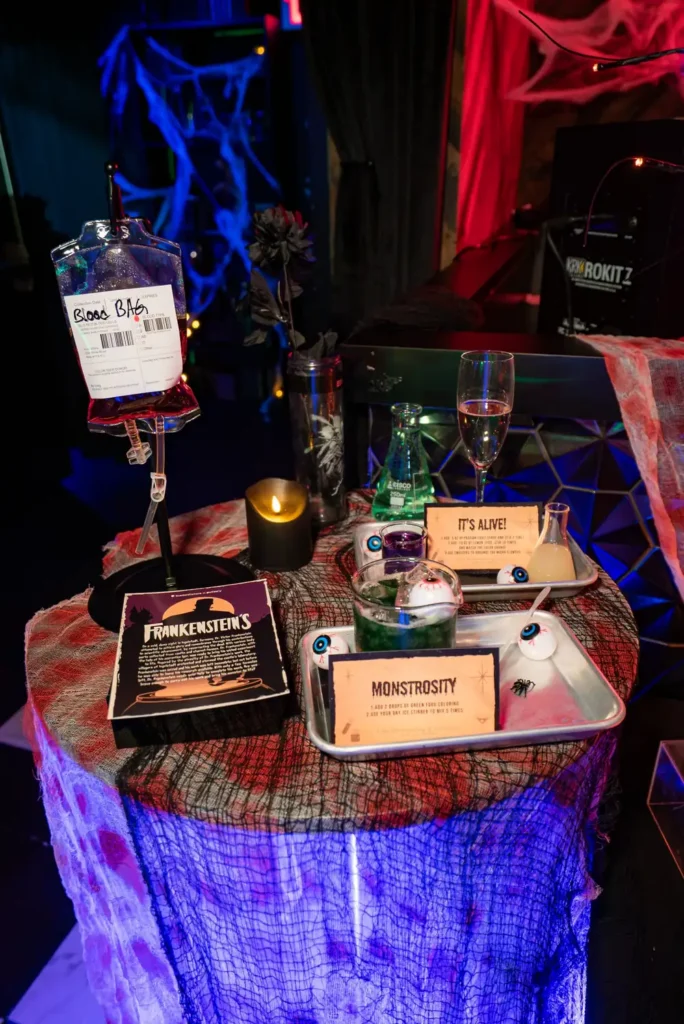
You pick one of three. All of them show up on a metal surgical tray, and all of them need you to finish them.
Electric Jolt. Blanco tequila, triple sec, lime and simple syrup over pebble ice in a glass beaker. It comes with a packet of activated charcoal and a glow-in-the-dark swizzle stick loaded with dry ice. Pour the charcoal in, stir with the dry ice, and watch the whole thing go dark and start smoking. This is the one people film.
It’s Alive. Prosecco with edible glitter in a champagne flute, next to a small beaker of color-changing gin and simple syrup and an Erlenmeyer flask of lemon juice. Pour the gin, then the lemon, and the color shifts in the glass. It also comes as a zero-proof version, so the designated driver still gets an experiment
Monstrosity. Rye whiskey, fig liqueur, cinnamon syrup and two kinds of bitters over pebble ice in a beaker, finished green, with a dry-ice stirrer so you can swirl the color in yourself. The whiskey drinker’s answer to a Halloween cocktail.
Our pick: the Electric Jolt for the show, It’s Alive for the photo, the Monstrosity if you think tequila and prosecco are for other people.
What else is on the lab menu?
Once the welcome drink is gone, the rest of the menu is where the bar teams had fun. Prices are on the menu in the lab. Everything here is available to order during your seating.
- Igor. Aged rum, absinthe, orgeat, grenadine, lime, grapefruit, cinnamon syrup, bitters and ginger beer over pebble ice. It arrives covered and filled with smoke, gets unveiled at your table, and you stir it to reveal the color.
- Blood Bag. Vodka, cranberry, hibiscus syrup and apple juice served inside a blood bag hanging from a display stand, with a beaker of pebble ice for the transfusion. Built for the photo.
- Deadly Dose. Citrus vodka, elderflower liqueur, lychee and lemon over pebble ice, with a syringe of grenadine on the side. You can swap the syringe for a strawberry gelatin shot.
- Divination. Mezcal and blanco tequila with blue curaçao, orgeat and lime in a sugar-rimmed coupe, plus a pipette of mole bitters to finish it yourself.
- The shots. Reanimator (vodka, sour apple, blue curaçao, grenadine, apple juice, gummy ring), Lightning Bolt (reposado tequila, melon liqueur, lime, charcoal-salt rim), Voltage Shot (rum, hibiscus, pineapple, gummy worm or eyeball), Franken Shot (peach liqueur layered with Irish cream and a splash of grenadine), and the Blood Shot, a strawberry gelatin shot in a capped syringe. Order the first four together as the Fright Flight and let the table fight over the eyeball.

What is on the Frankenstein’s food menu?
Six dishes are on the menu in all four cities, then each kitchen adds its own. Everything on it is available to order during your seating, which matters more than it sounds: 90 minutes goes fast, and nobody wants to leave for dinner halfway through.
| DISH | WHAT IT IS | WHERE |
|---|---|---|
| Firebolt Frankenwings | Wings in green buffalo sauce with a “radioactive ranch antidote” | All four |
| Radioactive Spinach Sludge Dip | Neon-green spinach artichoke dip bubbling in a mini cauldron, black tortilla chips | All four |
| Blackout Nachos | Charred black chips, queso blanco, black beans, pico, green tomatillo slime and a beet crema drizzle | All four |
| Slime Fries | Crispy potato spikes under green garlic herb cheese sauce and radioactive ranch | All four |
| The MonsterSmash Burger | Double patties, American cheese, glowing green aioli, house pickles and a sriracha ketchup syringe | All four |
| Grey Matter Sundae | Cookies and cream ice cream, dark cookie crumbles, whipped cream “tissue,” candy eyes and a vial of raspberry drizzle | All four |
| Necromancer’s Cajun Alfredo | Black-ink penne in creamy Cajun alfredo with chicken or shrimp | Chicago, Houston, DC |
| Lightning-Bolt Nashville Hot Chicken | Crispy chicken in Nashville hot sauce over pickles and coleslaw | Chicago, Houston, DC |
| The Mummy’s Cobb Salad Wrap and The Cryptkeeper’s Caesar Wrap | Wrapped tight like a specimen, with chicken, bacon, avocado, egg and blue cheese, or romaine, chicken, croutons and pecorino | Houston, DC |
| Surgeon’s Slice of Spicy Tuna Crispy Rice | Ahi tuna with gochujang aioli, avocado and fresno chili over a crisp rice slab | New York City |
| The Shock Therapy Chicken Sandwich | Crispy chicken thigh with a Sichuan peppercorn rub, sriracha pickles and charred scallion mayo | New York City |
| Graveyard Panzanella, Pipette alla Vod-Kook, The Abomination Steak Frites | A charred-bread salad, a vodka-sauce pasta with fresno chili, and a wagyu flat iron with chimichurri and house fries | New York City |
How does the night run?
Same script in all four cities:
- Arrive 15 minutes before your seating time. A line forms outside and nobody goes in before their slot.
- Show your Bucketlisters confirmation and your ID at the concierge. You get a welcome drink ticket.
- The concierge walks you into the lab, where a server or bartender greets you, walks you through the menu, and trades that ticket for your welcome drink.
- Your 90 minutes run from your seating time, not your arrival time. Show up late and you lose the difference. More than 15 minutes late and the venue can turn you away, with refunds handled by Bucketlisters.
- When the clock runs out, tabs close and the lab turns over for the next seating. You are welcome to keep going in the rest of the building.
Two things to know before you buy. Seating is not guaranteed on sold-out dates; the venue makes every effort, but seats go first come, first served, and busy nights mix table seating with standing cocktail space. And your seating time is hard-edged on both ends because the next group is scheduled right behind you.
What we learned from last year
We read every review from the 2025 run. The five-star ones name a bartender.
- “Jalen was our bartender. He took fabulous care of us and everyone else.” (Tina H. via Google, Puttery Houston, Oct 13, 2025)
- “Frankenstein’s Lab was very fun, festive and interactive.” (Olivia via Google, Puttery Houston, Oct. 13, 2025)
- “I was there for Frankenstein and had the best time.” (Taylor C. via Google, Puttery Chicago, Oct 29, 2025)
- A New York guest reviewing us last Halloween season put the best advice in one sentence: “come early though that way you can actually play golf for a couple of rounds” (Kwame O. via Google, Puttery New York City, Nov 27, 2025).
Which brings us to the obvious question…
Can you play mini golf with a Frankenstein’s ticket?
Not with the ticket, but yes on the same night. Gameplay is sold separately, and the courses run on regular venue hours, which go later on Fridays and Saturdays. Buy gameplay at the concierge when you check in, or book a tee time ahead for the slot before your seating so the reviewer’s advice actually works. Chicago has the Library and the Lodge. Houston has the Conservatory, the Lodge and the Library. New York City has the Lodge and the History Museum. Washington, D.C. has the Art Museum, the Conservatory and the Illusion. Every hole is a world you step into, not just play through.
The lab is 21+ every night it runs. Puttery itself is a different story: family-friendly during the day and built for adults at night, with cutoffs that vary by city. If you are bringing anyone under 21 for the golf part, check the age policy by location first.
Best Corporate Event Venues in New York City
Search “Convene One Liberty Plaza” and you get a very good conference floor in the Financial District: seven rooms, a plenary for 400, coffee that never runs out. What you do not get is the holiday party, the client night, or the offsite anyone talks about on Monday. That is the problem with most lists of event spaces in New York City. They rank rooms. Nobody sorts them by the job.
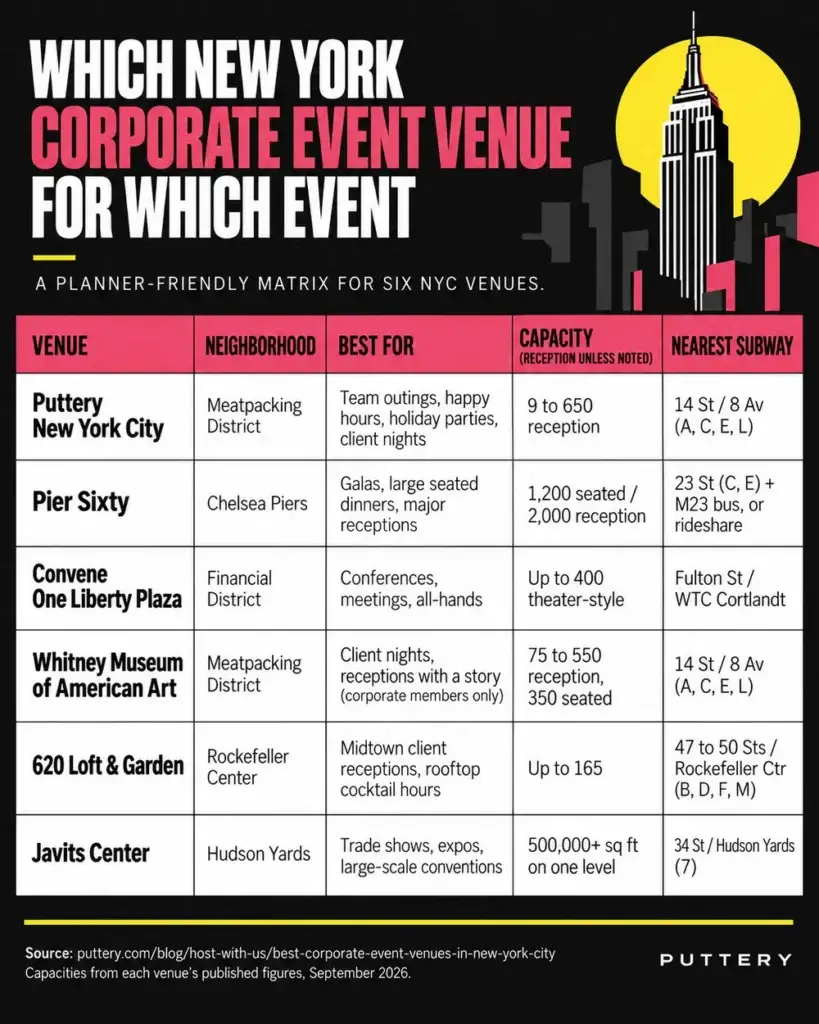
So that is what this is. Cvent’s 2026 rankings put New York eighth among meeting destinations in North America, up four spots in a year, which means the rooms you want are already spoken for and the leftovers all have the same carpet. Six picks, sorted by what your event has to do: Puttery New York City in the Meatpacking District for team outings, happy hours, holiday parties, and client nights of 9 to 650; Pier Sixty when the gala needs 1,200 seats and the Hudson under the windows; Convene One Liberty Plaza when the event is actually a conference; the Whitney when the night needs a story and the story is American art; 620 Loft & Garden when the client will not leave Midtown; and the Javits Center, because the list of convention centers in New York City is one item long.
One disclosure before the list. We run Puttery, and our New York venue is pick number one. A few of our own Google reviews come from people who showed up on a Friday and found the Museum course closed for somebody’s buyout. Fair complaint. If you are the one holding the buyout, that is the point. The other five venues are here because a list of one is an ad, and you would have closed the tab. (Different city? We did the same for Dallas, Houston, and Chicago.)
Six Corporate Event Venues in New York City, Matched to the Event:
1. Puttery New York City, for Team Outings, Happy Hours, Holiday Parties, and Client Nights (9 to 650 Guests)
Start with the thing that confuses people, including, some weeks, Google. 446 W 14th St is one building, High Line Hall, with five floors and five names on the door. Puttery is the indoor mini golf, scratch kitchen, and craft bar on floors two and three. Rory’s Rooftop is the roof. Yes, that Rory: four-time major champion Rory McIlroy is an investor in Puttery and advised on the course design. Look Alive is the third floor: sports bar, lounge, and dining room, sharing the floor with the Museum course. Rojo Room is the supper club under the sidewalk. High Line Comedy Club runs shows in the building every weekend. Planners find them as five listings, tour them as five venues, and email five inboxes. It is one NYC event venue, one planner, one agreement, one invoice. That is the whole pitch, and it also happens to be true.
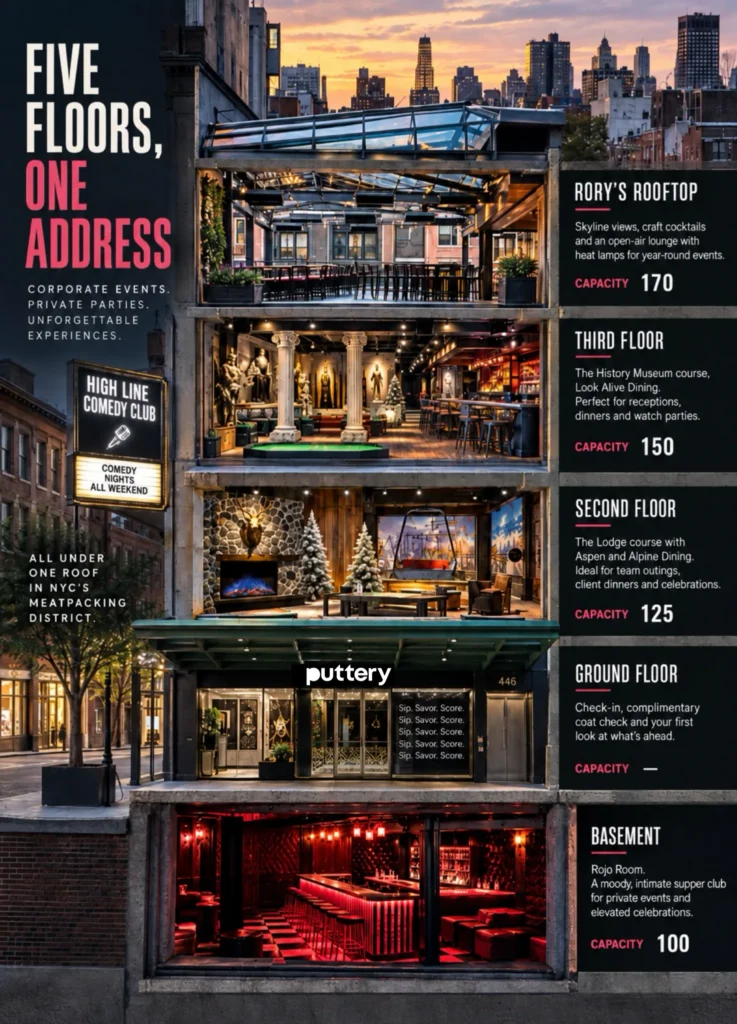
Time Out covered the opening in March 2024: 24,000 square feet over five levels, an underground lounge, a rooftop built to run year-round with heat lamps. amNY called it “mini golf with a nightlife twist,” and the city’s official tourism site files us under nightlife. By day the same building is full of families. The courses don’t change. The vibe does.
Floor by floor, top down, because that is how an event moves through it:
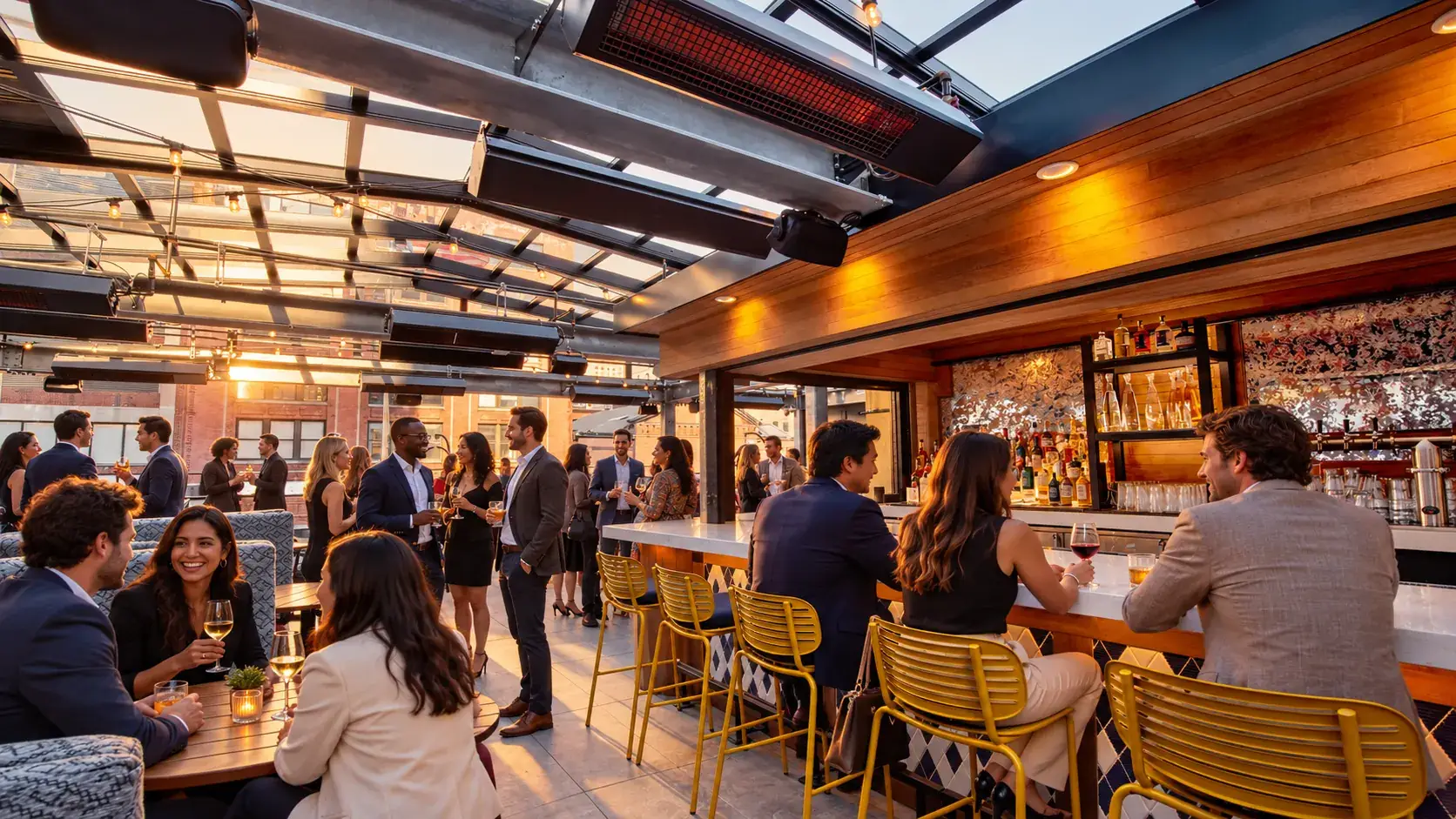
- Rory’s Rooftop. Skyline, open seating, heat lamps for the months that need them. 170 on a full rooftop buyout, or the Canopy (50), the Promenade (50), and the Sun Lounge (70, splits in two). “This is the one low-key Meatpacking rooftop bar where you can actually hear your friends talk,” a TripAdvisor reviewer wrote in July 2025. Welcome drinks go here. So does the last hour.
- Third floor. The History Museum course, nine holes of Roman columns, chariots, and Egyptian relics, and Look Alive, which is the rest of the floor: the sports bar, the lounge, and Look Alive Dining. Look Alive Dining seats 65 and splits in two. The bar and lounge take 15, or 30 with the bar top. Book the bar and dining room together and the floor holds 80. Take the whole floor with the course and it holds 150. Look Alive runs watch parties with its own AV for the match: the room for the sales kickoff that lands on a game night.
- Second floor. The Lodge course: fresh powder, a wall-length fireplace, a chairlift built for the group photo, a wine cellar stacked with Puttery Vino barrels, and a hot tub bubbling on the patio, because ski trips have priorities. Aspen Dining (30) and Alpine Dining (35) split into sections of 10 to 25 for the board dinner or the breakout. The floor holds 75 without the course, 125 with it.
- Ground floor. Check-in, complimentary coat check, and the desk that builds your scorecards. Guests arrive, get a putter, and go up.
- Rojo Room. Downstairs, one door, no sign. Pressed tin ceilings, black-and-white checkered marble, one long table down the middle, banquettes along the walls, a DJ booth and a sound system in a room built to hold the noise. It seats 50 as a supper club and takes 40 to 100 on a full takeover, 16 to 30 on the long table. Awards look better down here. So does the part of the holiday party people text about the next morning.
- High Line Comedy Club. Stand-up every weekend, comics you have seen on Netflix, HBO, and Comedy Central, 4.8 out of 5 across 62 TripAdvisor reviews. The club books its own private and corporate shows; if you want food and drink around the show, that part goes through our planner. One catch: shows are 21+, even though the building is 18+ after 6 p.m. If the intern class is coming, ask the club about a private show or skip the comedy.
Why it works for a corporate event: the icebreaker is built into the floor plan, and the agenda changes rooms without changing addresses. Town hall in Look Alive Dining. Foursomes on both courses, trash-talking the VP. Sunset on Rory’s. Awards in Rojo Room. Nobody stands in a circle with a name tag. The kitchen is scratch (our team told amNY at opening that there is not even a freezer in it), the bars pour Hometown Heroes, a rotating list created by New York bartenders, and zero-proof cocktails are on the menu every day, not on request: a Berry Basil Smash, a Tropical Ginger Cooler, a Chip Crush. Most corporate events venues hand you a room and a phone tree. We hand you a planner, and one invoice.
And the commute. Google owns 111 Eighth Avenue around the corner, all 2.9 million square feet of it, bought Chelsea Market one block north in 2018, and opened St. John’s Terminal a mile south in 2024, with more than 14,000 employees in the city. For a lot of west side offices, the offsite is a crosswalk.
Two organizers this summer, on Google. Avery Chung, September 2026: “My group rented out the dining room and bar on the 3rd floor and it was an ideal size for what we needed… Great balance of flex social networking time and organized game play.” Robert H, August 2026: “He made our transition from food to our rounds seamless,” and then, “we ended up at the rooftop bar after our event and that was also a cool way to end the day.” That is the building doing its job.
Now the one to read twice. A guest at an August 2026 work event gave us three stars and this: “Fix the flow between the rooftop and the course and this would be a really strong venue for group events.” He is right, and here is the math. A scorecard holds four names. Nine holes take about 30 minutes. There are two courses. So 120 guests is 30 foursomes moving between a roof and two courses, and either your planner puts that on paper as tee waves before you sign, or the rooftop becomes a waiting room. Ask for the wave plan. It is the most useful page in the agreement. Tell your planner what you are running, on which floor, and get the A/V confirmed in writing.
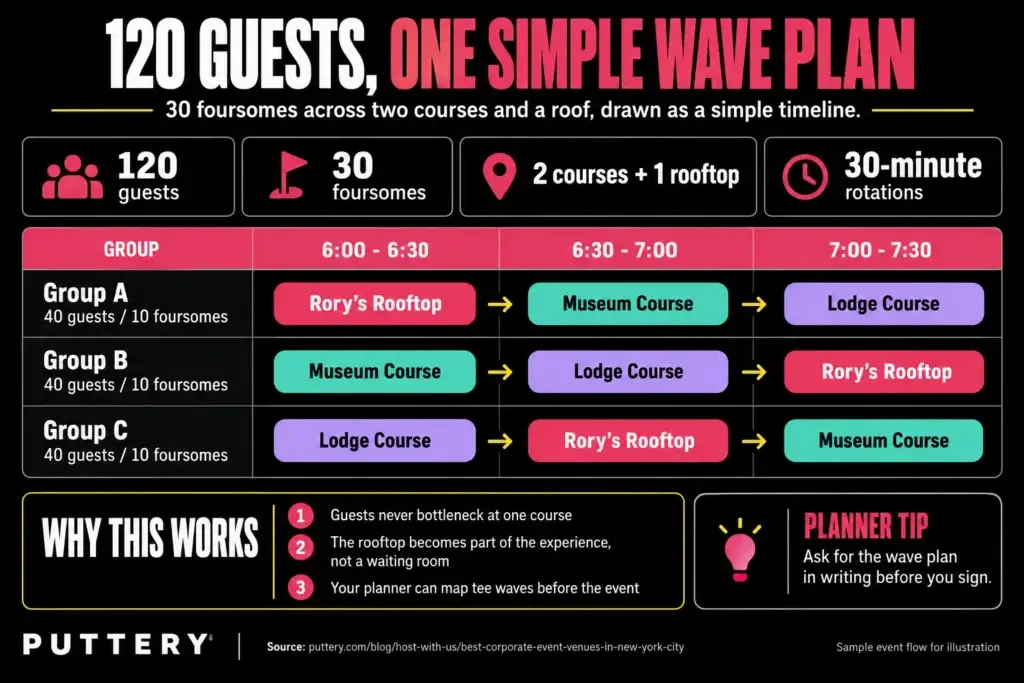
The spaces, the way our New York event team sells them (September 2026):
| SPACE | FLOOR | CAPACITY |
|---|---|---|
| Common tables and lounges (semi-private) | Any floor | 15 |
| Look Alive Bar & Lounge (30 with the bar top) | 3 | 15 to 30 |
| Rojo Room, long table buyout | Lower level | 16 to 30 |
| Aspen Dining (splits into A, B, C at 10 to 25) | 2 | 30 |
| Alpine Dining (splits into A, B at 10 to 25) | 2 | 35 |
| The Canopy, Rory’s Rooftop | Rooftop | 50 |
| The Promenade, Rory’s Rooftop | Rooftop | 50 |
| Look Alive Dining (splits in two) | 3 | 65 |
| Sun Lounge, Rory’s Rooftop (splits into A 35, B 35) | Rooftop | 70 |
| Rockies, second floor without the Lodge course | 2 | 75 |
| Look Alive Bar and Dining, third floor without the Museum course | 3 | 80 |
| Rojo Room, full room takeover | Lower level | 40 to 100 |
| Rockies buyout with the Lodge course | 2 | 125 |
| Third Floor Exclusive, the whole floor with the Museum course | 3 | 150 |
| Rory’s Rooftop, full rooftop | Rooftop | 170 |
| Full venue buyout | All five | 650 |
The practical part. All ages until 6 p.m. every day; after 6 p.m. the building is 18+ with photo ID at the door, and minors join an evening event only as part of a contracted private event arranged through your planner. A, C, E, or L to the 14th Street stop at Eighth Avenue, two blocks east, which also means the L brings Brooklyn straight to the door. The M14D stops across the street, and the High Line’s 14th Street stairs are at the end of the block. Street parking is scarce and paid with no validation, so it is transit or rideshare. Elevator to every floor, wheelchair access throughout, free guest Wi-Fi, staffed coat check.
Nine or more guests, book with a planner. There is no planning fee, and it is the only way to name your floor in the agreement: Look Alive Dining for the town hall, the Sun Lounge for cocktails, Rojo Room for the last hour. It is also where the menu opens up past the online packages, to dinner stations, a taco bar, a hosted tab or drink tickets, and dietary needs asked about before the night instead of discovered on it. Ken Kitchen, who leads event sales for all ten venues: “What you see doesn’t mean that that’s the only thing that you get.” Your planner holds tee times in the middle of the event and keeps your space yours while you play, two or three hours of it instead of the 90 minutes an online package reserves. Five to eight guests? The online packages and back-to-back tee times are built for you. December dates go first, and our holiday early-booking offer ends October 31, 2026. Whatever else is running this month is on the seasonal offers page.
When we’re not the pick: a seated dinner for 500 facing a stage, or a two-day conference with breakout tracks and a registration desk. Our floors are built for food stations, bars, lounges, two courses, and a dance floor, not fifty ten-tops and a podium. Two of the venues below do that better than we ever will.
2. Pier Sixty, for the Gala or the Seated Dinner in the Hundreds (Chelsea Piers)
Six blocks up the Hudson from us. Pier Sixty’s own numbers: 20,560 square feet with no columns, 1,200 for a seated dinner, 1,600 theater-style, 2,000 for a reception, with floor-to-ceiling windows that open onto a glass-enclosed all-season terrace and the river past that. Catering is in-house, with a short list of outside caterers for kosher and Indian menus. Two sister rooms on the same piers, The Lighthouse at 10,000 square feet and Current at 6,000, cover the gala that is not quite a gala. If the dinner is here and the after-party needs somewhere to go, we are a ten-minute walk down the river.
3. Convene One Liberty Plaza, When the Event Is Actually a Conference (Financial District)
It is on this list because you searched for it, and because it does the thing nobody should ask a mini golf venue to do. Convene’s own page lists more than 30,000 square feet on the second floor of One Liberty Plaza: seven rooms, the North Gallery seating 400 theater-style, two boardrooms, white-box walls built for sponsor branding, in-room A/V with an on-site team, in-house catering, and the snacks and coffee that never stop. Fulton Street (2, 3, 4, 5, J, Z), Cortlandt Street (R, W), and WTC Cortlandt (1) are all a short walk. Hold the all-hands here. Hold the party somewhere with a roof.
4. Whitney Museum of American Art, for the Client Night That Needs a Story (Meatpacking District)
Three blocks from our front door at 99 Gansevoort, and the fine print nobody puts on the listing: corporate events at the Whitney are a Corporate Membership privilege, not a rental you can book cold, and catering is exclusively Union Square Events, Danny Meyer’s group. If your company is a member or willing to become one, the rooms earn it. Kenneth C. Griffin Hall in the lobby takes 550 for a reception or 350 seated. The Hess Theater and Gallery on three holds 180. The Studio Bar and Thomas H. Lee Family Terrace on eight top out at 150 with the outdoor terrace open in season. Cocktails somewhere near a Hopper is the story your clients tell on Monday. The after-party is three blocks north.
5. 620 Loft & Garden, When the Client Will Not Leave Midtown (Rockefeller Center)
Some clients do not cross 34th Street. For them, 620 Loft & Garden is a rooftop garden with a reflecting pool looking straight at St. Patrick’s Cathedral, a renovated loft behind it, and tenting that keeps it working year-round; Rockefeller Center’s own roundup lists it at 165 for a reception. The same campus has 610 Loft & Garden above Fifth Avenue for the breakfast or the luncheon, and Radio Park, a half-acre garden nine floors above Radio City Music Hall. The backdrop does the work. Bring a photographer.
6. Javits Center, When Corporate Events Turn Into Trade Shows (Hudson Yards)
Twenty blocks north at 655 W 34th Street. Javits lists 3.4 million square feet across two buildings, more than 500,000 square feet of contiguous exhibit space on one level, 122 meeting rooms, a rooftop pavilion and terrace, and 74 covered loading docks, which is the number that tells you what kind of event belongs here. If your headcount has a badge and a lanyard, this is the room. Everyone else keeps scrolling.
Planning Guide: How to Choose a Corporate Event Venue in New York City
Match the capacity to the format
A floor that holds 150 for a reception holds far fewer for a seated dinner, and every venue’s biggest number is its reception number. Ask for the capacity that matches your layout, then ask where overflow goes when 20 extra people say yes the day before. At Puttery New York that answer is usually the floor above or below, because the building is five rooms on one elevator. Then ask the question specific to any venue with an activity in it: how does the group move? For us, that is the wave plan from the section above. For a museum, it is the gallery access windows. For a rooftop, it is the rain plan.
Know which pricing model you’re in
Search “nyc party spaces” and the first page is hourly rentals. Peerspace puts the average corporate event venue in New York at $202 an hour, typically booked for eight hours with about 37 people (August 2026). Tagvenue’s September 2026 data runs higher: around $400 an hour, a range of $200 to $600, minimum spends of $2,500 to $6,000, and per-person pricing from $65 to $200 when the room comes with food. Hourly buys a room. Food, bar, staff, furniture, and A/V are extra. The other model is per guest or a food-and-beverage minimum, where the room comes with the dinner. Puttery prices per guest. Whichever model you are in, five questions before you sign: what the service charge is and whether tax and gratuity sit on top of it, when the deposit is due, when the guaranteed count locks, what happens to the bill if your headcount drops after it, and the New York one: what your guests pay if they order beyond the package, and what lands on that check. One of our June 2026 reviewers gave us four stars and a warning about that last one. Read the agreement, then brief your guests before the first round.
Plan for the train, not the parking lot
New York corporate groups move on the subway and by rideshare, and the Meatpacking District is built for it. Fast Company called it the city’s most walkable neighborhood in August 2025: two blocks of 14th Street pedestrianized, the High Line pulling 8 million visitors a year, Little Island 1.5 million. That is also your answer for the team flying in. The High Line, Little Island, the Whitney, and Chelsea Market are all inside a five-minute walk of our door, so a 4 p.m. High Line walk before a 5 p.m. tee wave costs nothing and does more for out-of-towners than a welcome bag. Pier Sixty and Javits are rideshare venues. The Financial District and Midtown are subway. Then ask what nobody asks until the week of: coat check, elevator access, the age policy if plus-ones or families are coming, and who the on-site contact is after the sales office goes home at 5.
Book the date before you pick the menu
December Thursdays go first. A party space NYC planners actually want, a private floor with a real kitchen and a roof, gets booked by people who started in September, which is why early-booking offers exist and why they shrink as the calendar fills. Lock the date and the floor, then spend three weeks on the menu. The other order ends at a hotel bar with a cheese cube tray.
What a Corporate Event at Puttery New York City Actually Looks Like
We could write case studies. Our guests already did, in public, with their names on them, on Google and on Yelp.
- A 50-to-70-person team event, May 2024. “I was worried about day-of logistics since we had such a big group but check-in was seamless,” the organizer wrote. “Although you need to be in groups of 3/4, most of our teams were going back-to-back and the size/layout of the space allowed us to still mingle with everyone.” That is the wave plan, working.
- A company holiday party, December 2024. “Great venue on multiple floors with a fresh twist on a classic activity the whole team can participate in,” per the organizer, who thanked Ken and Alice by name.
- Dietary needs and last-minute changes, March 2026. “They were so accommodating with our dietary needs and stayed flexible even when we had last-minute adjustments,” one organizer wrote. “We felt truly welcomed and never once felt rushed.”
- The walkthrough, June 2026. “Alice and Kam were an absolute pleasure to work with… super helpful in the planning and walkthrough process as well as accommodating the needs of my team,” from a host whose team “kept raving about how fun the courses were and how much the rooftop section was such an amazing space.” Alice Smith is our New York Director of Sales. Eight different event hosts have named her in reviews since we opened, and she is the person you will be emailing.
Talk to a New York Event Planner
Bring the date and the headcount. We’ll bring the floor plan, the menu, and the roof.
Contact a Planner | (631) 212-8501, select 1 for events
Prefer to walk the rooms first? Start with the 360° tour, The other four names on the door have their own sites: Rory’s Rooftop, Look Alive, Rojo Room, and High Line Comedy Club. Same building, and one planner for the first three. The comedy club books its own shows.
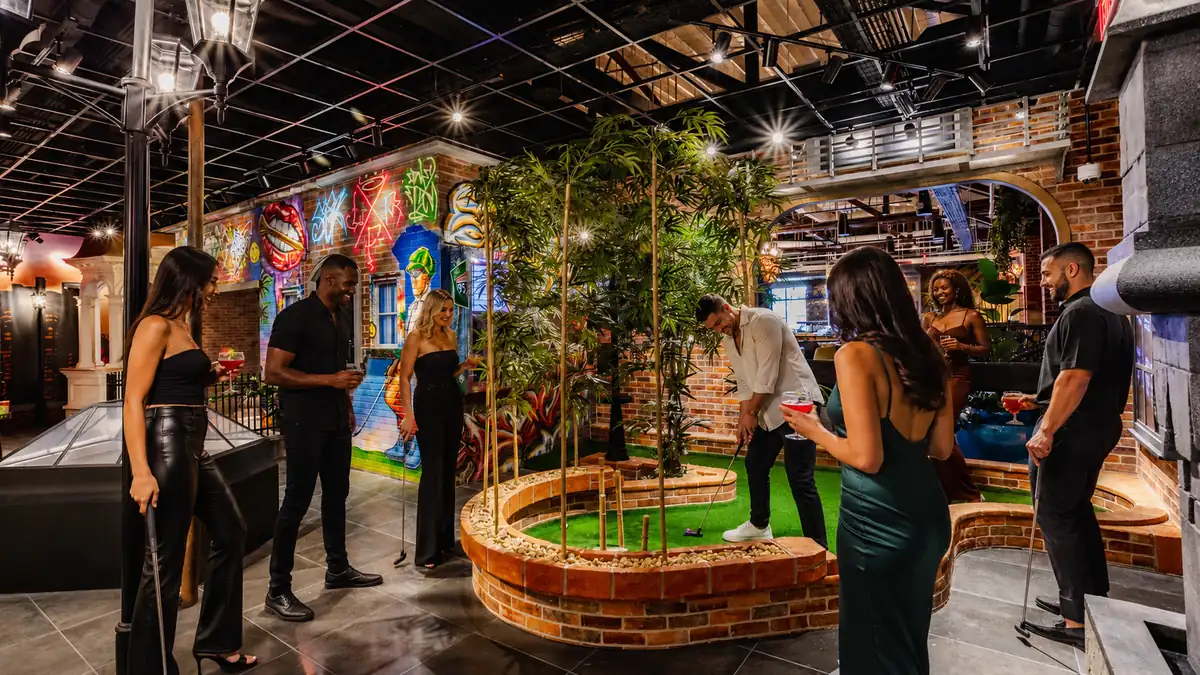
Adult Birthday Party Ideas That Don’t Feel Like a Kid’s Party
A party feels like a kid’s party for four reasons, and none of them is the number on the cake. The room was built for someone else. A schedule runs the guests instead of the other way around. The food is whatever was easiest to order for twelve. And the host spends the whole night on their feet. Fix those four and you can throw a 40th in a bowling alley and it will read grown. Miss them and the rooftop with the good cocktail list still feels like a rented pavilion.
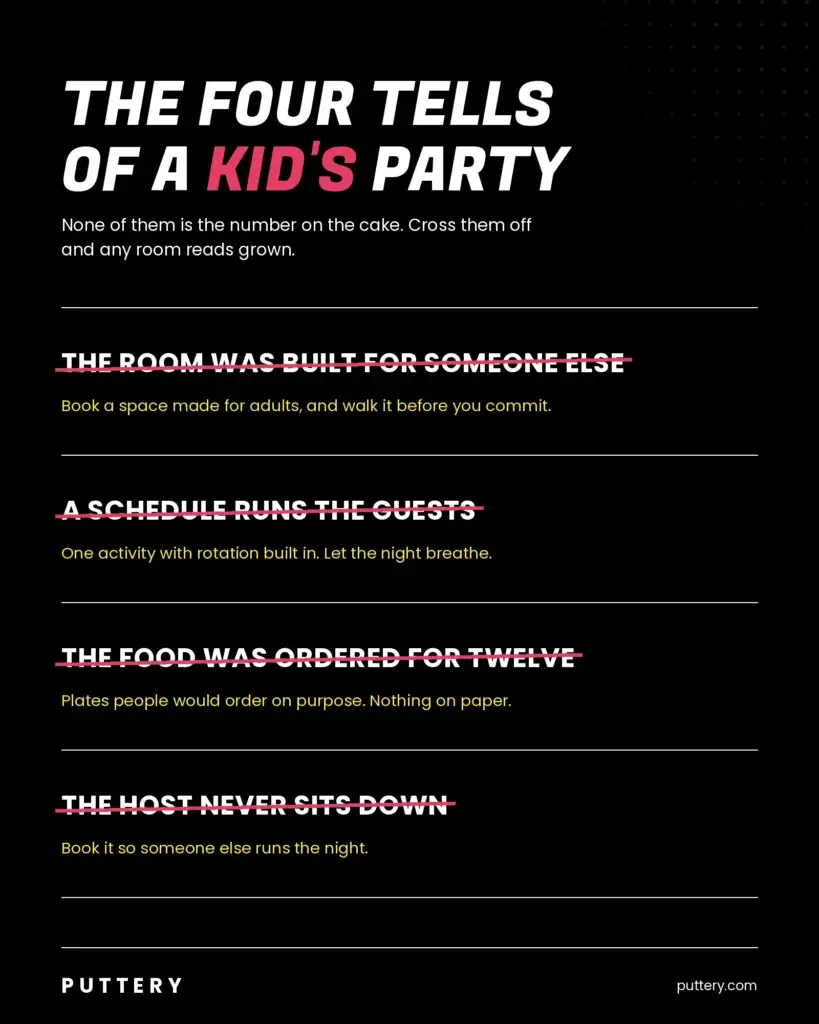
So that is how we sorted the birthday events ideas for adults below: by which of the four problems each one solves. One idea is ours to sell. We run 10 indoor mini golf venues, each with a scratch kitchen and a full craft bar, and a private mini golf night is on this list. We say so when we get there. The rest we have no stake in.
One more thing first. We pulled the 500 reviews that mention a birthday across our ten venues, back to 2021, and read all of them. Four in five are five stars. The ones that are not almost never complain about the idea. They complain about logistics: the group of twelve that booked a regular tee time instead of an event and got caught behind a private party, or the 21st birthday that showed up the night before the ID said 21. That is why the back half of this post is about booking, not balloons.
Experience-Based Party Ideas
The fastest way to find birthday activities adults will actually show up for: give people something to do with their hands. Conversation follows movement. So do the photos.
A private mini golf night (this one is ours)
Here is what it looks like at Puttery, since “mini golf” makes some people picture a windmill and a snack bar. Each course is nine themed holes and takes most groups about 30 minutes. Every venue has between two and four courses, and every hole is a set you walk into, not a carpet you walk across. Drinks come with you on the course, and there is a server on every one. Food stays in the lounge, which is where the party regroups between rounds. Scorecards are digital and hold four names. That number matters more than it sounds like, and we will get to why.
Jameane W., who did a 40th for ten in Minneapolis in April 2026, put it this way on Google: “The space is so cool and the vibe is perfect for a group.” A Houston guest, Tommy A., went shorter: “It was like adult recess with cocktails.”
The birthdays in those reviews run from a 21st in Pittsburgh to a 64th in Chicago to a 75th in Pittsburgh this past February, so no, there is no age at which this stops working. The people who had the best night are the ones who booked the right way for their group size. That is its own section below, and it is the part to read twice.
A cocktail class or a guided tasting
A class solves the “what do we do now” problem for the first hour and the “nobody is mingling” problem for the second. Pick one lane: cocktails, wine, beer, chocolate, zero-proof. Small pours, a slow pace, and someone who does this for a living running it. Everyone shakes, everyone tastes, nobody has to perform. Put the same care into the zero-proof flight as the rest or skip it. A sad ginger ale on a tasting card reads exactly like the kids’ table.
A workshop that sends people home with something
Cooking, pottery, a knife-skills class. Ninety minutes with a hard stop. People leave with a bowl or a tart and a story about the one who burned theirs, then dinner somewhere you do not have to clean up. This is the idea for the friend who says they hate parties. They hate standing in a kitchen holding a plate. Different thing.
Intimate Gatherings for Small Groups (6 to 20 People)
Six to twenty is where most birthday planning actually lives. It is also where most of it goes wrong, because people plan a 16-person party like a 6-person dinner with more chairs.
There is research on this. Casual conversations top out at about four people. A 2018 paper in Evolution and Human Behavior reviews decades of observation showing that past four, a group does not get louder, it splits. A four and a two. Two threes. You cannot fight it, so build for it. Whatever your birthday plans are, set up the room so people can be in a foursome, leave it, and land in another one without it being awkward.
That is the real argument for anything with rotation built in: a course where four people share a scorecard and the next four are one hole back, a progressive dinner that walks the group from starters at one spot to dessert at another, a game night where tables reset every 20 minutes. A long table of sixteen gets one conversation at each end and dead air in the middle. Four tables of four with room to stand fix that for the price of a floor plan.
Michaela S. booked a 30th for 20 people at Puttery Minneapolis in December 2025: “Justine took care of our group of 20 people and was absolutely amazing and so fun! Would definitely recommend booking an event here!” In Kansas City, Josilyn W. brought about 23 people for a cousin’s 40th: “There was nothing slow about our service.” Both booked as events. Hold that thought.
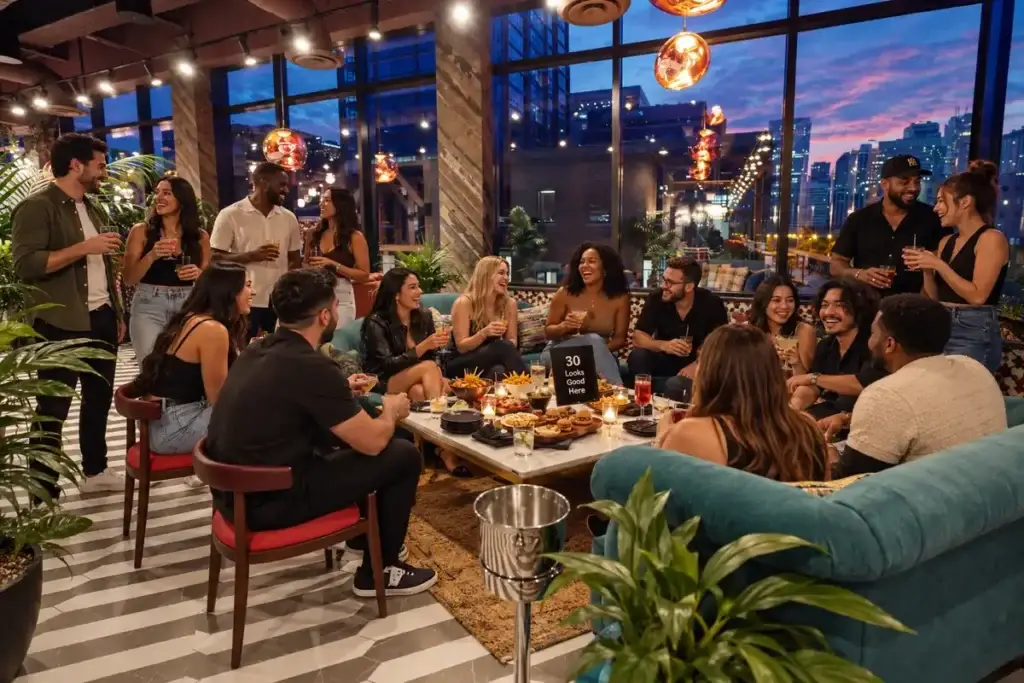
If you would rather do dinner: family-style so people pass things and talk, or a chef pop-up in your own kitchen so you get to be a guest at your own birthday. Game night at six to twelve: social deduction games, fast trivia, one small prize that becomes a running joke for a year.
Low-Key, Thoughtful Celebrations
Not every birthday wants a room. Some want a Tuesday. If the guest of honor would rather plan birthday dinner with two friends and call it a night, take that seriously. It is a preference, not a lack of ideas.
Two numbers back them up. In a published survey of 309 medical students, 79.6% said the best birthday gift was being with the people who matter to them. A party came second, at 45.3%. And a 2025 Empower survey reported by CNBC found 60% of U.S. adults think gift culture has gotten out of hand, and 48% have felt gift fatigue. Write “no gifts” on the invitation and mean it. That alone makes a party feel grown.
Brunch works. One egg dish, a pastry board, a spritz that is zero-proof by default and boozy on request. If brunch is out, confirm the venue serves it on the day you want before you promise anyone a biscuit. Our own weekend brunch runs Saturday and Sunday, 11 AM to 3 PM, at participating locations, and “participating” is doing real work in that sentence. Check your city’s menu on our Food & Drink page first.
Or a park day: shade, a speaker, lawn games that need no explaining. Or a spa afternoon at home: chair massages at 15 minutes a person, then tea, then nothing scheduled at all.
Theme Ideas That Don’t Require Costumes
An adult birthday party does not need a theme. It needs a decision. A theme is just a decision made once so you do not make it forty more times.
Color or era: a black-and-white table, a soul playlist, done. A ’90s night that lives in the speakers and nowhere else. Hobby-led: a book club kickoff with a first read, a vinyl night where every guest brings one record and one story. Menu-first: regional small plates, a taco bar with better toppings than anyone expected, a build-your-own cocktail lab where the recipe cards are the decor.
The test for any birthday celebration for adults: if the theme requires someone to buy something they will wear once, it is a costume party. Nothing wrong with that. Just call it what it is on the invitation so nobody shows up in a blazer to a toga night.
Venue and Logistics That Read Grown
This is where planning a birthday party is won. Not the theme. The mechanics.
Invite like you mean it
Emily Post’s timing guide gives a cocktail party one to four weeks’ notice and a casual party anywhere from same-day to two weeks. Use the long end for a birthday, because people have to decline something else to say yes. Put the start and end time on it, the plus-one policy, the dress code in plain words, whether the night is 18+ or 21+, and where to park. Say “no gifts” if that is the plan. An invitation that answers every question is the first sign the night is being run by an adult.
How booking a birthday at Puttery actually works
The single most common mistake in those 500 reviews: a group of ten or twelve books a regular tee time, the way you would book a table for two, then arrives to find a private event holding the floor. A tee time is a tee time. It is not reserved space, and it does not hold a table, because tables are first come, first served. Here is how to book so that never happens to you.
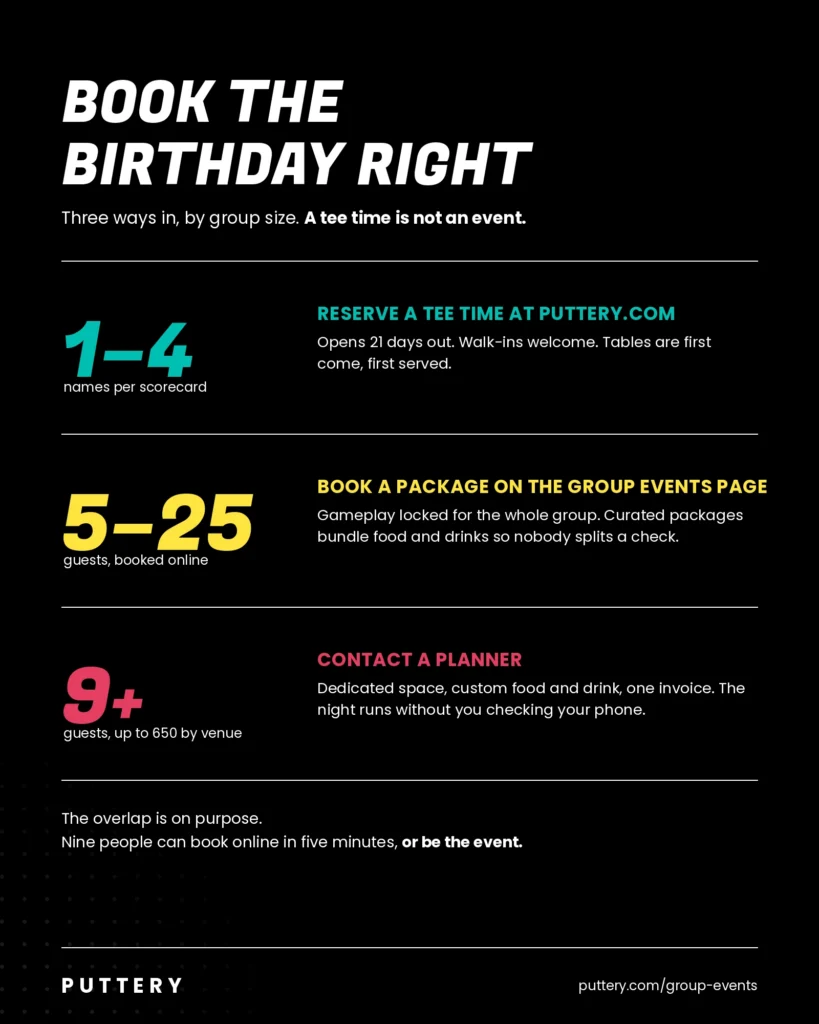
The overlap between the second and third rows is on purpose. Nine people can book a package online in five minutes or talk to a planner. Talk to the planner when you want the space held, the food customized, or the night to run without you checking your phone.
A few more things people get wrong, all fixable in advance:
Age policy is set city by city, and it tags your slot. Every location is all ages during the day. Evenings vary. The full table by city is here. For a 21st, the ID has to say 21 on the day you walk in. The night before does not count, and this is the one that hurts, because it is usually the guest of honor who gets turned away.
Bring a valid photo ID. Everyone. Even the friend who “looks 40.”
Cake is fine at most locations. A store-bought birthday cake or dessert is the one exception to the no-outside-food rule at most of our venues. Check your location’s FAQ before you buy the candles, because it varies a little by city.
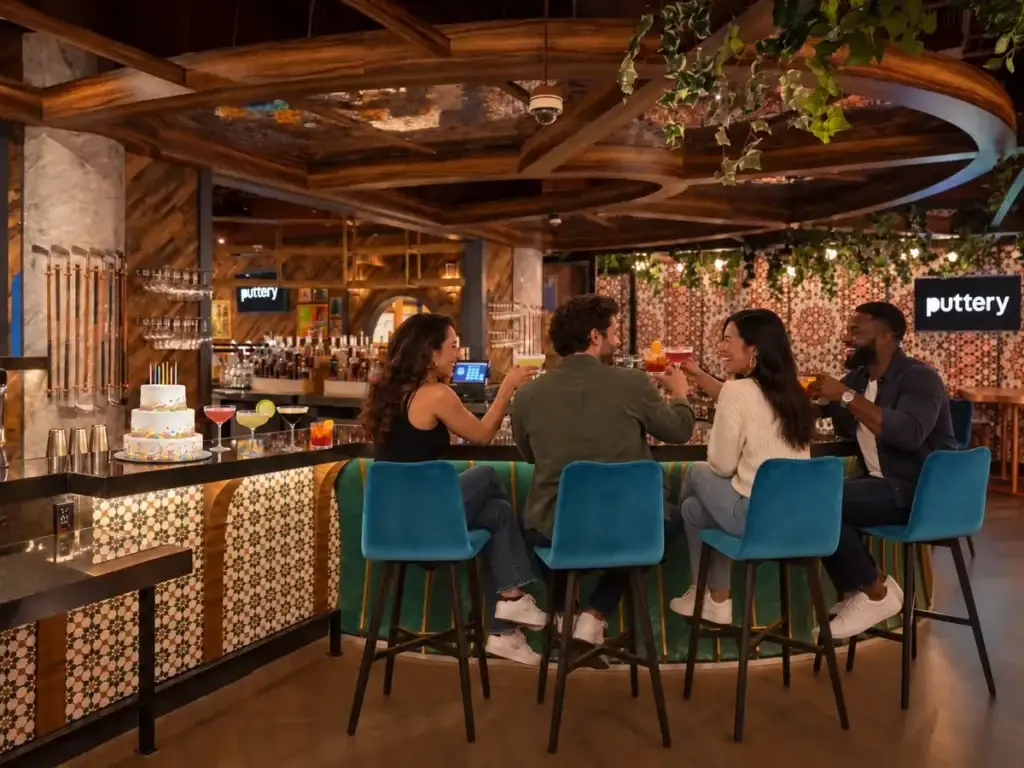
Say it is a birthday when you book. Put it in the reservation notes. Sean O. in Kansas City wrote about what happened when his wife did: “When we showed up they had a personalized birthday card waiting for me. It was a little thing, but it was really nice.”
Walk the room before you commit. Every venue has a 360 tour, and for a birthday it is worth ten minutes: Charlotte, Chicago, Dallas, Houston, Kansas City, Miami, Minneapolis, New York City, Pittsburgh, and Washington, DC. If someone in the group uses a wheelchair, every venue is wheelchair friendly with at least one fully ADA-compliant course, and the tour shows you the route. First visit? The first-timer’s guide covers check-in and scoring.
Where This Leaves You
Pick the idea that solves your group’s actual problem, not the one that photographs best. Then handle the mechanics like it is your job for one week. If the idea is a mini golf night for nine or more, contact a planner with the headcount, the date, and the age of the youngest guest. We handle the rest. Possibly more fun than you can stand.
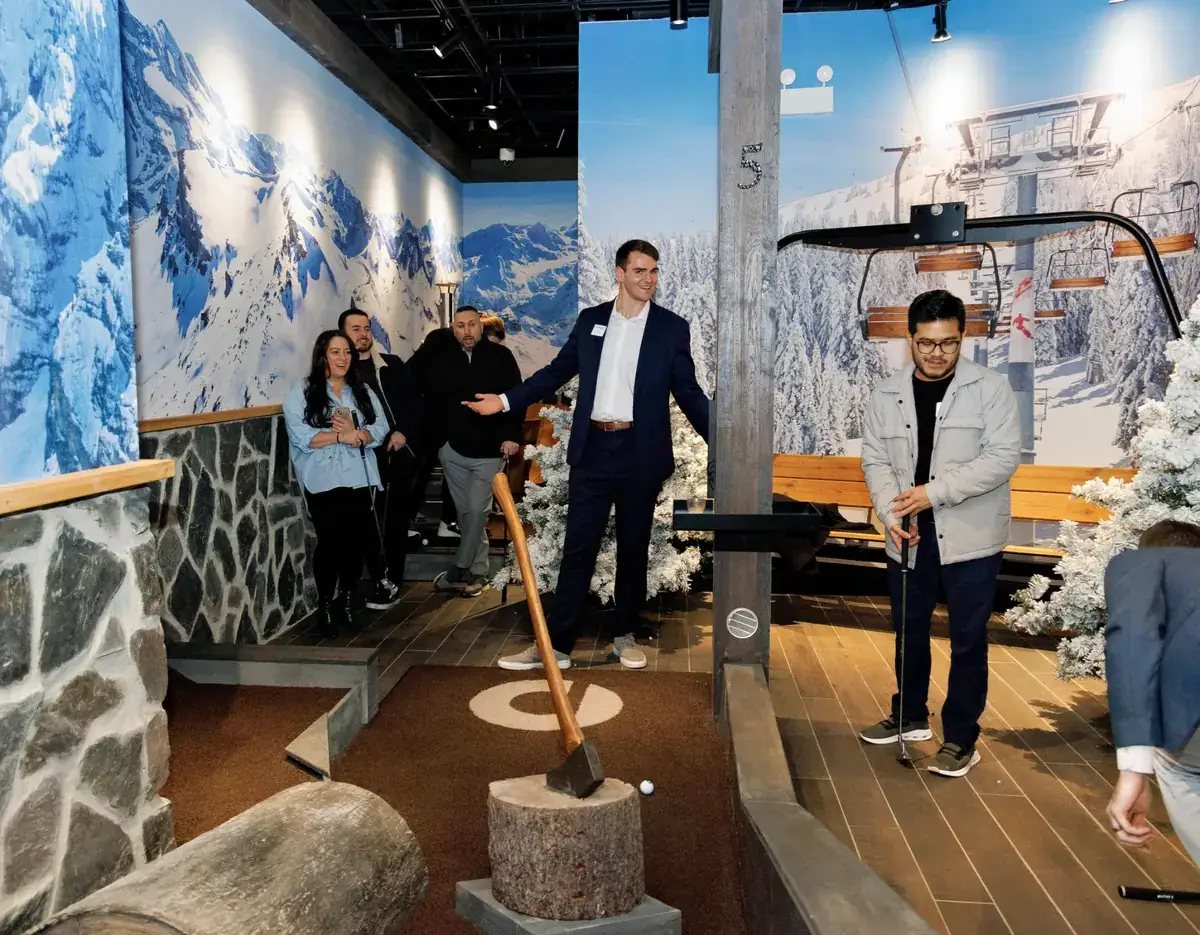
Team Building Nobody Calls Team Building
Nobody wants to go to team building. Plenty of people want to beat the VP of Sales at mini golf. Same event. The second one is team building nobody calls team building, and the only real difference is what you make people do once they’re in the room.
We run ten venues that host this every week, so read the rest knowing where we stand. What follows is what works when a group of coworkers walks through our door, what goes wrong, and three formats you can run yourselves without a facilitator, a lanyard, or a single trust fall.
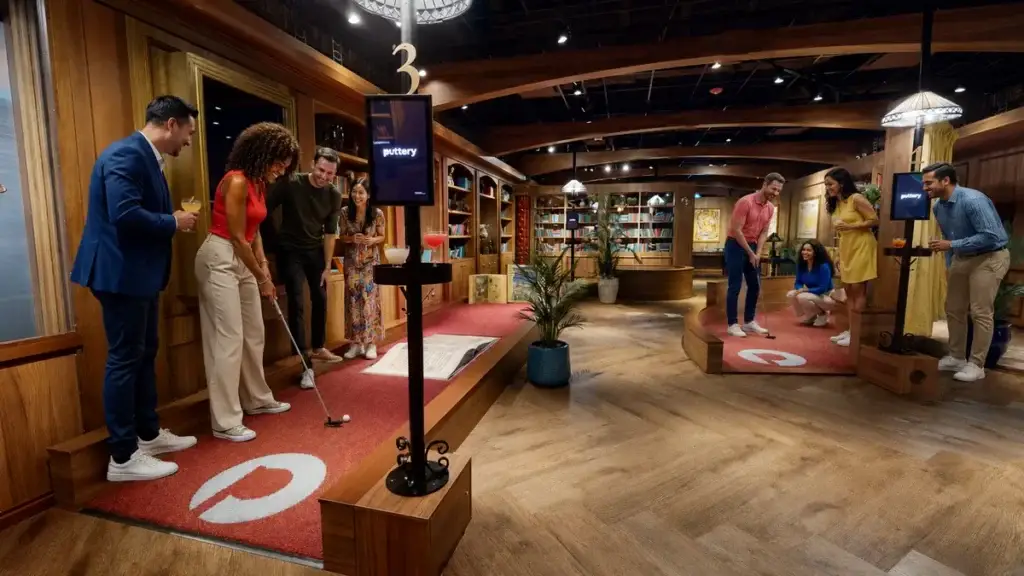
Why the label backfires
The numbers are not subtle. Gallup’s 2024 read on roughly 79,000 U.S. employees put engagement at a ten-year low: 31% engaged, and only 39% strongly agreeing that someone at work cares about them as a person. So companies reach for the standard fix, and the standard fix is the problem. In a 2025 study of 6,821 leaders and employees by the U.S. research firm Leadership IQ, nearly half said traditional “forced-fun” team-building activities make them uncomfortable or feel inauthentic.
Read those together and the problem is obvious. People don’t hate their coworkers. They hate being watched. Put the words “team building” on a calendar invite and an afternoon becomes a performance: share a fun fact, hold the rope, reflect on what we learned. The extroverts shine, everyone else counts the minutes, and the group goes back to Slack with a story about the time HR made them build a tower out of dry spaghetti.
Meanwhile the thing that actually moves a team is almost embarrassingly simple. Gallup has tracked it for decades: people with a best friend at work are more engaged, more likely to stay, and more likely to recommend where they work, and that link got stronger after the pandemic. Just two in 10 U.S. employees have one. Gallup’s own advice to leaders includes preplanned social events, off-site ones specifically, because friendship doesn’t come out of an exercise. It comes from time together where the stakes are low and the point is something other than the relationship.
So the fix is not a better icebreaker. It’s an outing with its own point, where the bonding happens on the side. A good one has four things going for it.
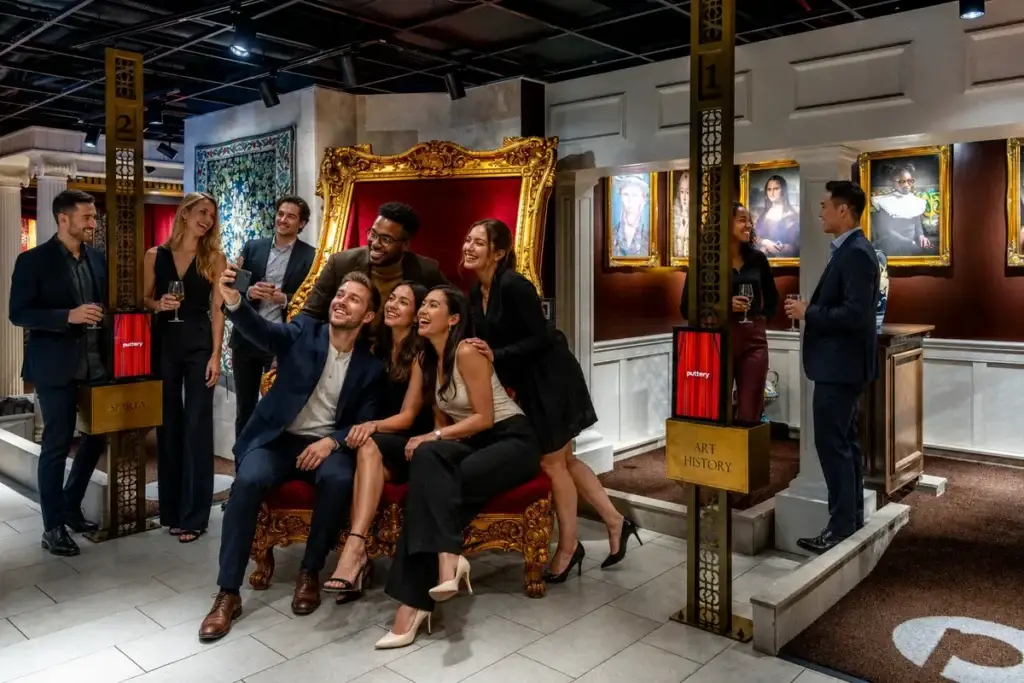
What the outing has to do instead
Nobody has to be good at it
The second an activity rewards skill, half the room checks out. Axe throwing, karaoke, trivia: someone is about to be humiliated and they know it. Mini golf has a skill floor of roughly zero. A hole in one is luck in a nice jacket. One guest at a Women in Medicine event in Houston said it better than we can: “some of the holes were impossible for our group of four. Still fun… Team building for sure.” (Helene S., Yelp, November 2025)
The group mixes without being told to
Our scorecards hold four names. That’s the whole trick. A team of twelve becomes three foursomes, and if you build those foursomes across departments instead of within them, the hard part is done before anyone picks up a putter. Each course is nine holes and takes about 30 minutes, so the foursomes reshuffle between rounds and the bar is where everyone lands. One organizer who brought 50 to 70 people to our New York rooftop watched it happen: “Although you need to be in groups of 3/4, most of our teams were going back-to-back and the size/layout of the space allowed us to still mingle with everyone so we didn’t feel isolated.” (Chloe Lee, Google, May 2024)
There’s something to talk about that isn’t work
Every hole is a world you step into, not just play through. There’s a dinosaur in the Library. There’s a ski lift and a fireplace in the Lodge. The Illusion course is black and white and will mess with your read. Small talk needs material, and a room that is actively strange gives people something to point at. Two coworkers with nothing in common will find it in a putt that broke left for no reason.
It ends on one check
Food and a drink at the end are not the reward for the team building. They are the team building. The course gets people talking; the table keeps them there. Our kitchen is scratch, the bar is full, and every city pours its own Hometown Heroes, three or four rotating cocktails created by the bartenders in that market, with zero-proof options always on the list. One check, one planner, nobody Venmo-ing the boss.

Three formats you can run on any course
We don’t sell these as packages. We don’t need to. Each one runs on the courses, scorecards, and tables we already have. A team outing with a format beats a team outing without one, every time. Pick one. Explain the rules at the bar before the first tee time. That is the entire setup.
#1: The Scramble
Best ball, the format real golf uses when it wants people to talk. Foursomes. Everyone putts from the tee. The team picks the best result, everyone putts from that spot, and so on until the ball drops. One score per team per hole. Put the team name in one scorecard slot and record the best ball there.
What it does: forces the read out loud. “Go left of the ramp.” “The ramp is a lie.” Your quietest analyst turns out to have the best eye on the floor, and now everyone knows it. Nobody carries a bad hole alone, which is the exact thing the rope was supposed to teach.
Make it sharper: rotate the captain every hole. Whoever’s ball got picked calls the next read. By hole five the director is taking direction from the intern, because the intern is right.
#2: The Bracket
Pairs, seeded by drawing names from a hat, never by department. Two pairs share a scorecard and play the same nine holes; the lower combined score advances. Winners meet winners in the next round, losers head to the lounge as the gallery. With unlimited gameplay, a 16-person bracket is three rounds, roughly 90 minutes, and the final has an audience.
What it does: energy. A bracket gives the room something to rally around, and a gallery of eliminated coworkers cheering from the lounge is the loudest, happiest version of your company you will ever see. Keep the knocked-out pairs in it with a one-putt closest-to-the-cup on a single hole, winner takes whatever prize you brought.
Make it sharper: seed so nobody plays with the person they sit next to. If your venue has two courses, rounds one and three run on the same course and nobody minds.
#3: The Points Challenge
For teams that would rather think than putt. Foursomes, team scoring, and a small bet on every hole. Before each hole the team calls a number: two, three, or four. Make the hole in that many strokes or fewer and bank points. Call a two and make it, bank three. Call a three, bank two. Call a four, bank one. Miss your number and you lose what you would have banked. Then the wildcards, each usable once per round:
- Double Down. Double the bet on one hole of your choosing. Declare it before anyone putts.
- Silent Hole. Nobody speaks. Hand signals only. Watch who gets listened to when nobody can talk.
- Wrong Hand. Everyone putts with the other hand. Humbling, and fast.
Our scorecards track strokes. The points live on a phone or a printed card, and the arguing lives at the table afterward.
What it does: puts risk and reasoning out in the open. You’ll learn who plays it safe, who doubles down with a lead, and who talks the whole team into calling a two on a hole with a dinosaur in the way. That tells you more than a personality assessment, and it costs nothing.
Here’s an easy way to compare the three formats, then download the PDFs so HR can call it team building while everyone else just calls it a good time.
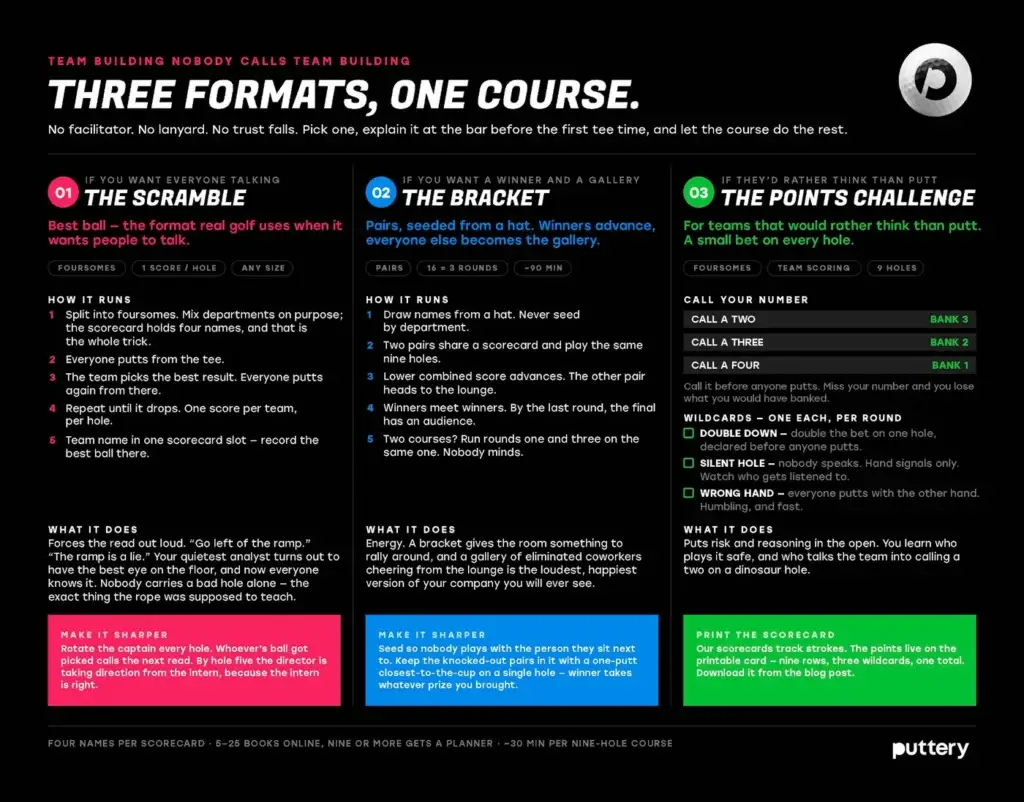
Two offices, one leaderboard
Teams split across two of our cities run the same format in the same week and settle it on one leaderboard. Dallas against Houston. Chicago against Minneapolis. Agree on the format, the week, and the prize, and let the group chat handle the rest.
Under nine people
You don’t need the events team. Groups of five to eight book two tee times in one transaction, we do our best to run them back to back, one person pays, and you run the Scramble as two foursomes. Or book a package online for five to 25 and have the food waiting. Want a custom event for nine or more? A planner takes over. More on that below.
Call it what it is
A happy hour comes out of someone’s discretionary budget and it’s the first line cut. Team building sits in HR, learning and development, and culture budgets that exist to be spent on exactly this, and it clears with a lot less friction. Same group. Same afternoon. Same invoice. If your company has a culture budget, a Scramble across three departments qualifies, and nobody had to trust-fall to earn it. The events team writes one agreement and one invoice, which is usually everything the people who ask about receipts need to see.
Read this before you book
The questions organizers ask most, and the ones the reviews keep bringing up. Answered plainly.
You’ll play in fours. Four names per scorecard, no exceptions. A group of 40 is ten foursomes, not one mob walking the course together. Decide the foursomes in advance, on purpose, across teams. Your planner staggers the tee times so groups go back to back, and the lounge or private room is where the whole group reconnects between rounds.
It gets loud at night. Music is part of the room, and Friday at 9 PM is built for adults who came to be loud. If your outing involves a speech, an award, or a client, book a weekday afternoon or ask your planner about a private room. Chicago, for example, has a glass-walled private room and a curtained semi-private space; every city has its own version. One Charlotte organizer last November: “The music was at a good volume where you could hear it, but you didn’t have to shout to hear each other.” (Christina Janek, Google, November 2025)
One invoice or split the check. Nine or more people go through the events team: one agreement, one invoice, gameplay and food priced per guest. Under nine, you’re booking tee times like any other guest, which means paying at the desk. Don’t make your team stand in a line deciding who covers the boss. Have one person book and pay online ahead of time, or book a five-to-25 package and let the link do it.
Who’s allowed in after dark. Every venue is family-friendly during the day and built for adults at night. The courses don’t change. The vibe does. What changes by city is the hour and the age. If your team includes interns under 21, book a weekday or a daytime slot, and check your city’s location page before you send the invite or read this blog post about our age policy.
How long it takes. About 30 minutes per nine-hole course. One course plus food is a tight two hours. Two courses and the Bracket is closer to three. Unlimited gameplay means you can go longer; one Pittsburgh group “Just spent 4 hours and played 63 holes.” (Ryan Merriman, Google, August 2024) Book the block you want, not the block you think you can justify.
Drinks go on the course. Plates stay at the table. Carry your cocktail hole to hole. Food stays in the dining and lounge areas, which is where the night should start and end anyway: shareables first, then tee times, then back to the table to settle the bracket.
Reserve, and reserve early. “Just make sure to reserve first, sometimes this place can get busy with corporate team building people.” (Ethan Jin, Google, July 2026) He’s right, and it’s us he’s describing. Private events block courses, and December goes first. Your planner confirms everything in writing in your event agreement. That’s your contact, not the online booking system.
What it looks like, city by city
Ten venues, and the same two words keep showing up in the reviews, usually followed by a recommendation.
| CITY | WHAT ORGANIZERS SAID |
|---|---|
| Charlotte | “Service was excellent and he made my team feel super welcome… highly recommend this venue for team building events” Armie D, Google, August 2026 |
| Chicago | “Amazing team building event that delivered beyond expectation” Alison Walsh, Google, October 2025 |
| Dallas (The Colony) | “We did 3 of the mini golf courses and were surprised at the creativity within such a compact area.” Michael Cheney, Google, May 2025 |
| Houston | “One of my co-workers has a gluten allergy. The chef went out of his way to make a delicious gluten-free dish for him and came out to talk to us.” Alexis Sassard, Google, February 2026 |
| Kansas City | “So accommodating and patient with our group. We recommend Puttery for any teambuilding opportunities.” Andrew Diegel, Google, February 2025 |
| Miami | “Took my employees for team building and what a great experience… The menu is very much geared towards shareables which is great to me.” Jessica A., Yelp, July 2024 |
| Minneapolis | “East Coast girly here visiting Minnesota for a work trip and came to Puttery for a team building event. We had the most fun.” Melissa G., Yelp, January 2024 |
| New York City | “We were looking for a venue to host a corporate event for about 50-70 people and everyone had a blast. I was worried about day-of logistics since we had such a big group but check-in was seamless.” Chloe Lee, Google, May 2024 |
| Pittsburgh | “My company rented out the top floor of Puttery for a team building event… We had the absolute best time. Everyone is still talking about that day.” Caitlin Allen, Google, June 2024 |
| Washington DC | “This was great for team building and corporate events and is conveniently located near the Gallery Place and Metro Center metro stops.” Evan P., Yelp, December 2025 |
The planners agree. When Connect NYC, an industry event where meeting planners spend two days with suppliers, gave its attendees an optional team-building session, it was at Puttery NYC. People who book rooms for a living picked ours.
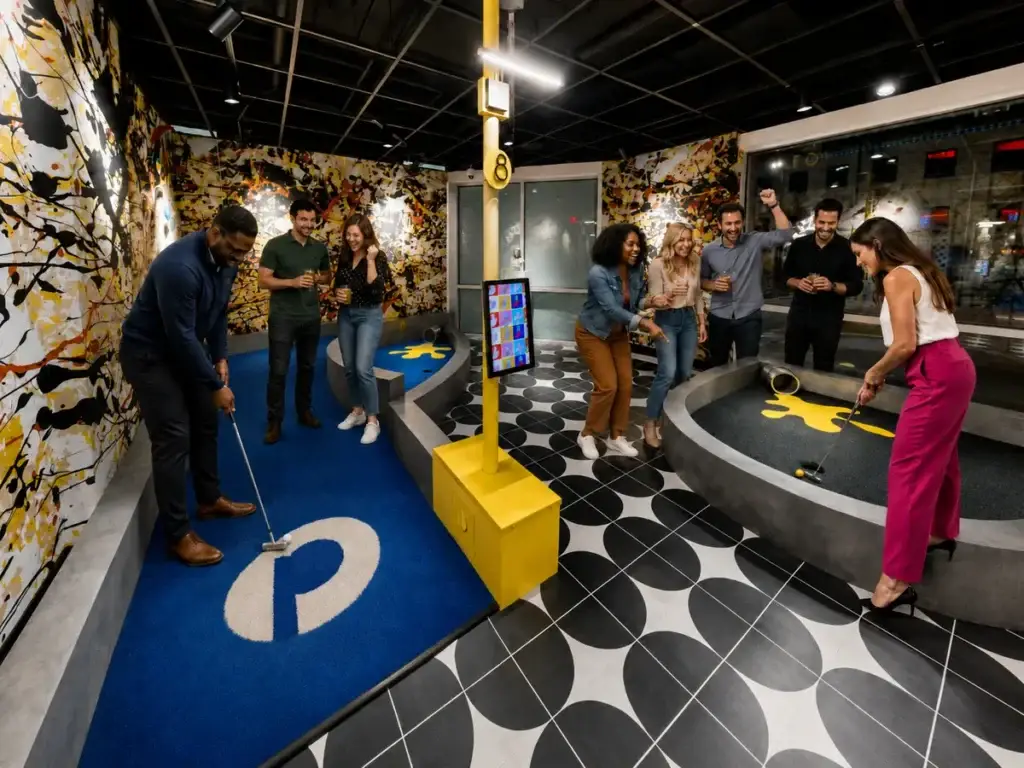
Bring the team
One Houston organizer left a line we think about more than we should: “Thank you for being more fun than I was expecting.” (Eric Rodgers, Google, November 2023) We’d take that on a plaque. We’d rather you find out for yourself.
That’s team building nobody calls team building. You bring the list. We handle the wow. Contact a planner, or start with group events to see packages and capacities for your city. Every location page has a 360 tour if you want to see the room before you commit.
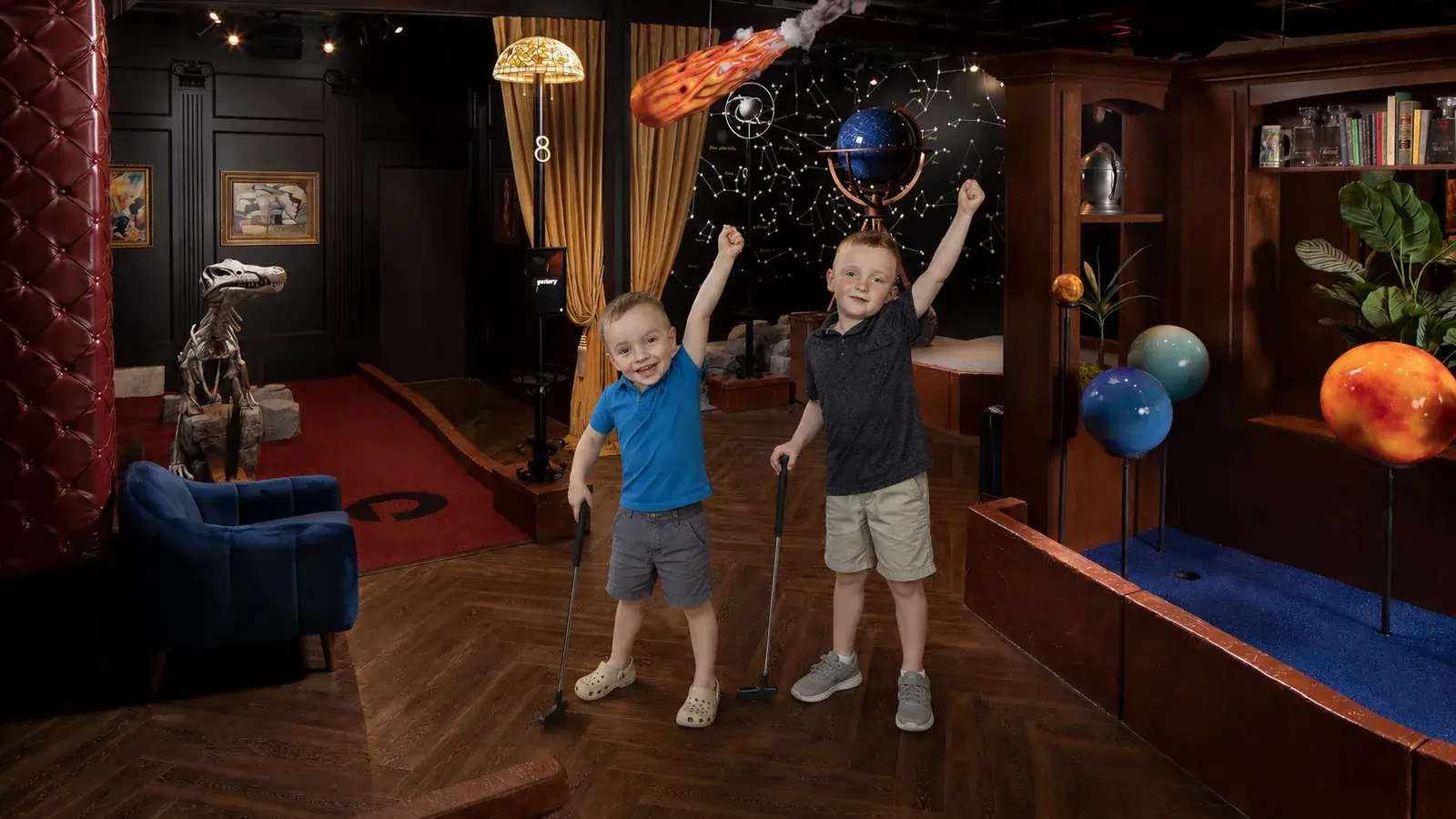
The Real Cost of a Family Fun Day: Arcade Math vs. Unlimited Mini Golf
By Lisa Case
Short version, because you may be standing in a parking lot doing math right now: an afternoon at a big arcade or air park can easily clear seventy dollars for two kids before anyone eats. Mine did. Unlimited mini golf at Puttery is $15 per kid, flat. No credits, no countdown, no reload kiosk, at all locations. They play until their mini golf hands get tired, and you leave when you decide to.
Full disclosure before we go one sentence further: I run marketing for Puttery. I’m also a mom of a seven year old and a four year old who pays for kids’ activities out of my own pocket like everyone else. Both things are true. Judge the math yourself.
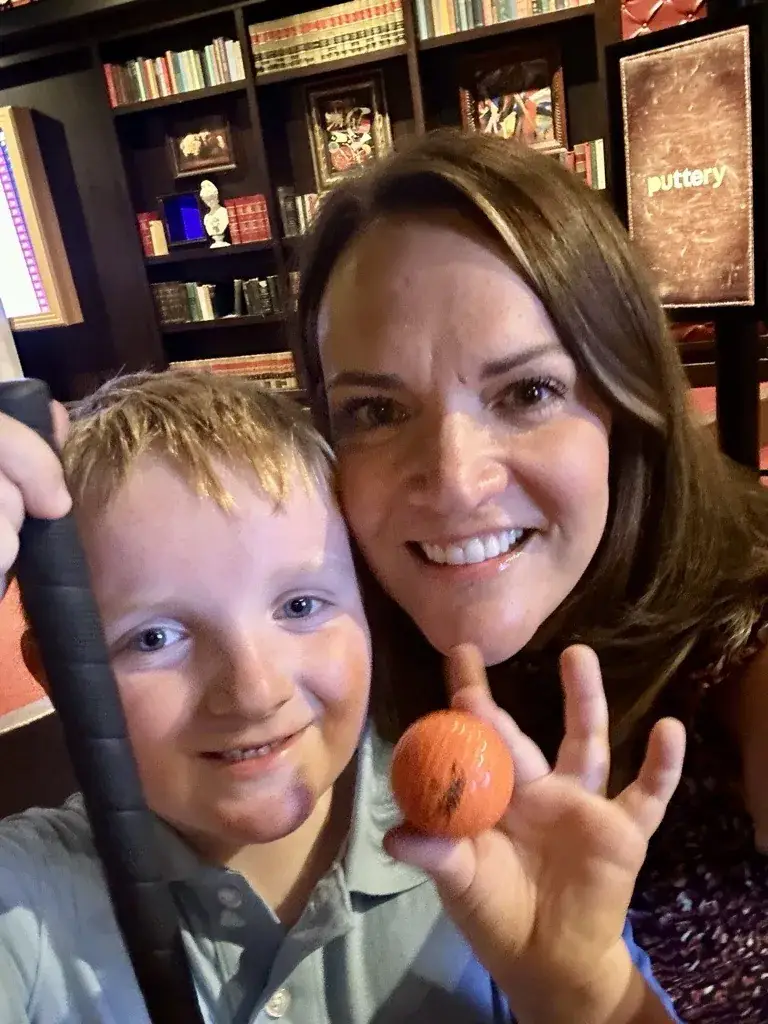
Seventy four dollars and four pieces of candy
Last weekend I took my kids to one of those big arcade entertainment complexes. Cool place. Lights everywhere, games everywhere, my kids lost their minds in the best way. We loaded two cards with thirty five dollars of credits each, plus two bucks a card for the plastic itself. Seventy four dollars. I figured that would carry us most of the afternoon.
It lasted one hour. One. A seven year old and a four year old burned through it in sixty minutes, and we walked out holding a strip of tickets that converted into four tiny pieces of candy at the prize counter. Two per kid. That was the haul.
Well, almost. We also won a stuffed duck, because mom is a whiz with the claw machine at least one in ten times. He sleeps with that duck now. Cost per duck: don’t ask.
I stood in that parking lot thinking, what just happened? The place was genuinely fun. Nobody did anything wrong. And I still felt like I’d been picked up and shaken up-side-down by my ankles.
The slide park down the road isn’t much different. Great facility, kids love it, and it cost me about the same as the arcade for two kids with a hard stop at two hours. Want to stay longer? That’s more money. Want a discount? That’s a membership. I don’t want another membership. I want an afternoon.
It’s not the arcade. It’s the card.
Here’s the part nobody tells you at the front counter. The card system isn’t there to make your life easier. It’s there to separate the fun from the math.
You don’t have to take my word for it. The companies that sell these systems to entertainment venues advertise exactly this. One major cashless platform pitches operators on options that increase per-guest spending and stretch visits longer. Another promises to maximize spend per visit. That’s the product. Your kid taps a card, the number on it drops, and nobody in your family is doing subtraction, because the whole point is that you can’t.
And the spend is real. According to Bureau of Labor Statistics data, American households put about $1,020 a year toward recreational outings for their kids as of 2023, up 19 percent from 2020. That’s a car payment. Families aren’t going out less. They’re just paying more for the same Saturday.
My four year old summed up the whole model better than any analyst. He spent half the hour running between machines going “Mommy, it won’t work.” Blue readers, green readers, one type takes credits, one earns tickets, or maybe it’s the other way around. I explained it four times. He forgot it in four seconds. “Which one can I scan again? The blue one or the green one?” Buddy, I honestly don’t know. To this day I could not tell you. The confusion isn’t a bug.
So we priced Puttery like a parent, not a card system
At Puttery, kids play unlimited mini golf for $15. Adults are $25, and in New York adults run $32 while kids stay $15. That’s the whole model. Pricing and offers vary a bit by location, so your location’s page always has the current numbers, but flat and unlimited is the point everywhere.
And it works the same way an arcade does in one honest respect: only players pay. You get a wristband if you’re playing. If you’d rather coach, heckle, or hold the sodas, you don’t need one. My husband and I didn’t load cards at the arcade either, we just chased kids for an hour. The difference is what happens when the grown-ups do want in. Two more loaded cards ran the arcade hypothetical to $148 for our family of four, for the hour. At Puttery, two adults and two kids is $80. All day. In New York it’s $94, and it’s still all day.
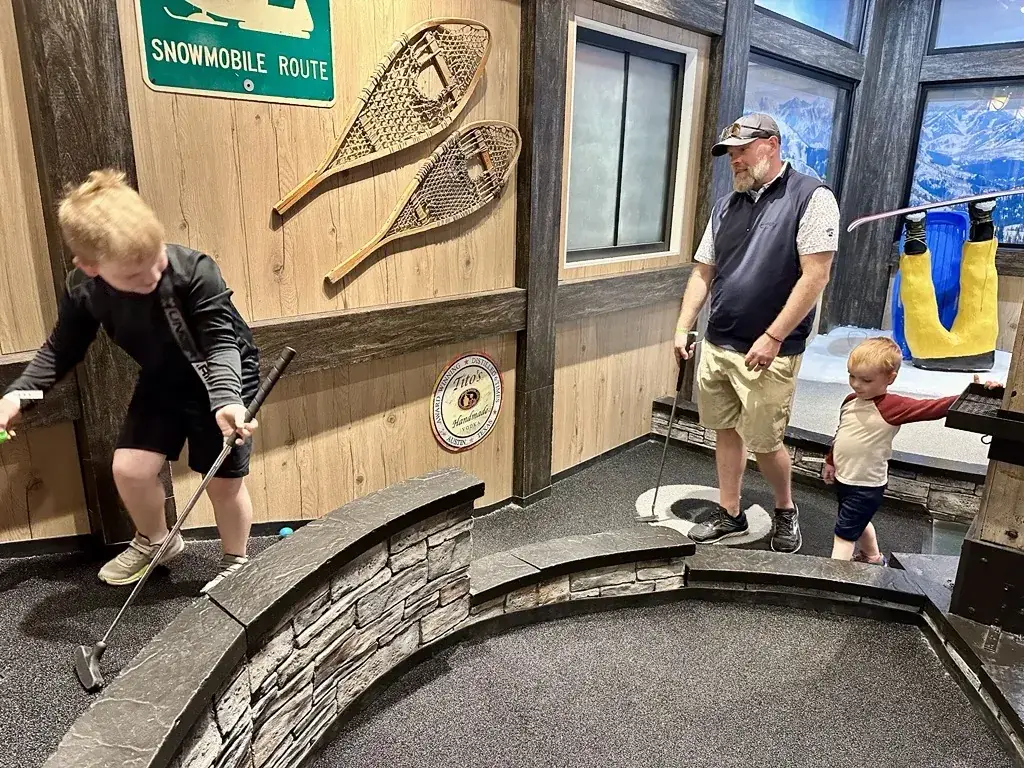
Unlimited means unlimited. Every course in the building, in any order, as many times as they want. At our Dallas location in The Colony there are four themed courses. A determined seven year old can play all four, demand a rematch on the Rooftop, lose the rematch, demand another one, and you have not spent a dollar more than when you walked in. There is no clock. Stay the whole day if your crew has the stamina.
Chris Williams visited our Pittsburgh location and left a Google review saying, “my son had just as much fun looking all over for the “secret doorway” he thought there was if you’d move a certain book or touch a certain statue lol he didn’t find one but was excited to come back again”
The food side works the same way. Kids meals are $10, soda included, everywhere except New York, where they run $12. Cheeseburgers, tenders, pizza, quesadillas, the classics, and the meal comes with a cup that changes color with the temperature of the drink, which my four year old rates as the greatest technology ever invented. Fancier kid drinks like the Lemon Pop run $6 if they’re feeling festive.
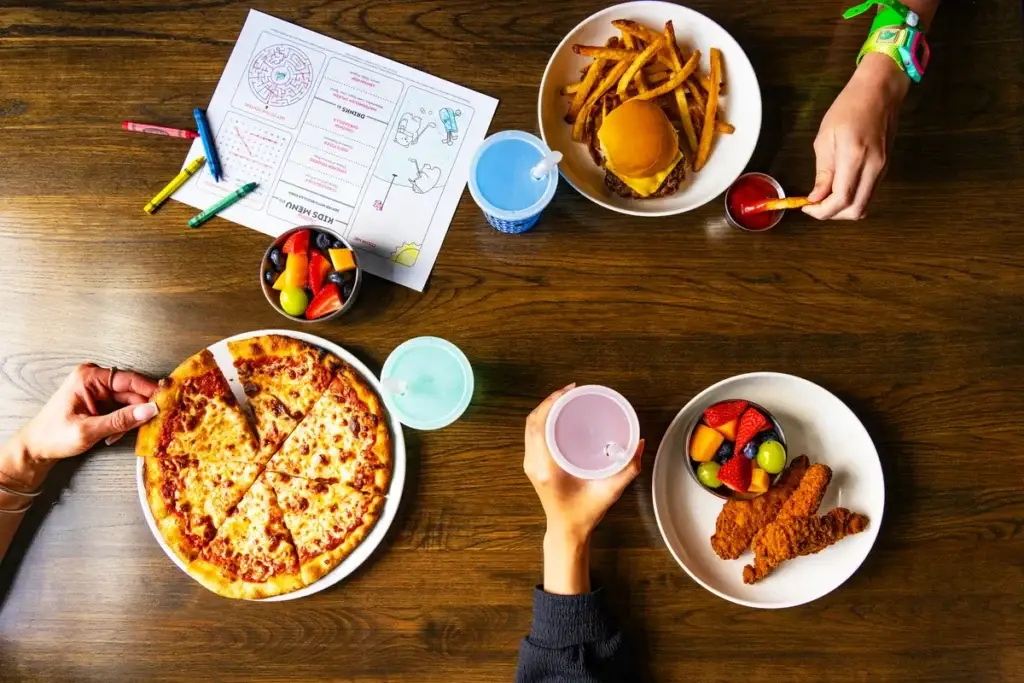
Then the deals stack. Weekday afternoons from 3 to 7 pm, that same kids meal drops to $5 at six of our ten locations: Dallas, Houston, Washington DC, Pittsburgh, Minneapolis, and Kansas City. The Eat & Play Combo pairs unlimited gameplay with an entrée for $29.99 for the grown-ups, and in New York the Kids Eat & Play Combo bundles unlimited gameplay plus a kids meal for $19.99 (for a limited time only). And if you can only make it on a Monday, good news: Half Price Game Mondays mean unlimited gameplay for half off, all day, at all locations except NYC, Miami, and Minneapolis.
The math, side by side
| THE ARCADE (ONE SATURDAY) | PUTTERY | |
|---|---|---|
| Two kids play | $74 in credits and card fees, gone in an hour (we chose the $35/200 credits cards per kiddo) | $30, unlimited (each child is $15 for all day play) |
| Two parents watch | $0 | $0 |
| Two parents play too | +$74 (two more loaded cards) | +$50 |
| All four playing | $148 for the hour | $80 for the day |
| Time limit | When the credits die (took us one hour) | None. Leave when you’re done. |
| Surprise add-ons | Card fees, reloads, socks, memberships | None |
| What kids understand | Blue reader? Green reader? | Putt ball in hole |
| What you leave with | Four tiny pieces of candy and one hard-won duck | A fed, exhausted, victorious child |
Am I biased? Obviously. See paragraph two. But every Puttery number above is on our site, and every arcade number is on a receipt in my glovebox, so this one’s checkable. Better yet, here’s a dad who doesn’t work here:
“Had a great time with our 2 kids ages 9 and 7. Staff was excellent! Haja took great care of us and the courses were a ton of fun. Good food, good drinks, great prices, wonderful time!!”
Manny Arciniega, Google review of Puttery DC
Nobody has to scan anything
The thing I underestimated until I watched other families do it: the total absence of logistics. You pay once at the front desk, get your wristbands, and the building is yours. Walk up to any course. Putters and balls are waiting at hole one, so you’re not hauling equipment between courses, and your hands stay free for whatever you’re drinking. Names go into the digital scorecard at the first hole and it keeps score for you. No pencils, no math, no arguing about whether that was a six or a “practice putt.” The course collects the ball at the last hole and you wander to the next one.
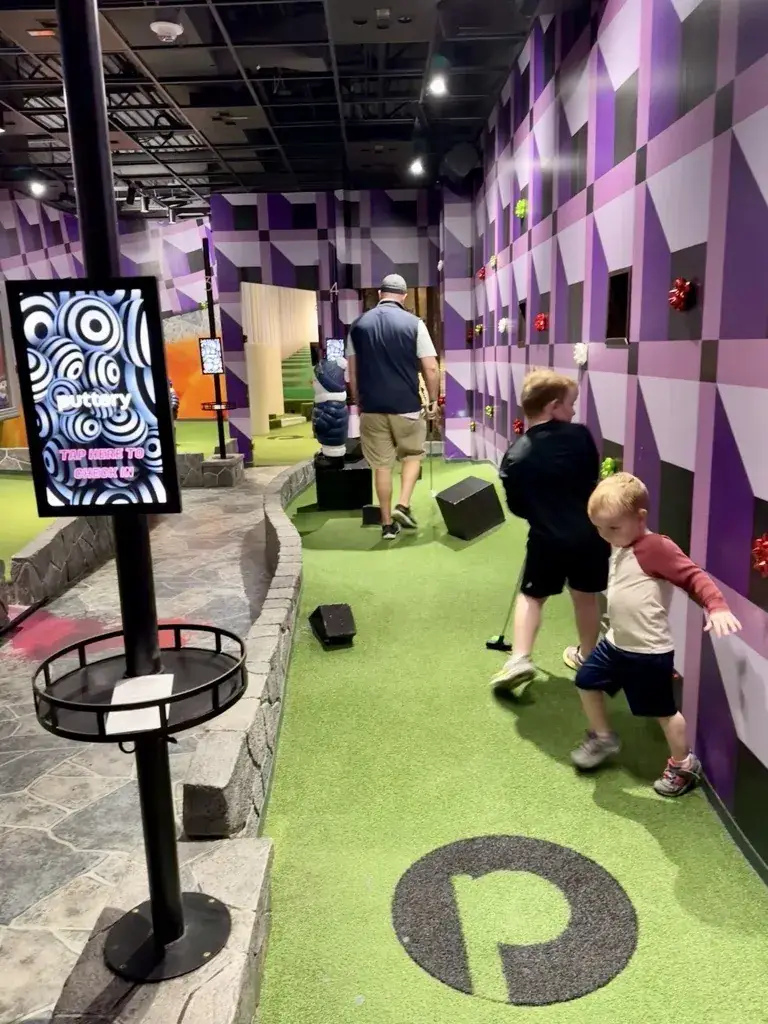
My kids figured out the entire system in one course. Nobody asked me which color anything was.
The honest part
Puttery is family-friendly during the day and built for adults at night, and we mean both halves of that sentence. Daytime is all ages at every one of our 10 locations. In the evening, most locations shift to grown-ups, and the cutoff varies by city. Kansas City is all ages all day, every day. Dallas and Pittsburgh switch at 7 pm on weekends, New York at 6 pm daily, and several markets at 5 pm. Check your location page before you plan a late dinner with the kids, and if you want the full rundown, we published it all here.
“We had a fantastic time at Puttery! Three generations of our family—from age 5 to 56—spent the night playing all three mini golf courses, and every one of us had a blast. The courses are creative, well-themed, and challenging enough to keep adults engaged while still being fun for kids.” Bradley Scott, Google review of Puttery Kansas City
I’ll say the quiet part: that split is a feature for parents too. Bring the kids at noon on a Saturday and it’s their world. Come back with your friends at nine and nobody’s yelling “MOMMY WATCH” while you line up a putt. Same courses. The courses don’t change. The vibe does.
First time bringing the family? Here’s exactly how a visit works.
One more thing, and it’s only good over Labor Day weekend 2026: Puttery turns five this year, and September 4-7 we’re running $5 unlimited mini golf at all 10 locations. Walk in and mention it at the front desk. If the regular math in this post sounded good, this weekend is the field trip. Check out all the details and enter to win a $500 Puttery gift card!
Wherever your Saturday lands, do the math before you load the card. Your kids won’t remember the credits. They’ll remember the rematch. And their first hole-in-one. Find your city and current pricing on our locations page. We’ll see you soon!
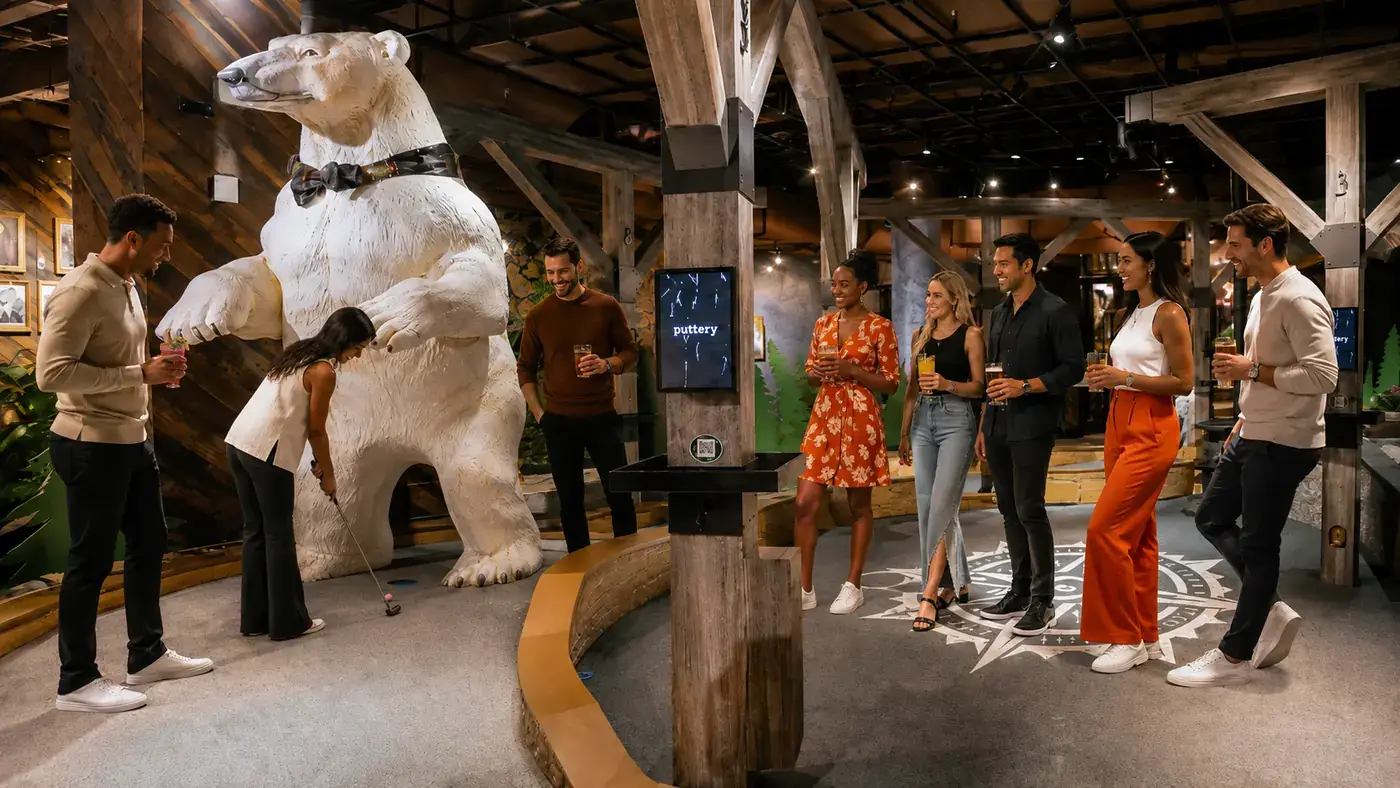
Best Corporate Event Venues in Chicago
Cvent’s 2026 rankings put Chicago fourth among meeting destinations in North America, which tells you two things. The good rooms go early, and a lot of what’s left is a ballroom with a different carpet. So here is a shortlist of unique event spaces in Chicago that earn the word, sorted by the job your event has to do: Puttery Chicago in Fulton Market for team outings, happy hours, and holiday parties of 9 to 400; Morgan Manufacturing for the gala that needs 30,000 square feet; LondonHouse Chicago when the client dinner needs the river under it; the Field Museum when the night needs a story and the story is a dinosaur; Wrigley Field when the backdrop should do half the work; and Navy Pier when corporate events in Chicago turn into conferences.
One disclosure before the list. We run Puttery. Our Chicago venue hosts company events most weeks of the year. We put ourselves on this list because we belong on it, and five other Chicago venues for corporate events because a list you can’t trust is a brochure. (Different city? We did the same for Dallas and Houston.)
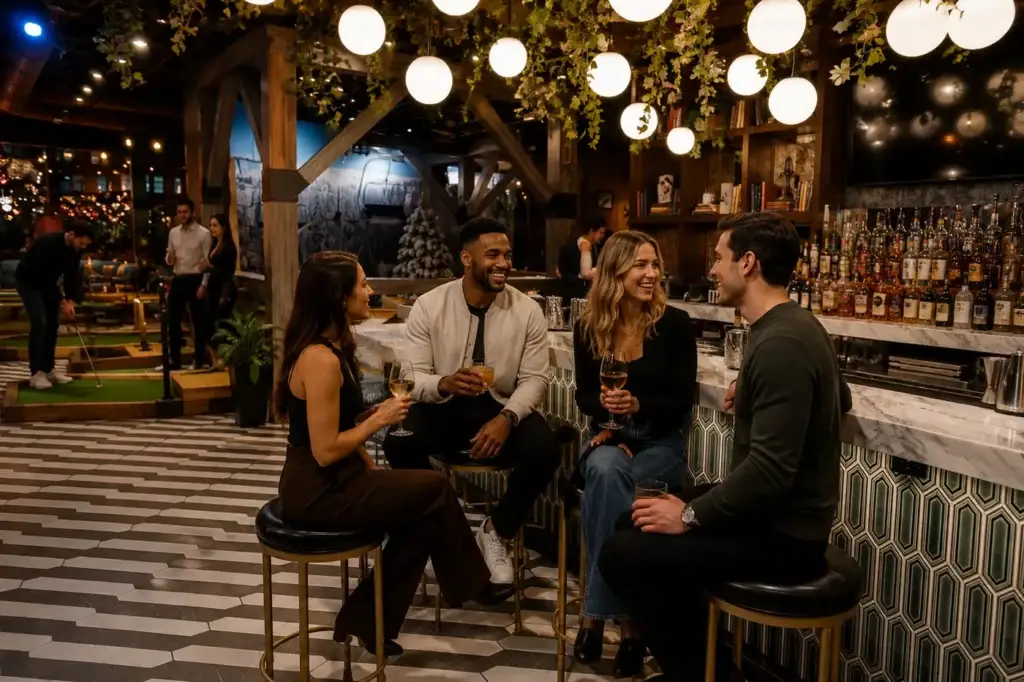
Six Corporate Event Venues in Chicago, Matched to the Event:
1. Puttery Chicago, for Team Outings, Happy Hours, and Holiday Parties (9 to 400 Guests)
Puttery Chicago is an indoor mini golf venue, scratch kitchen, and craft cocktail bar at 932 W Randolph St, on Restaurant Row in the Fulton Market district of the West Loop. Three floors, 23,000 square feet, opened November 2022 (NBC Chicago covered it). Two themed nine-hole courses share the building with bars on both event floors, lounges, a glass-walled private room, and a rooftop terrace. The Library is shelves to the ceiling, a globe you can spin, and a dinosaur waiting for the group photo. The Lodge is fresh powder, a fireplace, and a ski lift built for selfies. Google’s Midwest headquarters and McDonald’s global headquarters are both a short walk away, so for a lot of Fulton Market offices the commute to the offsite is an elevator and a crosswalk.
Why it works for a corporate event: the icebreaker is built into the floor plan. Nobody stands in a circle with a name tag. They stand on a tee box trash-talking the VP. Digital scorecards at every hole keep the competition real. The kitchen is scratch-made, the bars pour Hometown Heroes (a rotating lineup of cocktails created by Chicago bartenders), and zero-proof cocktails are on the menu every day, not on request. Most corporate events venues hand you a room and a phone tree. We hand you a planner, and one invoice. Meeting first, mini golf after? Done before.
One organizer put it this way on Google: “The way they structured the party gave time for us to have our presentation but still be able to enjoy our drinks and keep the fun flowing.” A/V capability is on the fact sheet; tell your planner exactly what you’re running and get the setup confirmed in writing.
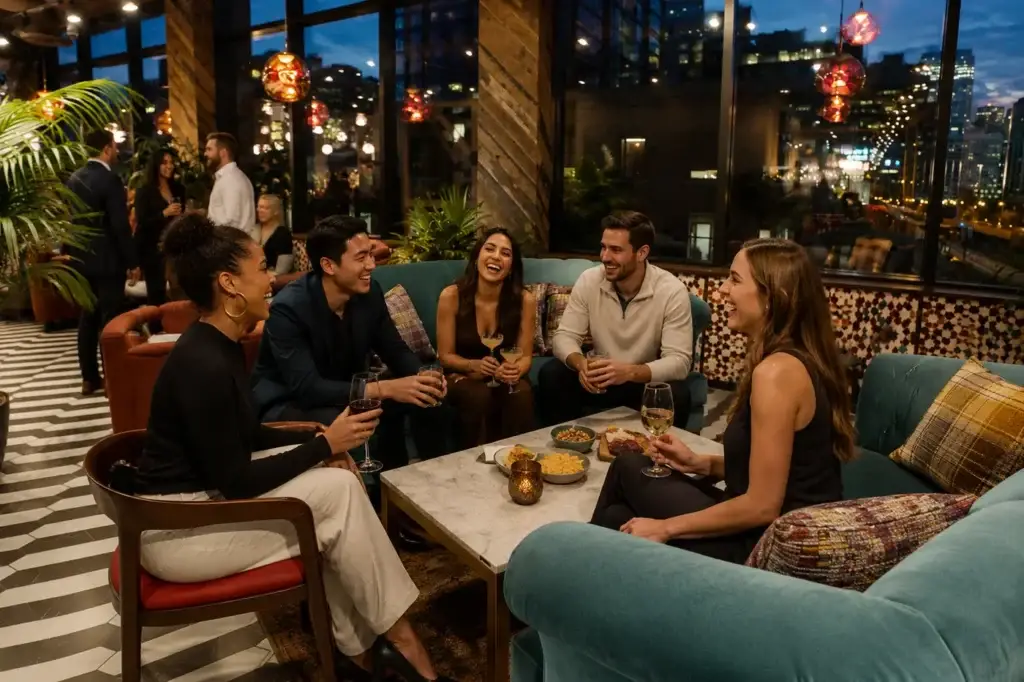
The spaces, from our Chicago fact sheet:
| SPACE | FLOOR | CAPACITY |
|---|---|---|
| Alpine Private Room (glass-walled) | 3 | 17 |
| Study (curtained, semi-private) | 2 | 25 |
| Den | 2 | 40 |
| Aspen Lounge | 3 | 50 |
| Parlor (splits into A 20, B 20, C 15) | 2 | 70 |
| Sky Terrace, rooftop (splits into A 35, B 35) | 3 | 70 |
| Arctic Dining (splits into A 20, B 30) | 3 | 80 |
| Second Floor Buyout | 2 | 175 |
| Third Floor Buyout | 3 | 225 |
| Full Venue Buyout | 2 + 3 | 400 |
The practical part. All ages welcome all day Sunday – Thursday and Friday – Saturday until 5 pm. 21+ after 5 pm Friday – Saturday, which matters if your holiday party invites plus-ones. The entrance is around the corner on Sangamon St, last door, behind Lululemon, and yes, it’s in our FAQ because people miss it. Green or Pink Line to Morgan, elevator to all three floors, free guest Wi-Fi, and coat check staffed through the cold months, which in Chicago is most of them. Groups of 9 to 400 go through our Chicago planner. Groups of 5 to 25 can book a curated package online, from $50 per guest, and skip the back-and-forth. December dates go first, and our holiday early-booking offer steps down as the calendar fills.
When we’re not the pick: a seated dinner for 300 facing a stage. Our floors are built for food stations, bars, lounges, and play, not thirty ten-tops and a podium. Two of the venues below do that better than we ever will.
2. Morgan Manufacturing, for the Gala or the Product Launch (West Loop)
A few blocks north of us at 401 N Morgan St, in a renovated building that predates the Chicago Fire. Morgan Manufacturing’s own numbers: more than 30,000 square feet across three main spaces, including the Skylight room at 10,000 square feet with a 23-foot built-in bar under six pitched skylights. Full service, planning through production, which is what you want when there are 600 people, a stage, and a sponsor wall. Raw industrial space is a blank canvas, and blank canvases cost money to fill. Budget for décor and lighting on top of the room.
3. LondonHouse Chicago, for the Client Dinner or the Leadership Offsite (The Loop)
85 E Wacker Dr, where Michigan Avenue meets the river. LondonHouse is a hotel, which is the point: a venue for corporate meetings by day that turns into the dinner with a view by night, with beds upstairs for the partners flying in. The property lists more than 25,000 square feet of meeting and event space, boardrooms, a ballroom with riverfront windows, and a three-level rooftop with the private Cupola on 23 sitting inside the building’s original beaux-arts dome. Book the Cupola for a board dinner and nobody asks why the agenda ran long.
4. Field Museum, for the Client Night That Needs a Story (Museum Campus)
1400 S DuSable Lake Shore Dr. Stanley Field Hall is white marble, vaulted ceilings, and Máximo the Titanosaur, which the museum calls its (literally) biggest attraction. Cocktails under a dinosaur is the story your clients tell on Monday. BizBash lists Field Museum spaces for groups of 25 to 15,000, including the 700-seat James Simpson Theatre. Plan for the museum’s approved vendors and a longer runway than a restaurant buyout.
5. Wrigley Field Events, for the Sales Kickoff Where the Backdrop Does Half the Work (Wrigleyville)
A National Historic Landmark with 20 event spaces across the ballpark and its campus, from club rooms to full-field buyouts. The add-ons are the sell: batting cages, private tours, the 2016 World Series trophy for photos. Gallagher Way, the open-air plaza next door, adds an 8,000-square-foot lawn with tenting and heating for the months when Chicago is Chicago. Check the Cubs schedule first. Game days change everything, including the price.
6. Navy Pier, When the Event Is a Conference (Lakefront)
The Aon Grand Ballroom dates to the Pier’s original 1916 construction: 18,000 square feet under an 80-foot dome, 1,400 seated or 3,200 for a reception by Navy Pier’s own count. Lakeview Terrace takes 450 seated or 1,000 standing, and Festival Hall plus dozens of meeting rooms handle the badge-and-lanyard end of venues for corporate meetings. Navy Pier’s event FAQ also spells out the deposit math most venues bury in the contract. Read it even if you book somewhere else.
Planning Guide: How to Choose a Corporate Event Venue in Chicago
Match the capacity to the format
A floor that holds 225 for a reception holds far fewer for a seated dinner, and every venue’s biggest number is its reception number. Ask for the capacity that matches your layout, then ask where overflow goes if 20 extra people say yes the day before. At Puttery Chicago that answer is usually the lounge next door, because our floors are built in pieces.
Know which pricing model you’re in
Search “event spaces Chicago” and the first page is mostly hourly rentals. Peerspace puts the average corporate event venue in Chicago at $136 an hour, typically booked for five hours with about 47 people; Tagvenue’s June 2026 data averages around $250. Those numbers buy a room. Food, bar, staff, furniture, and A/V are extra. The other model is per guest or a food-and-beverage minimum, where the room comes with the dinner. Puttery prices per guest. Whichever model you’re in, four questions before signing: what the service charge is and whether tax and gratuity sit on top of it, when the deposit is due, when the guaranteed count locks, and what happens to the bill if your headcount drops after it.
Plan for the train, not the parking lot
Chicago corporate groups move by CTA and rideshare. Puttery is a short walk from the Morgan stop; Navy Pier and Wrigley are bus-and-rideshare venues; the Loop and Museum Campus are well served by the L and Metra. If half your team drives in from the suburbs, the venue’s parking answer matters more than its cocktail list, so get it in writing. Then ask what nobody asks until the week of: coat check, elevator access, the age policy if plus-ones or families are coming, and who the on-site contact is after the sales office goes home at 5.
Book the date before you pick the menu
December Thursdays go first. Chicago party locations with a private floor and a real kitchen get booked by people who started in August, which is why early-booking offers exist and why they shrink as the calendar fills. Lock the date and the space, then spend three weeks on the menu. The other order ends at a hotel bar with a cheese cube tray.
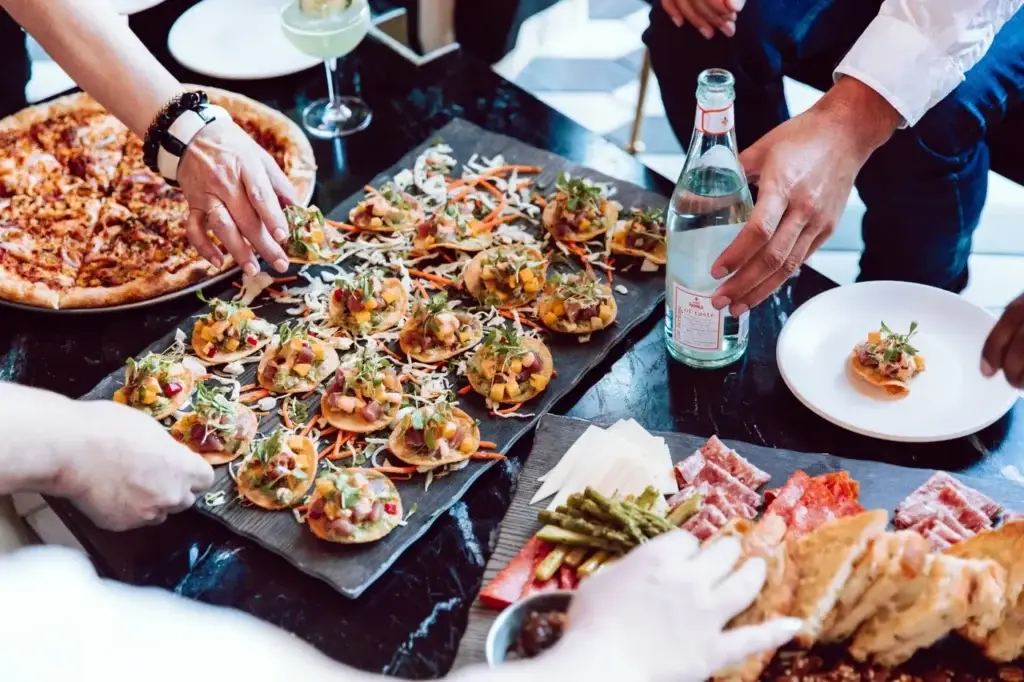
What a Corporate Event at Puttery Chicago Actually Looks Like
We could write case studies. Our guests already did, in public, with their names on them, on Google and on Yelp.
- A 140-person company event, June 2026. “Organizing and serving a group that size is no small task, yet everything was handled smoothly and professionally,” the organizer wrote, then named seven staff members by first name.
- A 250-person company event, February 2024. “The food, drinks, rooftop view, and mini golf experience were memorable,” per the organizer.
- A small corporate event on a package, November 2023. “I worked with Kate to put together a party package and everything was easy,” on Yelp. Small works. The package did the planning.
- The handoff, July 2024. “The service, from contract to night of, was exceptional,” from a guest who first came on a date, then came back with her company.
Talk to a Chicago Event Planner
Bring the date and the headcount. We’ll bring the floor plan, the menu, and the dinosaur.
Contact a Planner or call (773) 915-6040, select 1 for events
Prefer to walk the rooms first? Start with the Chicago fact sheet, the 360° tour, and the Chicago menu.

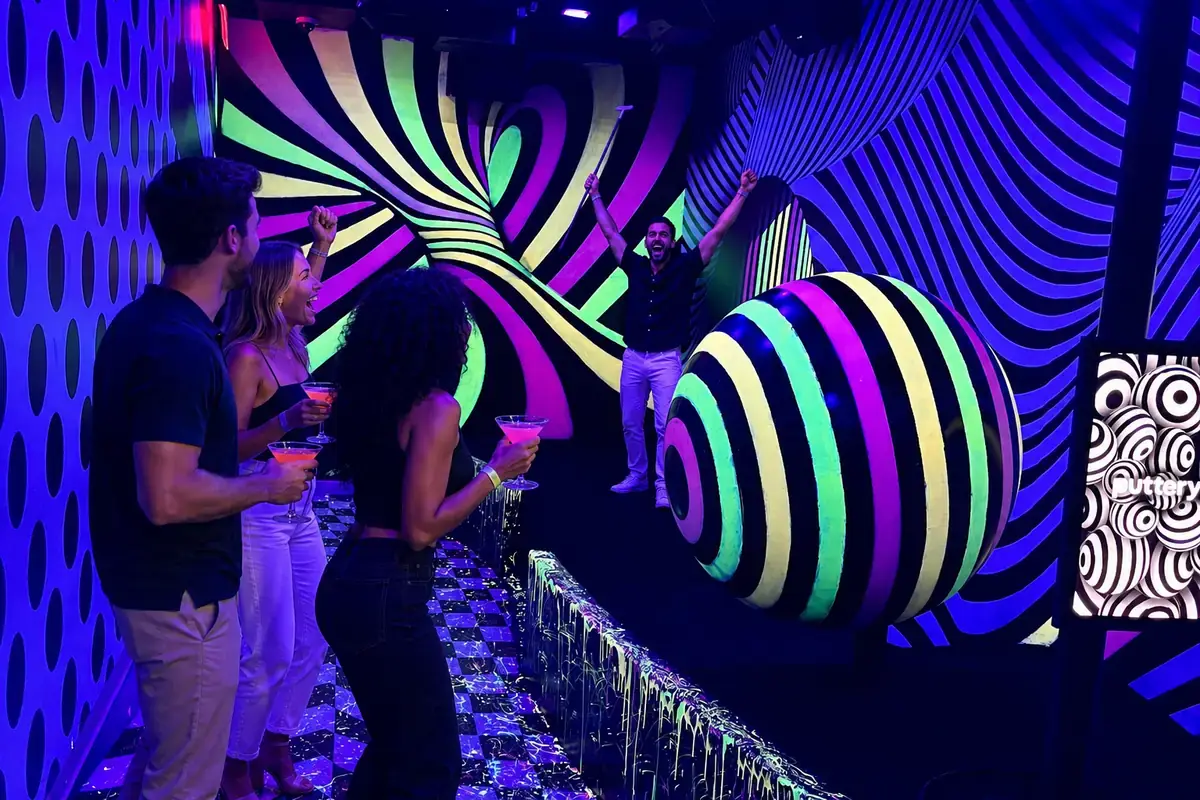
Puttery offers $5 mini golf for five-year anniversary

5 Things You Have To Do at Puttery’s 5th Birthday
Update, September 10, 2026: the 5th birthday weekend has wrapped. The $5 offer ran September 4-7, 2026 and has ended. The $500 Birthday Giveaway winner has been announced (congrats, Jennifer B. from Puttery Dallas (The Colony) location). Everything else on this page is still true every day at all 10 locations.
Five years ago, the first guest walked through the doors at Puttery located in Grandscape in The Colony, Texas on September 3, 2021. We had one venue and a point to prove: grown-ups still get to play. Ten locations later, we celebrated with a party where the presents traveled in the wrong direction on purpose. Yours, not ours.
For anyone new here: Puttery is a social destination that reimagines indoor mini golf around larger-than-life themed courses, a scratch kitchen, and a full craft bar, with venues in Charlotte, Chicago, The Colony near Dallas, Houston, Kansas City, Miami, Minneapolis, New York City, Pittsburgh, and Washington, D.C. From September 4-7, 2026, all 10 celebrated turning five at once.
Here are the five things that made the weekend, plus one to grow on.
1. All it took was three words at the front desk
Guests walked in and said they were here for the birthday. That was the whole process. $5 per person got unlimited mini golf at all 10 locations, Friday, September 4 through Monday, September 7, 2026 during all operating hours. No code, no reservation, no scavenger hunt through fine print. Walk-ins only.
“We launched this brand from a construction site in The Colony, and the plan has not changed since the drywall went up: build worlds worth stepping into and give people a reason to stay. The birthday deal is $5 because a thank-you should not have a paywall. Walk in, mention it at the front desk, and play until the scorecard finally goes your way,” said Head of Marketing Lisa Case ahead of the weekend.

2. Play everything. Then run it back.
Unlimited meant the rematch was included. Ask guests what they remember and it is rarely the par. It is the wall-length fireplace in the Lodge, the ski lift photo their group made them retake, the interactive art of the Art Museum course in Washington, D.C. We build immersive worlds into our courses because nobody ever crossed town for a windmill. Every hole is a world you step into, not just play through. Guests settled scorecard beef they had been carrying since last time.

3. Eat between holes. Or sit back and savor.
The scratch kitchen was the part of the plan people squinted at in year one. Mini golf, sure. A chef-crafted menu next to the ninth hole took some convincing. Five years later, it is half the reason a visit pencils. Order between rounds or book a table and make a night of it.
“A scratch kitchen inside a mini golf venue confused people in 2021. Then the food started showing up in reviews before the golf did. The best compliment we get now is guests booking a table on nights they never touch a putter,” said Culinary Director Koby Grace.
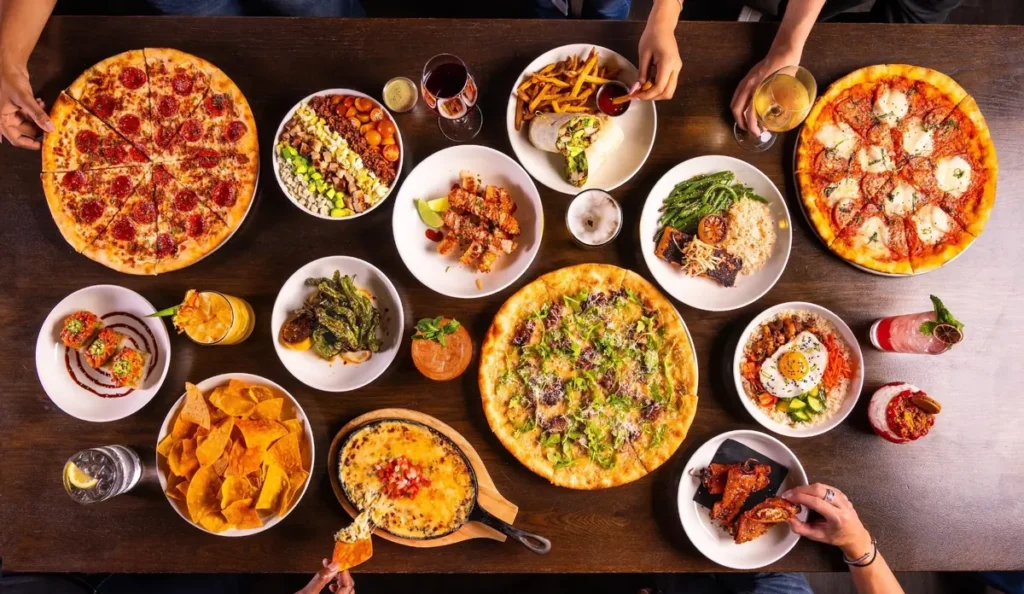
4. Order a craveable craft cocktail off the Hometown Heroes menu
Every Puttery bar runs Hometown Heroes: three or four rotating cocktails created by bartenders in that city, unique to that market. Order whatever the hometown crew is proudest of, because it will not be on the menu anywhere else.
“Through Hometown Heroes, every city’s cocktail list is built by its own bartenders, so the drink you order in Kansas City does not exist in Charlotte. Five years in, my favorite fight to referee is which city drinks best,” said Beverage Director Mustapha Wattar.
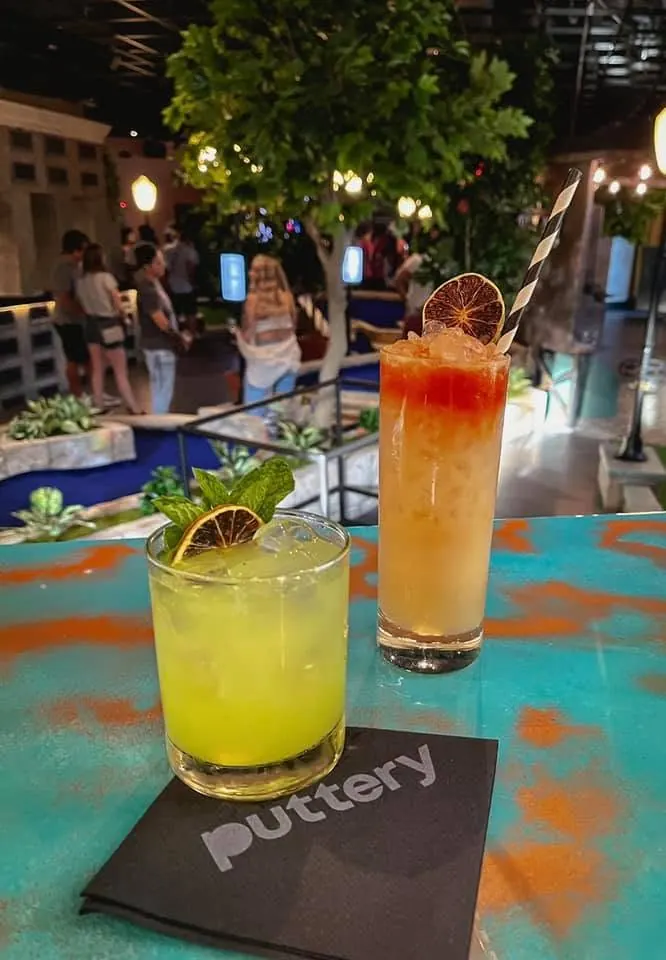
5. Stay past sunset
The Colony originally opened as a late-night, 21-and-up room. The daytime crowds taught us better. Families kept showing up before dinner, so the doors widened, and that rhythm now runs all 10 venues: family-friendly during the day and built for adults at night. The courses don’t change. The vibe does. Come for the golf. Stay for the shift change.
“We started Puttery with one venue and a belief that mini golf could be more than just a game. Five years and 10 locations later, it has become the backdrop for date nights, family outings and celebrations across the country. The noise a full room makes on a Saturday night is still my favorite measure of what we’ve built, and this weekend, we’re raising a putter to everyone who helped us get here,” said President & COO Kyle Rickman ahead of the weekend.

6. One to grow on: enter the $500 gift card giveaway
Entry closed at 11:59 p.m. CT on September 7, 2026, and Jennifer B. from our Dallas (The Colony) crowd is $500 richer. Congrats, Jennifer. Keep playing long after the candles are out.
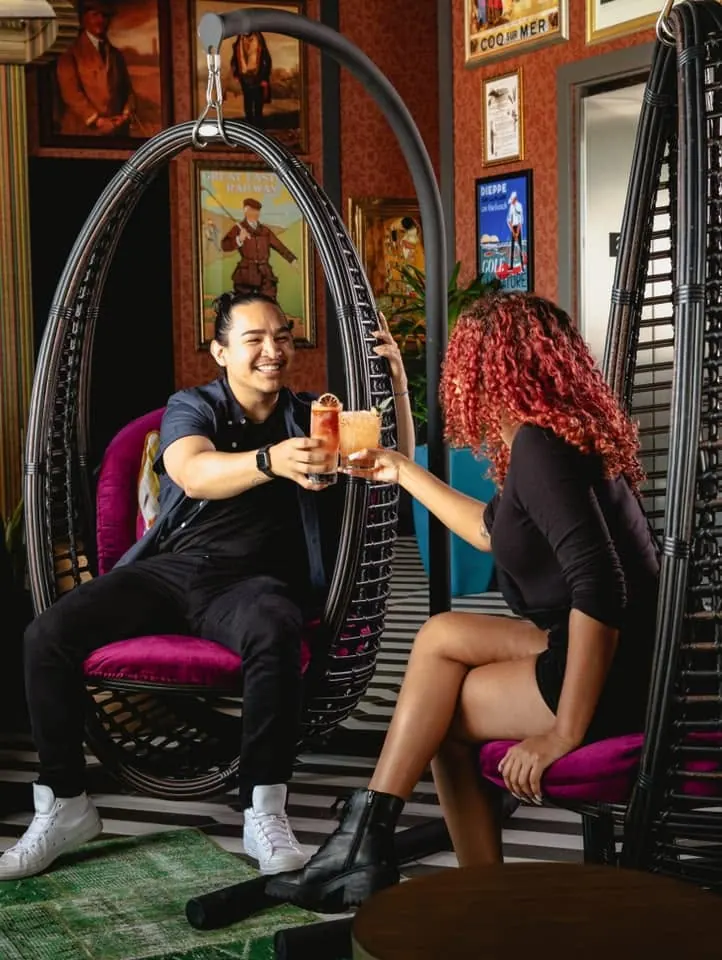
Hosting your own milestone?
Between the first putt and the fifth candle, we have mostly been in the business of hosting other people’s celebrations.
“We have spent five years hosting everyone’s celebrations: corporate wins, birthdays, even engagements. It feels right that this party is ours, and the whole country is on the guest list,” said National Director of Event Sales Ken Kitchen.
If your crew has a milestone coming, bring the celebration under one roof. We have the fun, food, and cocktails covered.
Five candles, 10 cities, and a room full of people who showed up. The birthday is over. The courses are not. Find your location and go off course.
This offer ran 9/4/26 through 9/7/26 and has ended. Walk-in only. Was not valid for parties and events and could not be combined with other offers.
